






When liberals talk about government, they almost always do so in the context of all the good they imagine it could do if we only let it.
There is one exception, of course: preserving order and people's safety, which is also the bedrock on which government legitimacy rests. To the extent that government is legitimate at all in acquiring coercive powers, that legitimacy rests in our ceding to the centralized power the responsibility to maintain law and order. Everything else follows from that, since the "state of nature" pre-government is anarchy and rule by whoever is strongest at any moment.
Liberals don't like that part of government; instead, they spin yarns about how, if we only allow government to take our money and our freedom, a near-utopia can be created.
To the extent that the government is reasonably good at providing baseline services, people become willing to cede more power to it, and that is especially true when they have a say in how that power is used. This is why we tend to think liberal democracies are particularly legitimate, although, as we have seen, well-run but less democratic regimes can be seen as basically legitimate, as happened in the Asian Tigers, where government efficiency justified their less democratic forms well enough that people were happy enough.
Experience shows that governments can be reasonably good, if hardly perfect, at providing basic services like police and fire protection because they are what we could call "blunt" tasks that don't require complicated judgments in most cases, and as the experiences of places such as the United Kingdom and other European countries show, the more complicated you make the jobs of law enforcement the worse they become at it.
Add "hate crimes" to the "don't steal and don't hurt people" role, and look at what happens.
Things completely break down once you create what amounts to invisible centers of power, such as regulatory agencies, which are mostly immune from basic oversight by populations or even their representatives. The need for basic regulations is indisputable: you need health and safety enforcement, regulation of things like pharmaceuticals, and basic environmental regulations show a clear public benefit. But regulatory power has an even greater tendency to expand indefinitely because oversight is limited and bureaucrats need to justify their jobs.
That's how you get this:
Under Biden and Obama, SpaceX got no reprieve. They had to do absurd nonsense all the time in order to do anything.
— Crémieux (@cremieuxrecueil) August 5, 2026
Under Obama, the FAA made SpaceX write a book report on local activity in the Mexican-American War. https://t.co/v1axssjLYi pic.twitter.com/TdN9CpfsvQ
Elon Musk reveals what happens when a rocket launch needs approval from Fish and Wildlife
Elon: "Nonetheless, we were forced to kidnap a seal, strap it to a board, put headphones on the seal and play sonic boom sounds to it to see if it would be distressed."
Elon: "This is an actual thing that happened. This is actually real. I have pictures."
Before the seal, there was a shark.
Elon: "One of the things that was a bit of a challenge at one point is that they were worried about our rocket hitting a shark."
He asked for the data to calculate the odds. They refused, in case shark hunters got hold of it.
Elon: "Then they said, well, there's another part of Fish and Wildlife that can do this analysis. I'm like, well, why don't you give them the data? They don't, we don't trust them. Like, excuse me, but they're literally in your department."
Then a second agency raised whales.
Elon: "If our rocket does hit a whale, which is extremely unlikely beyond all belief, that whale has some seriously bad luck. It's the least lucky whale ever."
The seal test was for launches out of Vandenberg, where the seal population has been rising for years.
Elon: "So if anything, rocket booms are an aphrodisiac based on the evidence."
Elon: "The amazing part is how calm the seal was. Because if I was a seal, I'd be like, this is the end. They're definitely gonna eat me."
Elon: "Its seal buddies are never gonna believe him that he got strapped to a board and they put headphones on his ears."
They did it twice.
Elon: "I don't think the public is quite aware of the madness that goes on."
When laws are made, there is some logical connection between the "will of the people" and the outcomes we get. The law may turn out to be a bad one, but that can be corrected over time (usually far too long a time). Regulatory power is extremely difficult to pull back, though, because every change goes through a long, horrific process, and bureaucrats can be very recalcitrant about giving up power, or the legal system can be manipulated to prevent change when interest groups don't want to see it.
Congress thoughtlessly delegates modern regulatory power to bureaucracies, and bureaucracies act as an unelected fourth branch of government and consider themselves independent of the president. As such, common sense has very little impact on what gets done in bureaucracies, which tend to be accountable to nobody.



































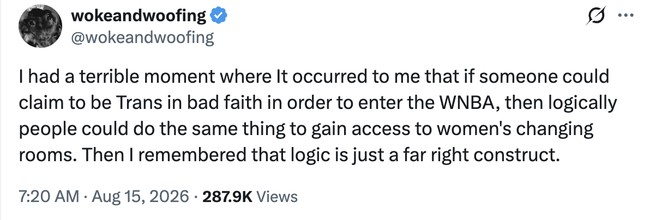
BEST OF THE BABYLON BEE:
Oh, Crap: Government Threatens To Fix Something https://t.co/CMh3uQfyVq
— The Babylon Bee (@TheBabylonBee) August 15, 2026
After Observing Adam For Two Minutes, God Decides Man's Going To Need A Helper pic.twitter.com/wIBaVKkANy
— The Babylon Bee (@TheBabylonBee) August 16, 2026
Millions Of Christians Renounce Their Faith After Irrefutable Social Media Post From Neil deGrasse Tyson https://t.co/xWHTO6xBmF
— The Babylon Bee (@TheBabylonBee) August 16, 2026
Algorithm Condemns Man To Lifetime Of Content About Something He Looked At One Time https://t.co/0zlhrZ8Hu3
— The Babylon Bee (@TheBabylonBee) August 16, 2026
California Fines Family For Building Sandcastle Without Coastal Commission Approval https://t.co/a1iWkqfmmk
— The Babylon Bee (@TheBabylonBee) August 16, 2026
Tragedy: Liberal Gets Stabbed Before Finishing Telling People How Peaceful Islam Is https://t.co/kn6PPSkTW2
— The Babylon Bee (@TheBabylonBee) August 15, 2026
Ignorant Boomer Shares CNN Article Thinking It’s Real https://t.co/pfy12Mwi6K
— The Babylon Bee (@TheBabylonBee) August 15, 2026
New Evidence Suggests Noah’s Wife Was Steering The Ark When It Hit Mount Ararat https://t.co/bNTqiaZqOL
— The Babylon Bee (@TheBabylonBee) August 15, 2026
Meghan Markle Inspires Millions Of Young Girls With Message That No Matter How Famous, Rich, And Powerful They Are, They Will Always Be Oppressed https://t.co/khly9XuG2D
— The Babylon Bee (@TheBabylonBee) August 15, 2026
Can You Spot All The Signs Of Racism In This Ordinary Picture Of A Highway? https://t.co/FcN71jFsvF
— The Babylon Bee (@TheBabylonBee) August 15, 2026
LEGO Unveils New Genderless Bricks With No Male/Female Connectors https://t.co/2REWRpArJQ
— The Babylon Bee (@TheBabylonBee) August 15, 2026
‘C' From ‘Coexist’ Sticker Arrested For Running Over Other Letters With A Truck https://t.co/3cWq98d5zA
— The Babylon Bee (@TheBabylonBee) August 14, 2026
Kentucky Derby Convenes Committee To Determine What Is A Horse https://t.co/WAsSMraCGP
— The Babylon Bee (@TheBabylonBee) August 14, 2026
Massachusetts Democrats Unveil Statue Of Molech At State Capitol pic.twitter.com/ckjKHvLQH9
— The Babylon Bee (@TheBabylonBee) August 14, 2026
Mangione Says He Is Only Guilty Of Stealing The Hearts Of Liberal Women Everywhere https://t.co/6ip4UtFcE3
— The Babylon Bee (@TheBabylonBee) August 14, 2026
‘How Do You Spell Gazongas?’ Asks Trump While Drafting Up Job Posting For New Press Secretary https://t.co/eDDnn0cvGF
— The Babylon Bee (@TheBabylonBee) August 14, 2026
Candace: 'If You Don't Count The Video, DNA, Murder Weapon, Ballistics, Motive, Text Messages, And Multiple Confessions, There Is ZERO Evidence Against Tyler Robinson' https://t.co/LOIZPT03GV
— The Babylon Bee (@TheBabylonBee) August 14, 2026
WNBA Changes League Name To ?NBA https://t.co/03vmqkgMnV
— The Babylon Bee (@TheBabylonBee) August 14, 2026
Sociologists: Western Civilization Began Its Decline When McDonald's Took Out Those Little Cheeseburger Stools https://t.co/zEKnEJ9PYD
— The Babylon Bee (@TheBabylonBee) August 14, 2026
Sad: WNBA Task Force Fails To Define Woman After Spending Entire Meeting Trying To Pick Restaurant For Lunch https://t.co/enE6fnxsGl
— The Babylon Bee (@TheBabylonBee) August 14, 2026
Renaissance Artist Finishes Masterpiece That Will One Day Be Great Training Data For AI https://t.co/adIYubxFto
— The Babylon Bee (@TheBabylonBee) August 14, 2026
Mamdani Grocery Stores To Feature Innovative New 'Queue Where You Wait For Loaves Of Leavened Flour Products' https://t.co/EE3sPZE9vf
— The Babylon Bee (@TheBabylonBee) August 13, 2026
Karoline Leavitt Prepared For Motherhood After Spending Last Two Years Answering Millions Of Stupid Questions https://t.co/YfDXXMZEsm
— The Babylon Bee (@TheBabylonBee) August 13, 2026
WNBA Brings In Revered Supreme Court Justice To Help Determine What A Woman Is https://t.co/iorLmD0pII
— The Babylon Bee (@TheBabylonBee) August 13, 2026
Stephen King Estate Reveals He Died Years Ago And His Twitter Account Is Being Run By A Mentally Ill, Glue-Sniffing Parrot With Tourette's https://t.co/l79rTygqLA
— The Babylon Bee (@TheBabylonBee) August 13, 2026
Democrat Mayors Report Violent Crime Down 40% Since They Redefined ‘Violent’ And ‘Crime’ https://t.co/8Dc7ifsnAA
— The Babylon Bee (@TheBabylonBee) August 13, 2026
AOC Struggling To Meet Single Men Under Age 90 At Work https://t.co/kzzynuJNGc
— The Babylon Bee (@TheBabylonBee) August 12, 2026
Devastating: Francesca Hong Forced To Return Home And Spend Time With Her White Son https://t.co/SssiYCiEk2
— The Babylon Bee (@TheBabylonBee) August 12, 2026
BEST OF THE REST OF THE INTERNET
Sophie having fun. pic.twitter.com/Yj2McHKljE
— Johnny Midnight ⚡️ (@its_The_Dr) August 15, 2026
The moment you take the red pill
— Massimo (@Rainmaker1973) August 15, 2026
[📹 leslyepenelope] pic.twitter.com/Taj2BzD6lk
The sound of a 7 week old baby red squirrel eating.
— Massimo (@Rainmaker1973) August 15, 2026
[📹 Dani Connor]pic.twitter.com/Rkxa2IV8En
A compilation of moments between animals and humans. pic.twitter.com/9P45Vfehdd
— Massimo (@Rainmaker1973) August 15, 2026
The world is a cat playing with Australia pic.twitter.com/xvtSAunxqK
— Massimo (@Rainmaker1973) August 15, 2026
The Norwegian Forest Cat is a breed of domestic cat originating in Northern Europe and it's one of the oldest, as it's believed to have been brought to Norway about 1000 CE by the Vikings.
— Massimo (@Rainmaker1973) August 16, 2026
[📹 bhelga9700] pic.twitter.com/xg2zECQYJ7
A smile for your timeline.. 😊 pic.twitter.com/Mvat6LdQ4K
— Buitengebieden (@buitengebieden) August 8, 2026
Peak relaxation.. 😊 pic.twitter.com/YUSUfr44pM
— Buitengebieden (@buitengebieden) August 12, 2026
Mood.. 😅 pic.twitter.com/mKw5eQYW1V
— Buitengebieden (@buitengebieden) August 12, 2026
Luigi Mangione found the loophole… or so he thought 😭 pic.twitter.com/pO1h6KdDwl
— Dr. Clown, PhD (@DrClownPhD) August 15, 2026
How much is it?
— Elon Musk (@elonmusk) August 11, 2026
Weather report: Germany vs Greece pic.twitter.com/vSPJ6ZdBlp
— Massimo (@Rainmaker1973) August 16, 2026
Every now and then it’s nice to remember this orangutan’s reaction to this trick. pic.twitter.com/i3paiTqVe6
— Massimo (@Rainmaker1973) August 16, 2026
800 year old drawings by a 7 year old discovered in Russia. pic.twitter.com/ewiE8e93q3
— Massimo (@Rainmaker1973) August 16, 2026
Only Sophie Cunningham could go from playing a Fever game to randomly showing up at a bar and singing “Courtesy of the Red, White and Blue” with the fans. 🥰🇺🇸
— Gina Milan (@ginamilan_) August 15, 2026
She’s truly the freaking best. ❤️❤️ pic.twitter.com/FSvsnUOjPZ
AND FINALLY...
What If We Abolished Prisons And Defunded The Police? pic.twitter.com/2KsNPfCeyT
— The Babylon Bee (@TheBabylonBee) August 12, 2026
Editor's Note: Do you enjoy HotAir's conservative reporting that takes on the radical left and woke media? Support our work so that we can continue to bring you the truth.
Join HotAir VIP and use promo code FIGHT to receive 60% off your membership.


Join the Conversation
VIP members get the ability to comment on articles.