









As I sit here writing, a helicopter is circling above, somewhere close to me. That has been true every day for the past week or ten days, and always is an indication of some public safety issue. Usually, we can identify the craft on flight apps—a hobby of my wife's—but she tells me that currently the information is being blocked.
So you can understand why I need to take a break from the steady stream of ICE-related news here, at least once or twice a day. It gets nerve-racking after a while, and I am far from the thick of it. And my neighborhood is nowhere near Ground Zero, although things have happened around here occasionally.
So, since I am interested in both science and propaganda, and of course their intersection, I thought I would take a look at this story that I came across a couple of times in my feed.
How to prove systemic racism:
— Against Narrative (@3RenChengHu) January 28, 2026
1. Regress a bad outcome on race and some haphazard controls.
2. Say the residual might be racism.
3. If reviewer #2 insists, add a disclaimer about how we can't be sure.
4. Tell the media your research shows how harmful systemic racism is.
Nearly half of the mortality gap between Black and White adults can be traced to the cumulative toll of stress and inflammation, a new study shows.These two biomarkers bolster the “weathering hypothesis” that links systemic racism to health disparities. https://wapo.st/4rg6NWj
The link between racism and early deaths of black people has been a steady stream in popular culture, with a similar arc of the Narrative™ to that of alphabet ideology or climate change. Over time, a steady drumbeat has pounded this idea into people, and The Science™ has been abused to make that Narrative™ first plausible, and then obviously true.
In an Episode from “New Amsterdam” a doctor explains to a mother that her son’s tumor grew because of internalized racism. You literally can’t make this up. pic.twitter.com/pAFhTRbiix
— Libs of TikTok (@libsoftiktok) June 20, 2024
You start out with something trivially true: X is bad. With climate change, it is the death of Gaia; with alphabet ideology, it is suffering children, and similarly, we all agree that racism is bad. From there you link every and all things you don't like to the bad thing, and accuse people who disagree on the connection of being in favor of some evil outcome.
Jamaal Bowman is something else.
— Thomas Hern (@ThomasMHern) June 26, 2025
"I'm a black man in America. The reason why heart disease and cancer and obesity and diabetes are bigger in the black community is because of the stress we carry from having to deal with being called the n word directly or indirectly every day." pic.twitter.com/lWlXabKVDm
Don't want to chop off a kid's genitals? You are KILLING THEM! Genocide! And so it goes, ad infinitum.
Since our education system is, itself, a propaganda mill for left-wing politics, the ability of people to think rationally is already limited, and they are primed to believe absurdities.
What the Washington Post is doing with this study is profoundly deceptive, which should surprise nobody by now.
Now let's acknowledge the basic facts: black people do have shorter lives than whites, and that is a tragedy. It is obviously something we would like to rectify, just as we would like to rectify the fact that in many ways Americans are becoming less healthy as a group. There are many reasons for this, and it is quite likely that stress could be one factor among many.
Add up stress, higher rates of obesity, and tendencies to certain diseases, poor diets, and less use of medical care, living in crime-ridden areas, and all the other factors that occur at rates different in black communities than whites, and it shouldn't surprise us, even though it should bother us.
But the study does not show what the headline claims.
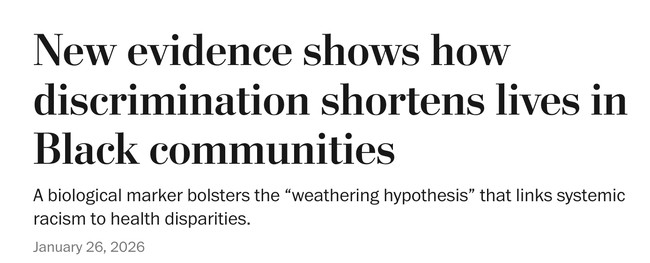
If you read that headline, it makes a rather bold claim: the evidence provided in the study shows that discrimination shortens lives.
To test that hypothesis, it would be interesting to see the comparison between, say, the lifespan of Japanese or Chinese people in the United States and that of whites. It turns out that people of Chinese descent, who we are told endlessly are subject to hate, live 10 years longer on average than white Americans.
Now that is not proof that discrimination has no impact on lifespan, but gee, it might be interesting data to test. Perhaps we can look at all non-white ethnic groups and do a comparative analysis of the non-immigrant populations.
Uh, no.
Nearly half of the mortality gap between Black and White adults can be traced to the cumulative toll of a lifetime of stress and heightened inflammation, a new study published Monday shows.
The study, published in JAMA Network Open, bolsters the body of evidence showing that chronic stress takes a biological toll that shortens lives.
“It’s important to be empirically demonstrated,” said Ryan Bogdan, the study’s senior author and a professor of psychological and brain sciences at Washington University in St. Louis. Researchers tracked the prevalence of two proteins linked to inflammation in the body and tied it to enduring discrimination and related social challenges. The measurement captures more comprehensively “the aftermath” of stressful events, he said.
Obviously, stress takes a toll on our bodies, and while the stress hormones measured are in fact higher in black people, it is not established that the elevated levels are entirely due to stress and not other factors, nor that racism was the source of the stress.
Researchers analyzed the proteins in the blood in more than 1,500 Black and White adults who were part of an aging study in the St. Louis area spanning 17 years. They found that decades of stress — childhood adversity, trauma, discrimination and economic hardship — were associated with higher levels of inflammation later in life, which correlated with earlier death.
Epidemiologists say the two biomarkers — C-reactive protein and interleukin-6 — tend to linger in the blood after the body’s fight-or-flight system has been repeatedly triggered, allowing them to capture what’s accumulated overtime.
The study, which was largely driven by Washington University in St. Louis graduate student Isaiah Spears, supports the “weathering hypothesis,” which posits that biological wear and tear is caused by striving to overcome hardships in an unequal society.
Over the course of the study, 25 percent of Black participants died compared with about 12 percent of White participants, the study found, meaning Black participants were more likely to die at younger ages. Researchers found that 49.3 percent of this gap was explained by stress and inflammation.
Now wait a minute. I know about C-Reactive Protein, because my doctor has tested for it. It does measure inflammation, usually due to chronic disease or other inflammatory causes. IL-6 may also be associated with stress, but it is a marker primarily associated with the immune system response. So basically, they measured the immune system and extrapolated to racism.
Healthcare providers typically order a C-reactive protein (CRP) test to help diagnose or rule out certain conditions, including:
- Severe bacterial infections, such as sepsis.
- Fungal infections.
- Osteomyelitis (infection of your bone).
- Inflammatory bowel disease (IBD).
- Some forms of arthritis.
- Autoimmune diseases, such as rheumatoid arthritis or lupus (systemic lupus erythematosus).
- Pelvic inflammatory disease (PID).
Providers also use CRP tests to monitor people after surgery or other invasive procedures to check for infection during their recovery period.
An awful lot of weight is put on a couple of lab tests here.
“The most-weathered have already died,” Geronimus said, noting that age span 35 to 60 is “the hardest, most stressful period of life for marginalized groups.”
She added that another limitation of the study was that the researchers used the “neon lights” of stress events, capturing major traumas or overt discrimination, while overlooking a quieter and important aspect of weathering — the daily stress of resilience. That includes microaggressions, or routine slights, and code-switching, the constant effort to adjust speech or behavior to fit into predominantly White workplaces. Over time, she said, suppressing anger or frustration to avoid reinforcing stereotypes can take a real physiological toll.
Ironically, with all the limitations of the study, it didn't actually even make the claim that racism was the cause. It mentioned that it could be one of many causes, and they obviously couldn't document the level of racism experienced by the individuals and how it interacted with myriad other variables.
Here are the key points from the study:
Key PointsQuestion Are elevated cumulative stress across the lifespan and inflammation associated with racial disparities in mortality between Black and White populations?
Findings Within this longitudinal cohort study of 1554 individuals, greater cumulative stress across the lifespan and higher inflammation partially mediated elevated mortality among Black participants.
Meaning These findings suggest that heightened cumulative stress and elevated inflammation are plausible mechanisms through which mortality disparities arise between Black and White individuals; there is a continued need for preventions, interventions, and policies that limit stress exposure and its potential impacts on health to reduce racial disparities in mortality.
The conclusion does mention structural racism as a possible reason for the disparity in lifespans, although there is no actual definition of this rather vague "cause."
Conclusions and Relevance In this cohort study of St Louis adults, heightened cumulative lifespan stress and elevated inflammation were associated with shorter survival among Black participants, suggesting these pathways may represent plausible mechanisms mediating racial disparities in mortality among Black and White US individuals. The findings underscore the need for policies that address structural racism, alongside treatments that reduce inflammation and limit stress exposure to reduce mortality disparities.
All the study conclusively showed is something we knew—black people die younger—and that many of the people who died young had high levels of stress hormones. There is no mention of diet, complicating diseases, or any similar confounding variables. The goal was to measure stress hormones by race and correlate them with deaths.
In fact, here is what they say about those potentially confounding variables:
A substantive portion of mortality differences between Black and White individuals (>50%) were not accounted for by cumulative lifespan stress and inflammation. Alternative derivations of stress (eg, geospatial indices of neighborhood deprivation)14 and inflammation (eg, multiplex arrays), as well as moderators of their impact on health (eg, institutional health care trust and health care access),7 may account for additional variance. Nonetheless, the additional unexplained variance underscores the need to examine additional factors (eg, toxicant exposure, intergenerational epigenetic signatures, and social determinants of health)8,15 that have been independently linked to race, stress, and mortality-adjacent outcomes (eg, disease).8,9
Uh, wut? Now wait a second. This sounds very fishy. We measured stress hormones, found elevated levels in people who died early, and concluded that racism caused the deaths. No, we didn't look at other variables to see if there is overlap (people living in bad neighborhoods with bad diets surrounded by gang violence). Surely it is racism.
Yeah, well, I can tell you that somebody who lives in the projects and rarely sees a white person is still under an enormous amount of stress, and it ain't caused by white people calling them names.
Could racism be one factor among many causing stress? Sure. Is it the reaper's scythe striking down half of all black people?
Uh, no. Complete BS.
But that is the Narrative™ that was wanted, and that was the Narrative™ that was created.
Editor's note: If we thought our job in pushing back against the Academia/media/Democrat censorship complex was over with the election, think again. This is going to be a long fight. If you want to join the conversation in the comments -- and support independent platforms -- why not join our VIP Membership program? Choose VIP to support Hot Air and access our premium content, VIP Gold to extend your access to all Townhall Media platforms and participate in this show, or VIP Platinum to get access to even more content and discounts on merchandise. Use the promo code FIGHT to join or to upgrade your existing membership level today, and get 60% off!



Join the Conversation
VIP members get the ability to comment on articles.