








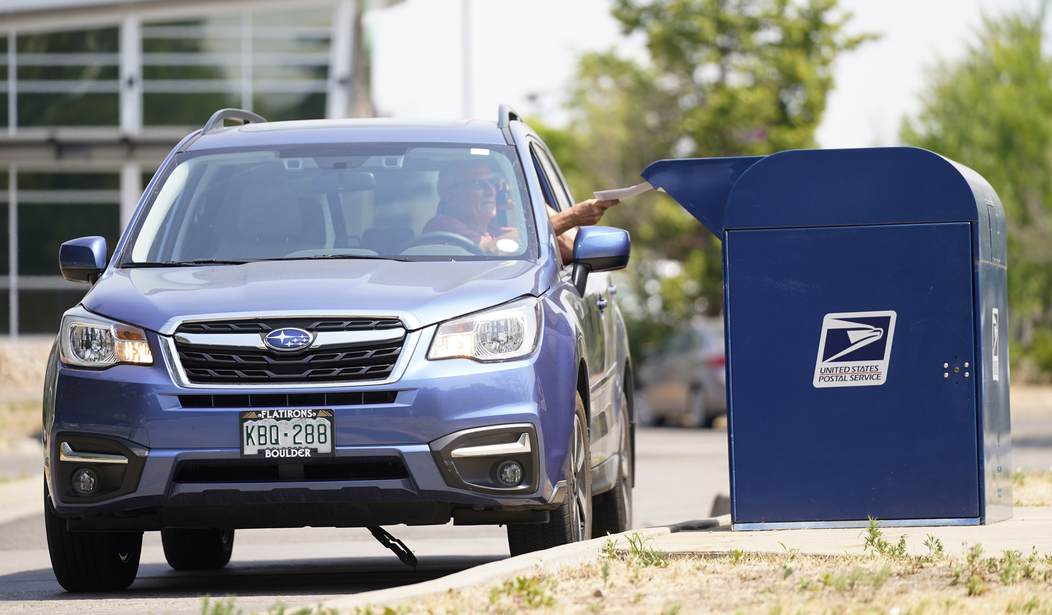

Two days ago, in a 6-3 decision, the Supreme Court of the United States gave the Trump administration the okay to begin implementing an executive order regarding how the Post Office would handle mail-in ballots.
First things first - let's clarify exactly what all the fuss is about with these ballots and precisely what the horrifying 'changes' are.
The new mail-in ballot procedure isn’t something to be afraid of. It works like this:
— Ron Rule (@ronrule) August 25, 2026
1. The state provides a list of the ballots they intend to mail out.
2. USPS assigns a unique barcode to each.
3. When the ballot is mailed out, this barcode is scanned to ensure uniqueness…
3. When the ballot is mailed out, this barcode is scanned to ensure uniqueness and that it matches. If there is no match or it’s a duplicate, it is not delivered.
4. When the voter mails the ballot back, the USPS scans it again and checks to make sure it matches what went out and isn’t a duplicate. Any ballots that don’t match won’t be delivered.
5. This is all done on the exterior envelope. The USPS isn’t determining eligibility or deciding who gets a ballot. They can’t see the actual votes. They are essentially just ensuring there are no duplicates, that the number mailed in isn’t greater than the number mailed out, and that the person mailing one in was the same person who received them.
This is a common sense solution and is completely reasonable.
Why would anyone oppose it unless their intention is to cheat?
That's it. Absolutely nothing else but barcodes on the ballot and envelopes for verification purposes. As Trump put it, so ballots are per individual, not 'carpet bombed' through the postal service.
Where it got kind of confusing right from the start was the fact that there were two lawsuits and two injunctions against the order. But only one of them was before the Supreme Court, and the SCOTUS order only addressed that one - the lawsuit brought by the attorneys general of 23 states and the District of Columbia. The other suit and injunction, brought by the League of Women Voters, among others, still stood.
The justices decided that because the U.S. Postal Service hadn't yet implemented its part of the new regulation, the states had not suffered any injury, ergo the lawsuit was premature, and the states had no standing to sue.
...The justices, over three dissents, paused a ruling by U.S. District Judge Indira Talwani in Boston that prevented the Trump administration from carrying out portions of a March executive order involving the U.S. Postal Service and voter eligibility lists. The court’s three liberal justices dissented.
But the decision does not immediately allow the Postal Service to put its new mail-ballot system into effect.
A separate nationwide injunction issued Aug. 11 by U.S. District Judge Indira Talwani in Boston still blocks USPS from implementing the new procedures for the Nov. 3 elections. The administration would have to overcome that order as well.
The distinction was central to the Supreme Court’s decision.
The majority said Trump’s executive order itself does not require states to change how they conduct elections. Instead, it directs federal agencies to develop policies that could later impose requirements on states. Because those policies had not yet been implemented when 23 states and Washington, D.C., challenged the order, the court said the challenge was premature.
The justices stressed they were not deciding whether Trump’s order or the policies developed under it are ultimately legal.
Basically, the court told them to come back when things got rolling, and they had something concrete to moan about.
The usual suspects who were already parties to the lawsuit, like New York's Letitia James and Pennsylvania's Josh Shapiro, all immediately threatened a new and improved filing. Off they scrambled to get typing.
The netroots went after the USPS for saying it was using the SCOTUS decision to finalize its plans to implement the executive order.
https://t.co/f9AkyjjKE1 pic.twitter.com/9oGcc3PnIR
— tree hugging sister 🎃 (@WelbornBeege) August 26, 2026
The judge in the case, the risible Obama-appointee Indira Talwani, lost her judicial cookies at the nerve of the USPS finishing what SCOTUS just cleared them to do, because the injunction in the other case against doing so was still active.
🚨 Judge Indira Talwani ruled that the USPS violated her nationwide injunction against President Trump’s election executive order by finalizing mail-ballot rules while the order was blocked, accusing the government of having “feigned complete compliance.” pic.twitter.com/m0VcozdCkM
— SCOTUS Wire (@scotus_wire) August 25, 2026
Are we keeping up here?
Judge Talwani issues an idiotic Order on the Mail-In ballot case that was NOT before SCOTUS yesterday.
— Shipwreckedcrew (@shipwreckedcrew) August 25, 2026
Basically her order is a self-own.
She finds the USPS violated her injunction by completing rule-making even though she ordered they not do so.
Then she says at the end --…
Then she says at the end -- paraphrasing -- this actually works to the benefit of the Plaintiffs because now they can amend their complaint to challenge the actual Final Rule which is no longer hypothetical.
NO SHEET SHERLOCK -- that's exactly why the Supreme Court faulted you for issuing the injunction in the first place in the related case when everything was hypothetical and no one could be sure what, if anything, the EO would result in.
She arrived at the right place -- she just ran backwards to get there.
These women are so mortifyingly dense.
So that was yesterday and...
Here we are.
The blue states have, as intended, cleverly glommed onto the fact that now that the USPS rules are 'finalized,' they have an actual 'harm' they can claim - that they are unable to comply with it so close to the midterms.
Two days after the Supreme Court temporarily allowed President Donald Trump’s mail-in voting order to proceed on the grounds that states had sued too soon, Democratic-led states returned to court Wednesday — this time challenging the finalized U.S. Postal Service rule implementing it.
The new lawsuit, filed by 23 states, Washington, D.C., and Pennsylvania Gov. Josh Shapiro, a Democrat, seeks to block requirements that election officials provide information on mail voters to USPS and use federally reviewed, uniquely barcoded ballot envelopes.
The Postal Service cannot implement the rule for the Nov. 3 midterm election because of a separate nationwide injunction that was not affected by Monday’s Supreme Court decision.
“Across the country, states are already deep into preparations for the 2026 elections. Now, at the last moment, the federal government is attempting to meddle in those preparations and potentially threaten countless Americans’ right to vote,” New York Attorney General Letitia James said in a statement. New York is one of the states that sued.
So that lawsuit is inbound.
As I have said many times, the usual suspects circle like sharks or vultures.
We’re suing to block USPS’ rule restricting mail-in voting. This rule is an unlawful overreach that shows just how far President Trump will go to control elections—and we won’t stand for it.
— Rob Bonta (@AGRobBonta) August 26, 2026
Your vote is your voice. We’re asking the court to ensure every person has the right…
Maybe both.
— Bytemeharder (@bytemeharder) August 25, 2026
Meanwhile, back at Camp Talwani, Herhonor has had a good night's rest, and she is off and running, literally just an hour ago as I was writing this.
JUST IN: Judge Talwani has lifted her order blocking the USPS rule on mail-in ballots for the 2026 elections.
— Kyle Cheney (@kyledcheney) August 26, 2026
Talwani, clearly frustrated by the SCOTUS decision, says she has no choice and implies SCOTUS based its ruling on flawed premises.https://t.co/q8amLmUZpT pic.twitter.com/JOAuoSVfqy
So, now the rules DO move forward for the midterms while the opposition hotfoots it to get their lawsuits in order.
Separate challenges are already underway. Democratic groups renewed their injunction request in D.C. after USPS finalized the rule, while 24 states and D.C. filed a new lawsuit today directly challenging the final USPS rules.
— SCOTUS Wire (@scotus_wire) August 26, 2026
Are we keeping up here?
And it's only midday.
In actuality, the chances of getting this done before the midterms are next to impossible, but this does accomplish two things: get election integrity front and center for the midterms, with Democrats once again fighting tooth and nail to prevent it. As well as most probably locking in this pretty simple anti-cheater-pants fix for the 2028 presidential cycle.
Oh. HELLO.