








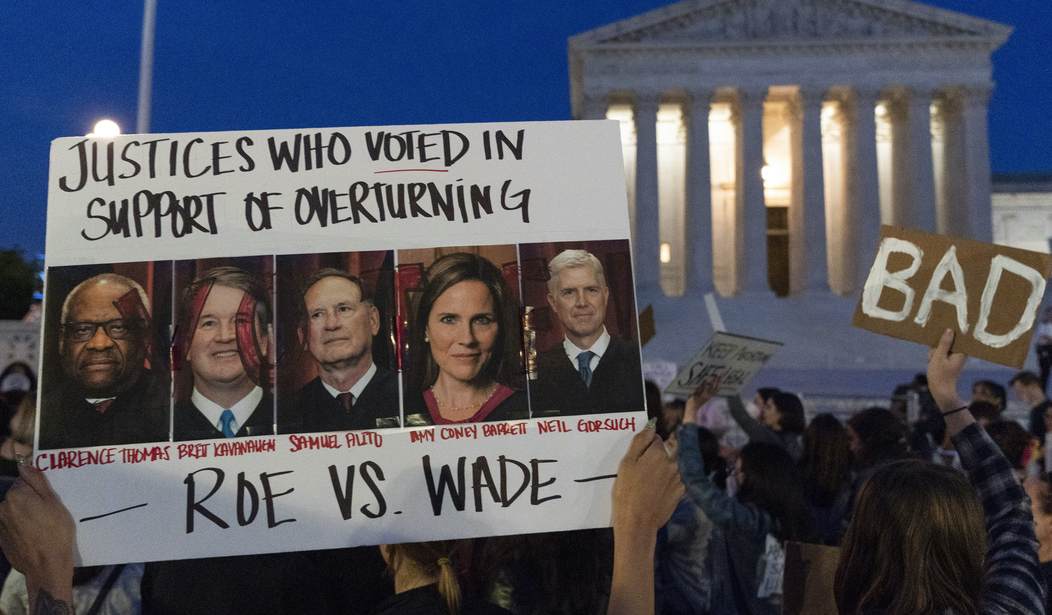
Progressives did everything they could to save Roe v. Wade. Someone, likely a progressive clerk, leaked a draft of the decision to overturn it and activist groups began denouncing the court. Some led protests to the judge's homes, sharing their addresses with anyone who wanted to know. And in the midst of this a deranged person named Nikolas Roske in California was inspired to attempt assassinating at least one of the conservative members of the court before the decision was issued.
Roske flew from California and made it all the way to Kavanaugh's house with a gun and burglary tools before changing his mind at the last moment when he saw there were armed guards stationed outside the house. He then called his sister and after that the police.
Initially, Roske pleaded not guilty to the charges. The problem for him was that he'd confessed to everything and the case against him was a slam dunk. So last April he changed his plea to guilty. Prosecutors were looking for a 30 year sentence which was in line with sentencing guidelines for domestic terrorism. Instead, the judge gave Roske just 8 years and cited his trans identity as one of the reasons he shouldn't face a longer sentence.
The judge also said that a lower sentence was warranted because of an executive order issued by President Trump mandating that transgender women be held at male-only federal facilities, which she said could interfere with her continuing to receive gender transition care. Judge Boardman also sentenced Ms. Roske to supervised release, after her prison sentence is complete, for the rest of her life.
The DOJ announced almost immediately that they would be appealing that sentence and this week the appeal is finally underway. The Washington Post has a story which identifies Roske as "she" throughout. It's headlined, "She got eight years for plotting to kill Justice Kavanaugh. Prosecutors want more."
On their first try, last October, Justice Department officials sought at least 30 years but a judge handed down eight. “Woefully insufficient,” they said afterward.
Their opening brief — a written argument that typically challenges whether the sentencing judge followed proper procedures, abused their discretion, or both — is due Monday in the U.S. Court of Appeals for the 4th Circuit. Experts in federal criminal law say prosecutors have legitimate arguments but face the broad discretion typically afforded sentencing judges.
The basic argument comes down to one question. Why did Roske walk away? Prosecutors say it was because Roske saw the U.S. Marshals outside and became afraid. But Roske and the defense argued that driving over in a cab, Roske began to have a change of heart because the surroundings were so normal. Not surprisingly, the Post story reads like a defense of the judge's sentence.
U.S. District Judge Deborah Boardman handed down the original sentence on Oct. 3 during a six-hour hearing, including two hours she spent explaining her reasoning.
“She was very conscious in building the record in explaining what she was doing,” said Douglas Berman, a law professor at Ohio State University and author of the widely cited blog Sentencing Law and Policy, one of four experts who, at The Post’s request, reviewed a transcript of Boardman’s findings and the arguments presented by both sides...
Boardman questioned and analyzed both arguments but ultimately sided with Roske’s.
“Law enforcement presence may have moved the needle for her, but there is insufficient evidence before me that the presence of law enforcement was the only reason she abandoned her plans,” Boardman said. “We simply do not know what would have happened if the marshals had not been there.”
As for the concern about Roske's gender transition, the Post does its best to downplay that.
Roske was named Nicholas Roske at birth and raised as a boy in a Southern California family active in a large Evangelical church. (Roske was identified by her name at birth in earlier coverage of the case.) Roske reached the rank of Eagle Scout, earned a philosophy degree Cal State Northridge and began to transition to a woman. “Sophie’s depression remained unresolved at least in part due to her gender dysphoria, which was not being addressed by her treatment,” Boardman said from the bench...
Boardman said that in weighing how long to sentence Roske, she factored in that Roske could face additional hardships in federal custody owing to assignment to a male prison and uncertainty about access to hormone treatment. Experts, however, said those considerations appeared secondary to the judge’s findings about the terrorism enhancement, abandonment and Roske’s mental health challenges.
“My view is that it had a limited effect on the final outcome,” said Richard Finci, a longtime federal and state defense lawyer. “It’s not as if Judge Boardman let her walk because she is transgender.”
So the defense lawyer thinks the judge who sided with the defense got it right. It's not exactly a shocker this person would think so. As for letting Roske walk, that exactly what Judge Boardman did on the flimsiest of pretenses, i.e. we don't know what might have happened and we can't sentence this poor trans person to decades in a male prison.
Here's hoping a more serious judge hears this appeal. Carrying out 98% of an assassination plot before getting cold feet at the prospect of shooting it out with U.S. Marshals and being trans shouldn't result in a light sentence.
Editor's Note: Do you enjoy HotAir's conservative reporting that takes on the radical left and woke media? Support our work so that we can continue to bring you the truth.
Join HotAir VIP and use promo code FIGHT to receive 60% off your membership.


Join the Conversation
VIP members get the ability to comment on articles.