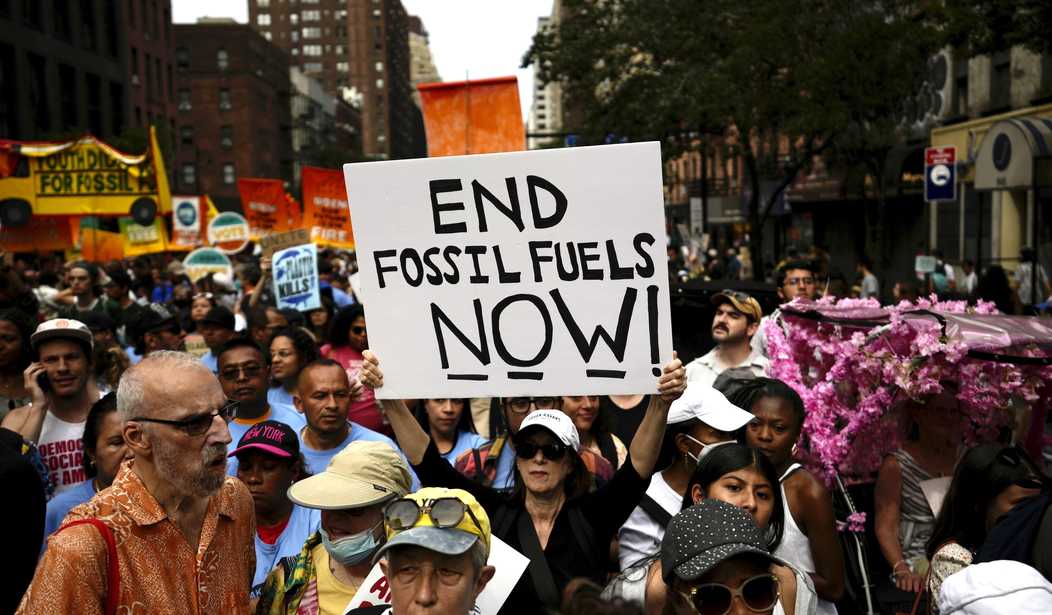
A UN body of researchers that puts together possible climate scenarios announced last week that one extreme scenario it put forward back in 2011 is no longer plausible. As Roger Pielke Jr. from AEI puts it, the climate apocalypse is no longer around the corner.
The climate apocalypse isn’t around the corner after all. That’s the upshot of a recent report from the international panel that supplies official “scenarios” to researchers, governments and banks. It turns out that the most extreme assumptions about the future — the doomsaying predictions embodied in the worst-case scenario known as RCP8.5 — are “implausible.”...
The substance of the paper, released last month, won’t shock anyone who has followed the subject scrupulously. The old scenarios described an impossibility, a world committed to the increasing consumption of coal at the expense of all other energy technologies. Scenarios based on those faulty assumptions nevertheless caught on: They dominated the assessments of the Intergovernmental Panel on Climate Change, academic papers and media reports that warned of a looming catastrophe.
The scenarios aren’t just wonky inputs to research. National climate assessments that inform policy in the United States‚ Britain, Germany, Canada, Australia, Japan and the Netherlands all emphasize them. More than 150 central banks calibrate capital stress tests against them, and lawyers cite them in litigation. It’s no stretch to say that even though most people have never heard of them, the scenarios influence decisions that affect everyone.
President Trump actually commented about this change last weekend.
GOOD RIDDANCE! After 15 years of Dumocrats promising that “Climate Change” is going to destroy the Planet, the United Nations TOP Climate Committee just admitted that its own projections (RCP8.5) were WRONG! WRONG! WRONG! For far too long Climate Activism has been used by Dumocrats to scare Americans, push horrible Energy Polices, and fund BILLIONS into their bogus research programs. Unlike the Dumocrats, who use Climate Alarmism nonsense to push their GREEN NEW SCAM, my Administration will always be based on TRUTH, SCIENCE, and FACT! President DONALD J. TRUMP
That tweet was quickly followed by several fact checks. Trump may have make a mistake here by attributing RCP8.5 to the UN's "TOP Climate Committee." The UN's top climate committee is the IPCC, but these models or scenarios are actually created by another panel that falls under the UN and then those scenarios are worked into the IPCC's reports.
In any case, the argument being made now is that RCP8.5 was always intended as an extreme worst-case scenario, not a likely one.
When it was originally published in 2011, RCP8.5 was intended to reflect the high end – roughly the 90th percentile – of the baseline scenarios available in the scientific literature at the time.
A “baseline” scenario is one that assumes no climate mitigation, explains Dr Chris Smith, senior research scholar at the International Institute for Applied Systems Analysis (IIASA) in Austria. He tells Carbon Brief:
“RCP8.5 was developed as a no-climate-policy scenario, often called ‘reference’ or ‘baseline’ scenarios. These are used to benchmark the actions of climate policy.”...
Prof Detlef van Vuuren from Utrecht University, a leading figure in the development of emissions scenarios for many years, tells Carbon Brief that RCP8.5 is a “low-probability, high-risk scenario and it was always meant like that”.
The problem is that calling this scenario unlikely (even before it was called implausible) didn't necessarily get communicated in subsequent research or media reporting on that research.
However, in some research papers, RCP8.5 was characterised as “business as usual”, suggesting that it was the likely outcome if society did not pursue climate action.
This was “incorrect”, says van Vuuren, noting that RCP8.5 “is not a likely outcome”. He adds: “It’s never been a likely outcome.”
Over time, RCP8.5 became hotly debated in academic circles, with some scientists arguing that such high emissions were becoming increasingly unlikely and others claiming that RCP8.5 was still consistent with historical cumulative carbon dioxide (CO2) emissions.
What happened over time is that 90% scenario that researchers say was never likely was often treated as the baseline assumption for what could happen if dramatic mitigation efforts weren't made by the entire world. In other words, it became an apocalyptic scare tactic whether that was the intent or not. This criticism of the dynamic surrounding RCP8.5 is already just shy of 6 1/2 years old.
RCP8.5 was intended to explore an unlikely high-risk future2. But it has been widely used by some experts, policymakers and the media as something else entirely: as a likely ‘business as usual’ outcome. A sizeable portion of the literature on climate impacts refers to RCP8.5 as business as usual, implying that it is probable in the absence of stringent climate mitigation. The media then often amplifies this message, sometimes without communicating the nuances. This results in further confusion regarding probable emissions outcomes, because many climate researchers are not familiar with the details of these scenarios in the energy-modelling literature...
We must all — from physical scientists and climate-impact modellers to communicators and policymakers — stop presenting the worst-case scenario as the most likely one. Overstating the likelihood of extreme climate impacts can make mitigation seem harder than it actually is. This could lead to defeatism, because the problem is perceived as being out of control and unsolvable. Pressingly, it might result in poor planning, whereas a more realistic range of baseline scenarios will strengthen the assessment of climate risk.
It's behavior like this (scaring people about the future followed by admissions many years later that such outcomes were always considered very unlikely) that convinces a lot of people that this entire field is politically driven junk-science. Allowing people to be casually misled about what's likely is how you lose credibility. President Trump may not be the perfect choice to vent public outrage about this topic, but he's not wrong that there is good cause for people to be upset about this. Again, not the models themselves, but the public catastrophizing using the 90% worst possible case as a baseline assumption.
Editor's Note: Do you enjoy HotAir's conservative reporting that takes on the radical Left and woke media? Support our work so that we can continue to bring you the truth.
Join HotAir VIP and use promo code FIGHT to receive 60% off your membership.








Join the conversation as a VIP Member