






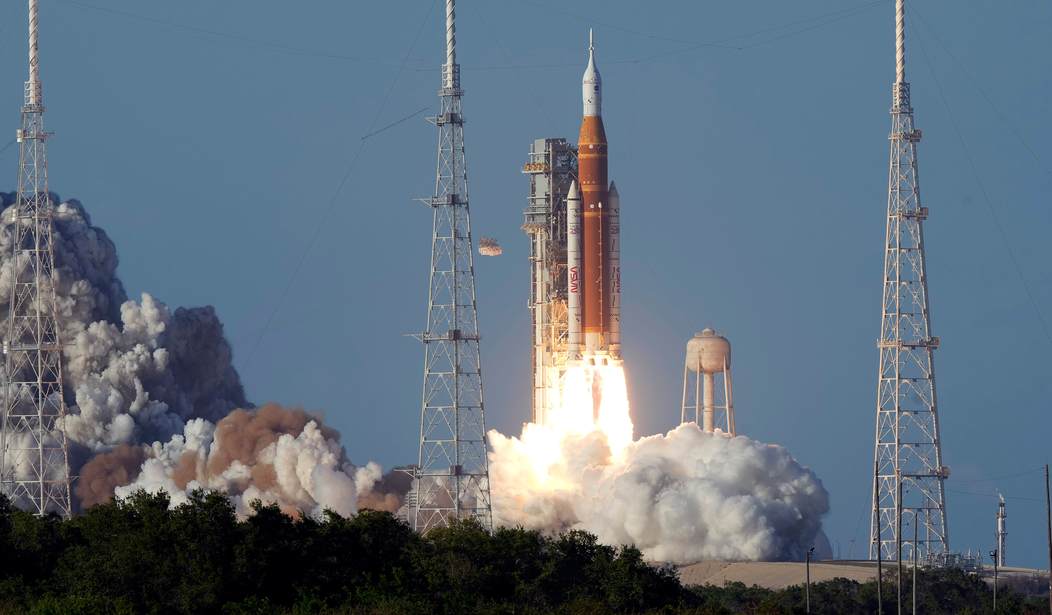
Friday night at about 9pm, the Orion spacecraft reached the halfway point between Earth and the moon. NASA's tracker showed it was 136,000 miles (plus a bit more) from both points.
When the ship blasted away from Earth's orbit it was traveling at 19,000 mph initially, but Earth's powerful gravity continued trying to pull it back so by the halfway point the ship had slowed to 3,000 mph. That meant the 2nd half of the journey to the moon took longer than the first half because of the reduced speed. The crew spent that extra time getting ready for the flyby today.
NASA’s Artemis II crew in Orion completed a manual piloting demonstration and reviewed their lunar flyby plan to wrap up their third full day in space.
NASA astronaut Christina Koch and CSA (Canadian Space Agency) astronaut Jeremy Hansen took turns controlling the spacecraft to test its performance in deep space starting at 9:09 p.m. EDT. For 41 minutes, the pair tested two different thruster modes, six degrees of freedom and three degrees of freedom, to provide engineers with more data about the spacecraft’s piloting capabilities...
Over the course of the day, the crew also reviewed a list sent by the lunar science team of surface features on the Moon that they will photograph and analyze during their six-hour flyby on Monday, April 6. The flyby period begins at 2:45 p.m. April 6, when Orion’s main cabin windows will be pointed toward the Moon.
Earlier in the day, the Moon-bound quartet also took some crew selfies using one of Orion’s solar array wing cameras. The images should be sent to the ground in the coming days.
Yesterday they also did some testing of the spacesuits.
The crew members are in the midst of testing their Orion Crew Survival System suits, performing leak checks, simulating seat entry, and assessing mobility and their ability to eat and drink. The suit protects astronauts during dynamic phases of flight and provides life support in the event of cabin depressurization and survival operations after splashdown...
Following spacesuit evaluations, the crew will turn their attention to the planned outbound trajectory correction (OTC) burn, scheduled for 11:03 p.m. EDT. The maneuver will refine the Orion spacecraft’s path toward the Moon. Earlier in the mission, flight controllers cancelled the previous two planned trajectory correction burns, as Orion’s trajectory remained precise.
At 12:41 am ET (very early this morning), the Orion spacecraft crossed into what's known as the lunar sphere of influence. This is the point at which the moon's gravity is pulling the ship forward more strongly than the earth's gravity is pulling it back.
We're going farther than ever before 🚀
— NASA (@NASA) April 6, 2026
Today, the Artemis II crew will break the record for how far humans have traveled from Earth as they fly around the far side of the Moon.
Coverage begins at 1 p.m. EDT (1700 UTC). Watch Artemis II make history:… pic.twitter.com/hCOVQPkxUF
There has been pre-selected wake-up music each morning which was chosen by the astronauts in advance. Today, however the wake-up included a surprise message from Jim Lovell, Apollo 8 astronaut who orbited the moon back in 1968. Lovell passed away last August at the age of 97. His message to the astronauts opened with, "Welcome to my old neighborhood..."
"Welcome to my old neighborhood." Our @NASAArtemis II astronauts woke up on the sixth day of their mission to a special message recorded in 2025 by astronaut Jim Lovell, the pilot of Apollo 8. pic.twitter.com/XA4Dc2yQm5
— NASA (@NASA) April 6, 2026
So here's what's coming up today. All times are ET:
- 1:30 p.m.: The science officer in mission control will brief the crew on their science goals for the upcoming flyby.
- 1:56 p.m.: The Artemis II crew is expected surpass the record previously set by the Apollo 13 crew in 1970 for the farthest humans have ever traveled from Earth.
- 2:45 p.m.: Lunar observations begin.
- 6:44 p.m.: Mission control expects to temporarily lose communication with the crew as the Orion spacecraft passes behind the Moon.
- 6:45 p.m.: During “Earthset,” Earth will glide behind the Moon from Orion’s perspective.
- 7:02 p.m.: Orion reaches its closest approach to the Moon at 4,070 miles above the surface.
- 7:07 p.m.: Crew reach their maximum distance from Earth during the mission.
- 7:25 p.m.: “Earthrise” marks Earth coming back into view on the opposite edge of the Moon.
- 7:25 p.m.: NASA’s Mission Control Center should re -acquire communication with the astronauts.
- 8:35-9:32 p.m.: During a solar eclipse, the Sun will pass behind the Moon from the crew’s perspective.
- 9:20 p.m.: Lunar observations conclude.
NASA will have live coverage starting at 1pm.
Make new friends, but keep the old.
— NASA (@NASA) April 6, 2026
A new photo captures the Moon's near side on the right (the side we see from Earth, identifiable by its dark splotches) and its far side on the left. The Artemis II crew are the first to see the far side with human eyes. pic.twitter.com/Z8QaZ6J9iA
The live video should become active once they get started (just under an hour after this post goes up).
Update: If you've been watching the live feed then you already know Orion has now set the record for the farthest humans have ever traveled from earth, passing the previous record set by the Apollo 13 astronauts.
Approaching the near side of the Moon.
— Mission Moon (@Mission_MoonLi) April 6, 2026
The Artemis II astronauts have surpassed the record for the distance from Earth at 1:56 ET (1756 UTC). This record was previously set during the Apollo 13 mission when the astronauts traveled 248,655 miles from Earth. The Moon continues to… pic.twitter.com/iXjRifPBrY
Editor’s Note: Do you enjoy Hot Air’s conservative reporting that takes on the radical left and woke media? Support our work so that we can continue to bring you the truth.
Join Hot Air VIP and use promo code FIGHT to receive 60% off your membership.



Join the Conversation
VIP members get the ability to comment on articles.