









Answer: No, not really. However, in the immortal words of Wooderson from Dazed and Confused: "It'd be a lot cooler if you did."
The New Republic created a social-media stir this week over a rerun of a scare piece that ran three months ago and mainly flew under the radar at the time. Under the headline, "Trump Moves to Cut Off Student Loans for Tons of Degrees," which was at least somewhat accurate, TNR added a hyperbolic and inaccurate lede, which it then used in its tweet yesterday:
Trump is banning students majoring in degrees that don’t make enough money from taking out college loans. Degrees for social work, art, religious studies, teaching aides, and music will be hit the hardest. https://t.co/6tV30STfyc
— The New Republic (@newrepublic) September 28, 2026
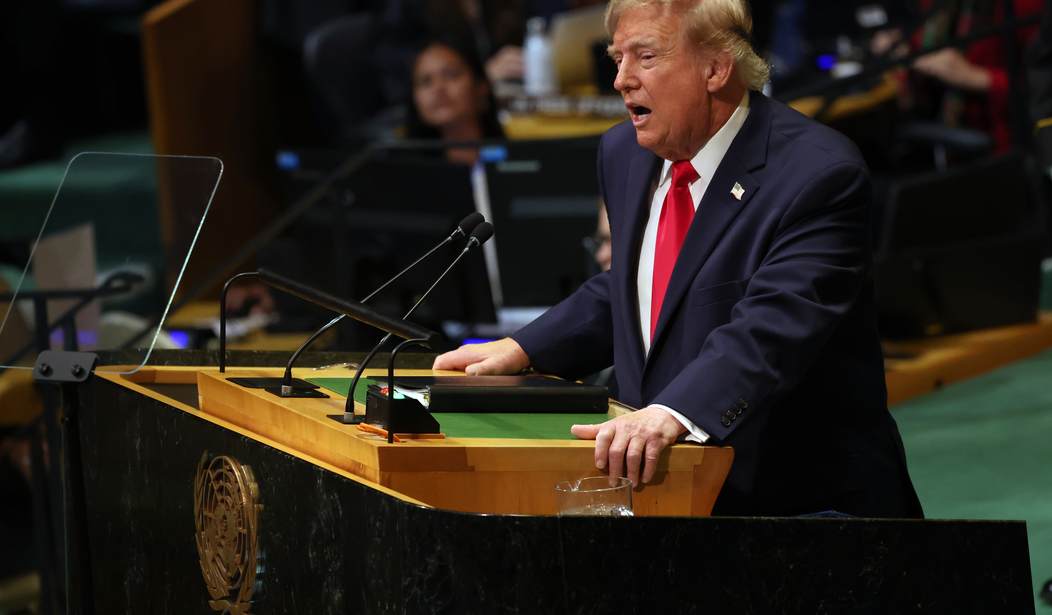
Trump banned majors? Can he do that? Er, no, and that's not what happened. As the Los Angeles Times reported in July, the Department of Education proposed a rule change on federal student loans that would restrict such subsidies to majors with a reasonable chance of future income capable of covering the loans. The rule change attempted to address a major crisis in student-loan debt by linking subsidies to potential income levels, hoping to avoid saddling students with crippling lifetime debt for degrees that simply don't have the potential to overcome it.
TNR's hyperbolic coverage at the time nevertheless failed to match its dishonest lede:
The Los Angeles Times reported Wednesday that the Education Department has finalized a rule that will force schools to prove that the loans students are taking out are paying off.
Degrees for social work, art, religious studies, teaching aides, and music, and cosmetic certification programs will be hit the hardest. For-profit programs will also be hit particularly hard.
While the Trump administration is framing the policy as “accountability” for higher education, and some are welcoming the move, others see it as an attack on those whose work is important regardless of salary.
The Education Department intends to use IRS data to determine students’ salaries four years after they graduate and compare them to those of people similar in age who just have high school diplomas. If they’re below that baseline, that degree will be ineligible for loans.
This has a name in the real world: business modeling. Any business applying for a loan must create a business model to demonstrate its ability to repay the capital infusion. A student loan should be no different, especially when unsecured by other capital.
Instead, TNR addressed it as a social entitlement:
“We need social workers,” American Council on Education Ted Mitchell told the Times. “Whether it’s the fentanyl epidemic or homelessness in L.A., we need people who can work on the street with people who need it the most.”
Do we need social workers? Of course. Do we need them to spend $200,000 in tuition to get degrees in order to do the work? Almost certainly not, and the same is true for artists, musicians, and "cosmetic certification programs." Only in recent decades has credentialism crept into these fields. Most of this training could be accomplished by apprenticeship/mentoring programs within the organizations that provide these services. We have had "social workers" for longer than we have had broad access to higher education, and we have had artists and musicians for millennia without Academia to bless them first.
At any rate, this rule change does not "ban" majors. It does not ban students from choosing these majors, nor does it even ban loans to students who pursue them, as long as they get private loans rather than taxpayer-subsidized loans. If students want to rack up $200K in debt for degrees with low earning potential, they can choose to do that on their own. The Trump administration is taking a rational step toward proper loan modeling, both to protect the borrower and to protect the taxpayers who guarantee these loans.
This will have two key effects. First, it will encourage students to pursue degrees in more lucrative and productive fields, while incentivizing those inclined to other majors to look for opportunities outside of Academia to pursue those ambitions. Second, it will drain demand for these programs at universities, which are the very disciplines in which Academia applies its progressive-politics indoctrination the hardest. That's why TNR and others are panicking over this new rule, attempting to paint it as a "ban" rather than what it actually is – a serious attempt to remedy a crisis that government created, which has victimized a generation of students.
As Geiger Capital argued in response, this is long overdue:
This is long overdue.
— Geiger Capital (@Geiger_Capital) September 28, 2026
He’s not banning the degrees. If you want to study african-american history or music theory, you still can. You simply need to pay for it or apply for private student loans.
The student debt crisis in this country is insane and so many degrees today are… https://t.co/ZcyvZ1Xvu1
The student debt crisis in this country is insane and so many degrees today are absolutely useless. The reason college is so expensive now is because the US government started backing the loans. Obviously the universities were going to start charging $200k, because their customer is now the US government instead of the music theory kid.
Taxpayers should only be subsidizing, and therefore incentivizing, degrees our nation actually needs: doctor, engineers, etc.
Precisely, although this rule change does not go far enough. As I have argued for almost three years, the real solution to the student debt crisis and the corrosive nature of the Marxist control of higher education is to completely defund it at the federal level. The intervention of federal subsidies over the last six decades has warped the higher-ed market, rapidly escalated costs, vastly expanded an administrative class that has distorted education into indoctrination in every discipline, and demonstrably degraded the overall product all the way down to the primary education level.
This is a good start, perhaps, but it's a drop in the bucket to the scope of the reforms necessary to Make Education Great Again. It will take Congress to make the full scale of changes necessary to achieve that end, and unfortunately, this session did not address it. Given the likely composition of the next session of Congress, we are not going to see much action for the next two years either. Rule changes will only get us so far, but at least the Trump administration is pursuing what it can do to deal with an entirely corrupt Academia.