








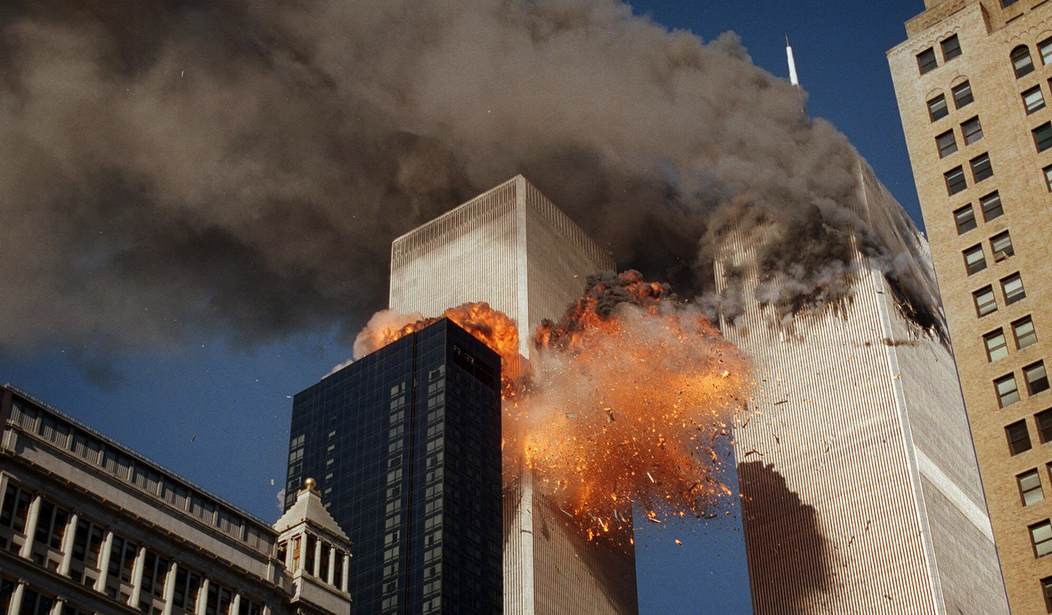
Twenty-five years ago today, at the minute this post goes live, American Airlines Flight 11 struck the North Tower of the World Trade Center in New York City. The terrorist hijackers murdered the other 87 passengers and crew on that plane and also massacred an unknown number of people inside the building. They also killed the world as it was for many around the world and created a new world for all of us.
It's still difficult to write about 9/11 and the changes it has made in my life personally, as well as in creating that new world. During last night's midterm convention live blog, the four of us commented on our struggle to contain the rage we still feel when seeing the footage of that day. For the first few anniversaries, I watched the archive coverage of the attacks, now preserved on any number of YouTube accounts. I stopped doing that when I realized most of it had been long burned into my memory, and to a certain extent, into my soul.
We have written many remembrances since, telling the stories of who we were on that sunny late-summer morning. That has been a form of mourning, as the people we were – individually as well as collectively – died in a sense that day. Never would we step into an airport again without a heightened sense of danger. Our eyes had been opened to the critical danger of a foreign theological extremism that had targeted us. And at least for a while, we finally recognized that it had put America in its sights long ago. It took the loss of almost 3,000 Americans to wake up to the threat.
But eventually, a funny thing happened: We went back to sleep.
Not entirely, of course. We still have enhanced security in air travel to prevent a similar kind of terrorist attack. We recognize the necessity of dealing with radical Islamist regimes and networks, although even that seems to have faded when dealing with them impacts our gas prices. For the past three years, American campuses have churned with activists declaring their solidarity with an Islamist terror network that perpetrated a massacre on Israelis that far surpassed the scale of 9/11 on a population-adjusted basis and demand that Israel get handed over to radical Islamists whose ideology barely differs at all from al-Qaeda and the terrorists of 9/11.
We fret over "Islamophobia" rather than honestly deal with the threat of radical Islam, both abroad and at home. David will have an example in his next post, in fact.
That is one reason why writing these commemorative posts has become so difficult. It's not just the memories; it's the forgetting. No one needs another "I was in my office dealing with a shift change" memory post. What we need is a slap in the face and someone yelling, "Wake up!" With the exception of the anniversaries and perhaps a day or two on either side of them, 9/11 has gone to sleep in America.
To see how much this is true, let me share with you an exchange on X/Twitter earlier this week between Shannon McDermott and film critic Kyle Smith. Shannon asks a piercing question about the lack of resonance in our culture about this gaping wound in the American psyche, and Kyle delivers a brutally honest truth in return:
United 93 was great but it flopped because it was too real. People couldn’t handle it. Oliver Stone did a silver-lining story with World Trade Center, which also was not a hit. Studio executives want very badly not to get fired so they avoid things that audiences reject.
— Kyle Smith (@rkylesmith) September 10, 2026
As it happens, we discussed United 93, a gripping and harrowing film by Paul Greengrass, on our live blog last night. David and I both mentioned having seen it once and finding it so difficult to relive that we never watched it again. I did buy it on DVD and still own it, a gesture of support for Greengrass' honesty and fine work in paying tribute to the first American heroes to fight back against the radical Islamist terrorists, but I still hesitate to play it again. I have watched World Trade Center multiple times (and also own that on DVD), which may have been Stone's best work, or at least his most honest and direct. Both films deserved better than what they received.
Kyle's right about the market response to both films, and how it has discouraged further cinematic explorations of 9/11. That's just business. However, that doesn't fully explain the near-total absence of 9/11 from our art and culture over the last quarter-century. It's not entirely an issue of political manipulation by an entertainment industry that is oriented more toward hostility regarding the versions of America on either side of 9/11.
The truth has been this: People prefer to go back to sleep. We have recoiled from the "never forget" mantra regarding 9/11, perhaps even more completely than about the Holocaust in relation to the October 7 attacks, and for the same reason. Few people want to talk honestly about the massive threat of radical Islam to the United States and the West.
To discuss 9/11 is to admit the threat. To admit the threat requires recognition of those who threaten. That, in turn, requires action, not just by the Department of Homeland Security or the Department of War, but by all of us. It means action in controlling our borders. It means vigilance in choosing our leaders. It means fully funding law enforcement and ensuring its focus on mission. It means heightened awareness, or in the vernacular that erupted in the days after 9/11, it means "If you see something, say something."
When was the last time anyone heard that phrase? It disappeared into obsessions over "Islamophobia," a DARVO-like response after decades of radical Islamist terror. That campaign succeeded in its mission to make us the villains, shame us into silence, and bully us into submission. And it continues to this day in phrases like, "Some people did some things" and "hurt people hurt people."
Today, no one wants to remain awake. Sleep is much easier. We stir momentarily for the commemorations, pray for the victims and first responders, and then roll over and go back to sleep.
For nearly 3,000 people exactly 25 years ago, the alarm clock went off just past too late. Will it be just past too late for you as well, when our complacency and willful amnesia allow for another 9/11?
National Geographic put this retrospective together a few years ago, called One Day In America. Perhaps this year will be the one that will rouse us again from our stupor and create the will to stand up to terrorists and their apologists.
Editor's Note: Do you enjoy HotAir's conservative reporting that takes on the radical Left and woke media? Support our work so that we can continue to bring you the truth.
Join HotAir VIP and use promo code FIGHT to receive 60% off your membership.
Join the Conversation
VIP members get the ability to comment on articles.