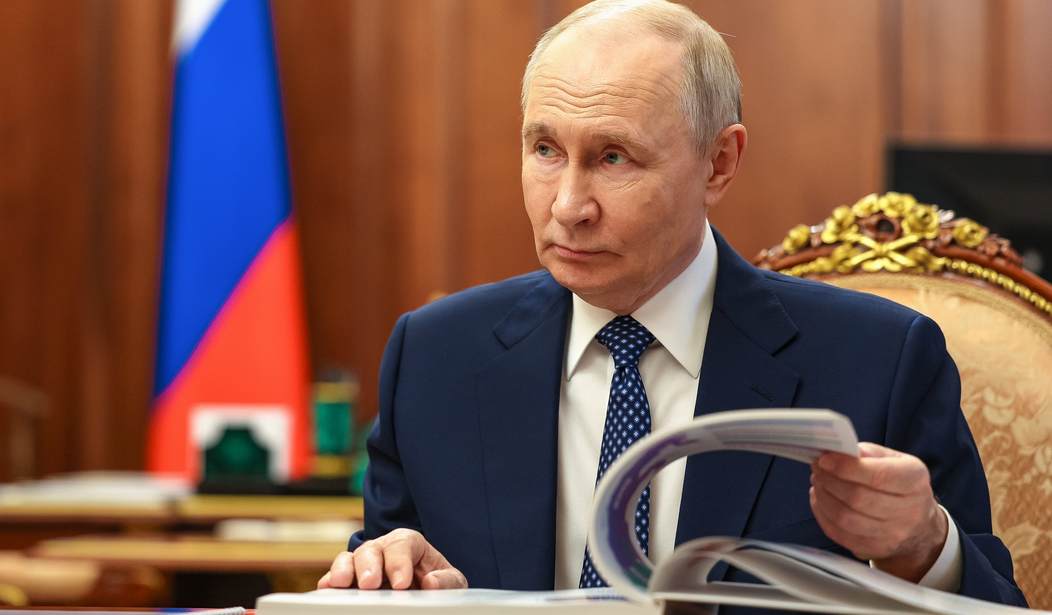
It's been over four years since it became clear that Vladimir Putin couldn't win the war in Ukraine. For most of that time, the Russian president-for-life has maintained the support of his oligarchs and nationalist hawks as he tried to wear down Kyiv and Volodymyr Zelensky, not to mention Joe Biden and Donald Trump. Putin has also managed to keep the Russian economy from collapsing, surprising many observers, but the war has encroached in more significant ways than expected of late.
The Wall Street Journal reports today that Putin's core of political and financial support may have soured on the war and wants Putin to end it, but perhaps doesn't give the full context of their exhaustion:
Russia’s inability to break through the stalemate in Ukraine is becoming so evident that significant voices in the Russian establishment have publicly started to call for an end to the conflict.
The big question is whether President Vladimir Putin will acknowledge this reality and abandon his aspiration to extinguish Ukrainian independence. ...
The calls don’t just come from the business elites and more liberal parts of the Russian establishment. Some of Russia’s best-known hawks have also become much more open in expressing a belief that Moscow simply doesn’t have the capacity to achieve an outright victory against Ukraine.
That much has been painfully obvious since Russian forces failed to capture Kyiv at the beginning of the war. When that operation failed, Russia tried to use its superior numbers (with an inferior combined-arms strategy) to overwhelm Ukraine from the east. More than four years later, Russian forces basically occupy only those parts of Ukraine they controlled before the war, with minimal gains traded for perhaps a million or more casualties.
And in recent days, Russian forces have begun falling back, thanks to Ukrainian innovation in drone warfare. The WSJ takes note of these developments, but not their scope:
In Russian-occupied parts of Ukraine, middle-range strike drones have in recent days paralyzed Russian logistics, a major new development in the war. Often using artificial intelligence, they have targeted fuel trucks and military convoys on roads that link Russia to the Crimean Peninsula and to bases along the front line. Fuel rationing has been imposed in Luhansk and Donetsk, and supplies have already run out in Crimea.
Russian military commentators are warning of an imminent Ukrainian offensive. In recent weeks, Ukraine has had greater success in its long-range strikes throughout the European part of Russia, including Wednesday’s attack on the oil terminal in St. Petersburg, just as Putin’s hometown hosted the opening of an annual economic conference.
The WSJ quotes an analyst who warns that it may take more time for the expanded drone warfare to have an impact on public opinion in Russia. Perhaps, but the expanded long-range drone warfare has gone from relatively isolated attacks on a narrow target set to a far broader campaign in the past year. ABC News charted the data from the Russians themselves, noting the rapidly increasing number of shootdowns:
Ukraine is significantly expanding its long-range drone attacks on targets across Russia — including the capital Moscow — according to data published by the Russian Defense Ministry.
— ABC News (@ABC) June 4, 2026
Read more: https://t.co/FdNJODFXiF pic.twitter.com/c5aXYsDfxI
Ukraine is significantly expanding its long-range drone attacks on targets across Russia -- including the capital Moscow -- according to data published by the Russian Defense Ministry, as the Kremlin's four-year-old full-scale invasion of its neighbor grinds on with little apparent hope for a peace deal or for the Russian victory that President Vladimir Putin has framed as inevitable.
May saw the Russian Defense Ministry claim the shooting down of 9,418 Ukrainian drones -- the highest monthly total ever reported by the ministry -- according to public statements analyzed by ABC News.
And even in Moscow, which open-source intelligence analysts say has been ringed by more than 100 air defense systems amid Ukraine's expanding strike campaign, the threat from Kyiv appears to be more present than ever before. ...
This year has seen a significant uptick in the rate of Ukrainian drone attacks toward Moscow, according to Sobyanin's statements, with the mayor reporting a record monthly high of 398 drone interceptions in March.
Putin built a lot of support for the war in its early stages by claiming to be fighting Nazis in Kyiv, part of a long-standing grudge in Russia over Ukraine's collaboration with Germany in WWII, as well as by isolating the impact of the war from Moscow. Russian propaganda still leans heavily on the Nazi theme, but the Ukrainians have pierced that cocoon Putin built for Muscovites and in St. Petersburg as well, where Putin's power base lives. Putin avoided conscription in these areas to prevent questions from being asked about the true nature of the conflict, although it's not clear that he's been able to maintain that policy of late. With Ukraine's long-range drone capabilities vastly improving, the war has come home to Moscow and St. Petersburg anyway, and with it the question of why Russia's vast numerical superiority hasn't translated to victory – as attacks keep taking place in the Russian capital, far from the front.
Small wonder, then, that the core of Russia has lost its taste for the war now that it has become part of the battlefield.
Will it matter, though? We've often speculated that Putin's regime might collapse economically under the weight of the war, but he's been successful at keeping it propped up – at the cost of reserves, likely, so those props might still be brittle. Nevertheless, Putin doesn't appear to exhibit the usual signs of regime weakness; he's not rounding up and murdering dissenters by the thousands, like his allies in Tehran, and indeed, there hasn't really been an organized opposition on the streets to his rule. The oligarchs may have become discouraged and disillusioned, but they're heavily dependent on Putin for their wealth and protection, too. People may be unhappy with the war, but they're not mobilizing in reaction to it. Yet, anyway.
Perhaps the pressure will force Putin into talks to end the war on the "Anchorage terms," as the WSJ calls them, which were favorable to Russia but which Putin rejected at the time. Trump can use a foreign-policy win at the moment, but Zelensky and the Ukrainians have a lot more leverage than they did a few months ago, especially after their participation in the Persian Gulf defense against Iranian drones. Putin may regret not taking that deal while he still had the chance, although he has far more reasons to regret launching a war that cost Russia lots of gold and blood for no real gains on the ground.
Editor’s Note: Thanks to President Trump and his administration’s bold leadership, we are respected on the world stage, and our enemies are being put on notice.
Help us continue to report on the administration’s peace through strength foreign policy and its successes. Join HotAir VIP and use promo code FIGHT to receive 60% off your membership.






Join the conversation as a VIP Member