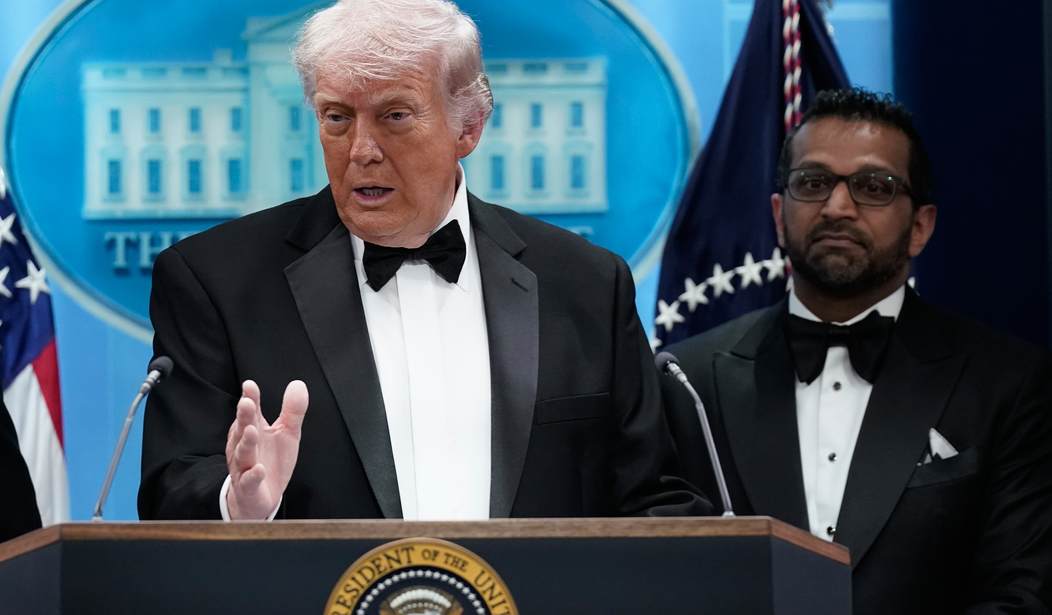
So much for strategic patience?
As the US Navy tightens its grip on the blockade of Iran and tries to convince shippers to surf the Strait of Hormuz, Donald Trump has yet to act on the expiration of his extension of the ceasefire. Iran has yet to do so as well, at least any further than it has acted throughout it – threatening shipping in the Strait, but not much else. The IRGC hasn't fired missiles or drones at its neighbors, and that has at least protected US allies for the past three weeks.
It seems as though Trump may decide to simply starve the IRGC out of power. Late yesterday, the Wall Street Journal reported that Trump had decided to stand pat on the blockade rather than move in two opposite directions:
President Trump has instructed aides to prepare for an extended blockade of Iran, U.S. officials said, targeting the regime’s coffers in a high-risk bid to compel a nuclear capitulation Tehran has long refused.
In recent meetings, including a Monday discussion in the Situation Room, Trump opted to continue squeezing Iran’s economy and oil exports by preventing shipping to and from its ports. He assessed that his other options—resume bombing or walk away from the conflict—carried more risk than maintaining the blockade, officials said. ...
Unilaterally stopping the fight offers a quick exit to the conflict and relief to the U.S. and global economies. But Iran’s proposal last weekend would have allowed Tehran to set the terms of that off-ramp.
Restarting hostilities, meanwhile, would further weaken a battered Iran, but it would likely react by wreaking more havoc on Gulf energy infrastructure, bolstering the costs of the war. The blockade shrinks the Islamic Republic’s funds but commits U.S. forces to a longer deployment in the Middle East—with no guarantee the regime capitulates.
There are some other benefits of waiting out the regime, too, which is not exactly a choice for stasis nor a "cold war," as Axios put it yesterday. The blockade is an ongoing act of actual war with massive potential for kinetic operations, especially against an enemy that lacks a blue-water navy or effective air defenses. Iran has no other means for revenue in hard currency except its oil, and it also faces a catastrophic tipping point for its main industry when it runs out of storage space. There's some debate about when Iran will hit that limit, but we can easily maintain a blockade well past any of those dates, and Iran knows it.
Iranian ex-pat Ida Turan laid out the case for strategic patience in an X/Twitter essay yesterday. It's the option that may thread the needle in a way that promotes regime change most effectively:
3. The regime actually welcomes an aerial conflict. War, which it always calls “imposed” and “defensive”, is a blessing for them. That’s why they keep provoking and refusing any meaningful cooperation.
They know that even if they are weakened, they can survive. All failures can be blamed on the war and the enemy, and any domestic protests can be crushed more brutally amid the chaos.
4. The real benefit of sanctions and sustained pressure is that they deepen the internal fractures inside the regime. They force rival factions to turn on each other in the fight for power, weakening the system from within. Everyone knows Mojtaba Khamenei is dead, and there are multiple serious contenders for succession. ...
The option of a Libya-style approach, providing limited but decisive support to protesters, safe zones if needed, and close air support to help Iranians finish the job themselves, should seriously be on the table.
The Arab states have turned against the regime, it has almost no remaining international support, and there are credible opposition forces ready to step in and take control.
Everything feels far more prepared for this kind of outcome than it did at the start of the campaign.
It's worth noting, however, that it took Barack Obama and the EU seven months of military operations to finally decapitate the Moammar Qaddafi regime. It may take more intense kinetic operations to plow the ground to get to the stage where this strategy could succeed. If the current IRGC leadership remains too entrenched, Turan suggests a limited round of targeted strikes to get "another layer peeled back," even though it may bolster the regime in the very short run in the manner she describes in Point Three.
Has Trump come to that conclusion already? Five hours ago, Trump posted a meme on Truth Social promising "No More Mr. Nice Guy." The background strongly suggests what he has in mind:
Trump likes to bluster on social media, but as Iran's IRGC has learned on multiple occasions now, Trump also likes to deliver on his bluster. In this case, it pays to take him both seriously and literally. Trump is drawing a red line around Iran's nuclear programs, which it keeps trying to take off the table in discussions for ending the war, despite months of demands from Trump to end the program and surrender Iran's stores of highly enriched uranium. This message makes clear that any proposal that doesn't include those points is dead on arrival, and will result in a new offensive to further degrade the IRGC's infrastructure and grip on power.
There is another important reason to do this, apart from the obvious fact that we can't trust the IRGC to possess HEU. The IRGC's grip on power is now conditional on escaping this trap without being seen as losing to Trump. Any success or concession offered by the US will be painted internally in Iran as a victory in the war, which will make it more difficult for rivals to organize a coup or rebellion. This dynamic was very much present in 1930s Europe, where the military caste in Germany had waited for the British and French to humiliate Hitler enough to allow them to seize power, nearly from the moment Hitler rose to it. Instead, the enforcers of Versailles kept handing Hitler victory after victory without firing a shot, from the reoccupation of the Rhineland all the way through Munich and Hitler's violation of that pact a few months later. And after that, it was too late; Hitler had consolidated his power and could launch the war he'd always wanted, especially when Stalin figured the West was too weak to stop Hitler and decided to ally with him in August 1939.
That dynamic is definitely in play here too, only in a reverse timeline. IRGC chief Ahmad Vahidi started off with full concentrated power after that first strike eliminated most of the regime's leadership, followed shortly afterward by the strike on Ali Larijani. Ever since, however, cracks have begun to emerge and grow as the economic situation grows more dire. The more that continues, the more Vahidi needs to demonstrate mastery of a situation he no longer controls in any meaningful sense. As that becomes clear, the more emboldened his rivals and outside opposition forces will become, and perhaps even more importantly, how desperate all of those factions will be to rescue Iran before Vahidi vaporizes its potential forever.
The only way to get regime change, short of a massive invasion that has no chance of ever taking place, is to convince the rivals to Ahmad Vahidi that the US will wreak generational destruction on Iran as long as the IRGC remains on this path. Any hint of appeasement or concession will only strengthen Vahidi. That's why the blockade is likely going to prove the most effective path to forcing a collapse, but a targeted bombing campaign may still be needed to push the fractures into motion for a full-scale breakdown.
Editor's Note: For decades, former presidents have been all talk and no action. Now, Donald Trump is eliminating the threat from Iran once and for all.
Help us report the truth about the Trump administration's decisive actions to keep Americans safe and bring peace to the world. Join HotAir VIP and use promo code FIGHT to get 60% off your VIP membership.







Join the conversation as a VIP Member