






How do we know that the US Navy blockade of Iranian ports has succeeded? The Pentagon plans to expand it to new locations.
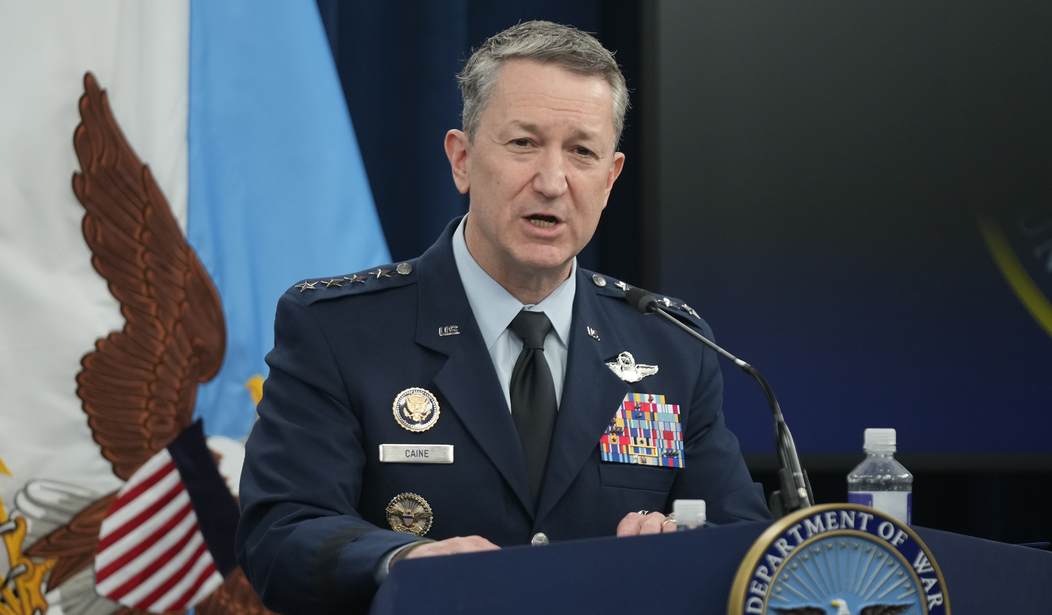
In a briefing this morning, War Secretary Pete Hegseth and Joint Chiefs chair Gen. Dan Caine explained how the military would continue to increase pressure on the regime remnants in Tehran. Caine reminded attendees that the US Navy has not blockaded the Strait of Hormuz, despite a number of media outlets' sloppy reporting. The blockade applies only to Iran, its ports, and any ships that attempt to conduct business with the regime.
That applies globally as of today, Caine announced. Fleets around the world have orders to interdict any shipping connected with Iran no matter where in the world they happen to be. That includes the "dark fleet" that has allowed Iran to avoid sanctions on its oil – and allowed China to benefit from its discounts:
Gen. Dan Caine said the U.S. is expanding its blockade of Iran’s ports and coastline to directly target so-called “dark fleet” vessels—sanctioned, covert tankers used to evade restrictions and move Iranian oil. pic.twitter.com/WIJVBAyv0p
— Kassy Akiva (@KassyAkiva) April 16, 2026
“In addition to enforcing the blockade, all Iranian vessels, vessels with active OFAC sanctions, and vessels suspected of carrying contraband, are subject to belligerent right to visit and search,” the notice said, referring to the Office of Foreign Assets Control. “These vessels, regardless of location, are subject to visit, board, search, and seizure.”
Contraband items include weapons, ammunition, combat aircraft, military electronics, the notice said. “Petroleum products and lubricants are conditional contraband due to their essential role in military operations and their contribution to Iran’s war-sustaining economy,” the advisory also said. The notice was first reported by Seatrade Maritime News.
Until now, the blockade, which went into effect Monday, covered only ships sailing to and from Iranian ports. U.S. Central Command said Wednesday that in the first 48 hours no ships had breached the blockade.
So far, Caine revealed, no boardings or warning shots have been necessary. Since the start of the blockade on Monday, thirteen Iran-linked commercial ships have approached the blockade line, and all thirteen returned to Iranian ports. The Rich Starry apparently tried first after attempting to spoof its location, but the US Navy had enough data on its activities to warn that the ship would be seized if it continued to steam out of the Gulf of Oman. It reversed course, as have the other dozen ships.
Iran has already threatened retaliation in the Strait of Hormuz. A former commander in the IRGC and now a "senior advisor" to the Nepo Babytollah appeared on regime-controlled television yesterday to claim that the Iranians could sink any American battleship that sailed into the strait and the Persian Gulf, and that the blockade would prompt a return to fighting:
Mohsen Rezaee, the ex-commander of the Iranian Revolutionary Guard Corps, mocked President Trump on state TV Wednesday — claiming he wants to be the “police” of the waterway before boasting that Tehran’s missiles can take out American vessels, as reported by Agence France-Presse.
“Is this really your job? Is this the job of a powerful army like the US?” the regime stooge, dressed in a military uniform, threatened Trump.
“These ships of yours will be sunk by our first missiles and have created a great danger for the US military. They can definitely be exposed to our missiles and we can destroy them.”
Rezaee, a senior adviser to the supreme leader, challenged claims that Iran’s navy has been “completely obliterated,” posing the question, “Why does the United States not dare to cross the Strait of Hormuz?”
It's true that sailing into and through the Strait of Hormuz would put US Navy ships in range of Iranian missiles and drones. It's also true that American missile destroyers are designed to deal with those specific threats against themselves and other shipping. Caine explained that to reporters at the briefing:
Chairman of the Joint Chiefs of Staff Dan Caine on American warships:
— Open Source Intel (@Osint613) April 16, 2026
"These ships are armed to the teeth with surface to air missiles, land attack cruise missiles, anti-ship missiles, anti-submarine rockets, torpedoes, five inch naval guns, multiple electronic warfare systems."… pic.twitter.com/NdkvxakE4L
Rezaee may be referencing the location of the enforcement cordon for the blockade, which isn't in the strait itself, a point that confused reporters on the first day of the blockade. The US is enforcing the blockade in the Gulf of Oman rather than the Strait of Hormuz to avoid having to waste resources on missile defenses, but the US is already taking control of the strait and clearing passage for commercial shipping. The Iranians have threatened retaliation throughout that process, but have yet to deliver on any of those threats.
Hegseth scoffed at the response and reminded Rezaee and others that the US would control the strait and maintain the blockade for as long as it took the Iranians to concede. And time is running out on that option, Hegseth and Caine announced:
Gen. Dan Caine: "I'd like to emphasize during this pause that the United States joint force remains postured and ready to resume major combat operations at literally a moment's notice." pic.twitter.com/APNOlgEngk
— Open Source Intel (@Osint613) April 16, 2026
U.S. forces are “maximally postured” to resume military operations if negotiations fail, Defense Secretary Pete Hegseth says. Hegseth acknowledged that Iran is “digging out” its remaining missiles and launchers, but says that it doesn’t have the capability to make new weapons to replace them.
“If Iran chooses poorly, then they will have a blockade and bombs dropping on infrastructure, power and energy,” he added.
That's the context in which efforts to advance talks with the regime in Islamabad are continuing. Donald Trump and J.D. Vance have spoken positively about the prospects of a deal on American terms, about which more later. However, the failure to reach an agreement on US terms carries with it consequences that will also be on American terms, and decided by American military and political leadership – not to mention the Israelis.
Tick. Tock.
Editor's Note: For decades, former presidents have been all talk and no action. Now, Donald Trump is eliminating the threat from Iran once and for all.
Help us report the truth about the Trump administration’s decisive actions to keep Americans safe and bring peace to the world. Join HotAir VIP and use promo code FIGHT to get 60% off your VIP membership.


Join the Conversation
VIP members get the ability to comment on articles.