








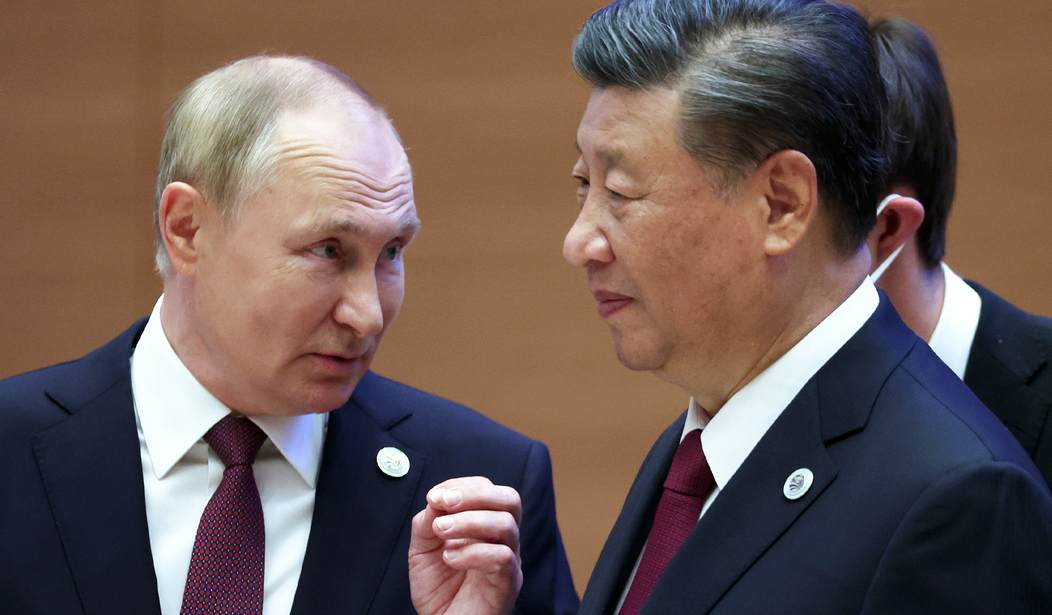

So, how goes that Russia-China-Iran axis these days? You know, the combine that acted to push the US out of the Middle East during the Biden Regency, created a black-market oil-shipping network to evade sanctions, and threatened to undermine the dollar?
Shot, February 28, from Politico:
As Tehran was being pounded by U.S. and Israeli bombs on Saturday morning, its top diplomat dialed Moscow’s number.
On the other end of the line, according to an official Russian statement, Foreign Minister Sergey Lavrov offered his Iranian counterpart sympathy and promised his — verbal — support.
Iran, thus, became the latest country after Syria and Venezuela to feel firsthand what partnership with Russia does, and doesn’t, mean.
Since launching its full-scale war in Ukraine four years ago, the Kremlin has flexed its rhetorical muscle as the flag bearer of a so-called multipolar world. But, at decisive moments, its response on the ground in allied nations has been conspicuously anemic as their leaders came under attack.
Chaser, yesterday in the Wall Street Journal:
As the U.S. and Israel have pummeled China’s closest partner in the Middle East, killing Iran’s leader and calling for its people to overthrow the government, Beijing has responded with sharp denunciations, but little more....
China “supports the Iranian side in safeguarding its sovereignty, security, territorial integrity and national dignity,” Wang said, speaking with Iranian Foreign Minister Abbas Araghchi by phone on Monday.
Instead, Beijing is likely to position itself as an upholder of the international order and avoid ensnaring itself in a protracted Middle East conflict while preparing to work with whoever governs Iran after the fighting stops, analysts say.
That pattern follows Beijing’s limited support for the government of Venezuela, another close partner of China’s, when the U.S. military captured President Nicolás Maduro in January. It could also presage China’s stance if the U.S. were to take action against Cuba, with which Beijing has what it calls an “ironclad friendship.”
Havana has to understand that better than anyone. China may have an "ironclad friendship" with Cuba's current regime, but that mainly benefits the Castroites. China gains intelligence from Cuba, but otherwise Cuba is a dependent of Beijing more than a benefactor. China's relationship with Iran was far more consequential for Xi Jinping, both strategically and economically. Politico laid out Iran's value to China in charts for readers yesterday:
Over the span of two months, the Trump administration has removed the leaders of two countries that both shared China as their most important crude oil customer. Although China buys oil from nations all across the Middle East, Iran was second only to Saudi Arabia as its supplier last year, according to a POLITICO analysis of data provided by market research firm Kpler.
Almost all of Iran’s exported oil, and more than half of Venezuela’s, went last year to China, which remained one of the only purchasers of goods from the two heavily sanctioned nations. The two countries combined represented some 17 percent of China’s overall oil purchases — a meaningful share for the world’s largest importer of crude oil. ...
Iran exported 520 million barrels of crude oil to China in 2025 — more than three times as much as Venezuela. Another 1.4 billion barrels came from the five other countries that rely on the Strait of Hormuz. In total, more than half of China’s crude oil imports come from countries that now face trade disruptions.
Cuba's an afterthought to Beijing in comparison to Iran. China remains highly reliant on fossil fuels for its energy production, despite their massive production of solar panels. Those are mainly for export to Western countries. Not only do coal and oil account for the vast majority of energy consumption in China, its use has scaled up faster than that of alternative sources even in the last decade, according to the Energy Institute:
The impact in China of a regime change in Iran could be devastating. A new regime may be able to rid itself of sanctions, and that would allow oil sales on the open market without discounts. China would have to pay more and get less as a result, although the overall effect would eventually lower prices for everyone. The new regime may not want to do as much business with nations that enabled the repression of the mullahs, either. If China had the means to react to anything, the war on the Iranian regime would be it.
The same is true with Russia. Moscow's interest in Iran goes back to the era of the tsars; it was one of the prizes of Great Game espionage and diplomacy in the imperial era. Russia saw Iran as an opening for long-desired warm-water naval ports, which Syria provided until the fall of Bashar al-Assad. Russia and China failed to react to the crisis in Venezuela, and now they are keeping their core axis partner at arm's length in this conflict with the US, too.
All of this undermines the credibility of both countries in global power applications. Xi Jinping in particular had tried to build multilateral organizations to challenge the West, partnerships that relied on the credibility of Chinese and Russian power. The WSJ points out how that worked for Iran in this crisis, or more accurately, didn't work:
China, together with Russia, helped Iran join two multilateral groupings where they are charter members: the so-called Brics bloc of emerging economies in 2024 and the Shanghai Cooperation Organization, a security-focused body, in 2023.
But membership in such groups ultimately added little to Iran’s security. “It is very discouraging for anybody who believes that China was offering an alternative because there is no alternative,” said Alicia García Herrero, chief Asia Pacific economist for the French bank Natixis. “China won’t be there if you need them.”
Not against the US, anyway, which is all that matters. Venezuela and Iran fell for it, and paid the consequences for relying on the axis while defying the US and Donald Trump. Will Cuba make that same mistake after watching Trump reset global-power balances around the world? Even before the attacks launched in Operation Epic Fury, Trump warned Cuba to choose their friends wisely:
Republican Senator Lindsey Graham has said the government in Cuba will be next to "fall" after U.S.-Israeli strikes killed Iran's supreme leader over the weekend and Venezuela's former president sits in a New York detention center.
"This communist dictatorship in Cuba? Their days are numbered," Graham said during an appearance on Fox News late on Sunday.
U.S. President Donald Trump had said ahead of the cycle of strikes in the Middle East that the U.S. could orchestrate a "friendly takeover" of Cuba but offered scant details on ongoing negotiations with Havana.
That's the message that Trump wants to send to everyone else, too. Choose wisely.
Editor’s Note: Thanks to President Trump and his administration’s bold leadership, we are respected on the world stage, and our enemies are being put on notice.
Help us continue to report on the administration’s peace through strength foreign policy and its successes. Join Hot Air VIP and use promo code FIGHT to get 60% off your membership!