
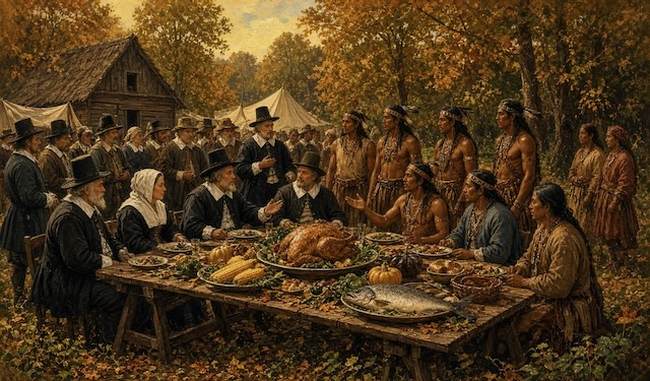
Not being a fan of turkey, I admit I sympathize with the idea that the celebratory dinners on the fourth Thursday in November are a mixed blessing.
However, I think declaring the day most of us call "Thanksgiving" a "National Day of Mourning" goes a bit too far. Turkey is really not THAT bad. It's just a bit dry and tasteless, when there are much better foods to be thankful for. In fact, for this year's Thanksgiving, I cooked up a nice marinara sauce with Italian sausage meatballs, froze it, and sent it off to Washington State so my dad could enjoy his Thanksgiving dinner with the West Coast family as they ate the execrable bird meal. He loved it.
'National Day of Mourning' in Plymouth, MA: "And until this country...and all settler colonial projects are dismantled, we will continue to live in the time of the pilgrims...we cannot allow their crimes to be sanitized and forgotten. And that is why...we have gathered on this hill to tear down the Thanksgiving mythology." This isn't fringe thinking on the left. They hate the country and want it destroyed.
— Western Lensman (@WesternLensman) November 27, 2026
Unfortunately, when I read that Boston and other blue areas were declaring Thanksgiving a "National Day of Mourning," it turned out they weren't agitating to replace turkey with prime rib or Italian sausage meatballs, but rather to abolish the existence of Western culture in Turtle Island.
Boston’s City Council designates Thanksgiving as a “National Day of Mourning” over what councilors call the “devastating consequences” of colonization. “I think it’s important that we recognize that these are not simply injustices of the past.” “As a city, we have a responsibility to ensure that our commitment to equity and justice includes the Indigenous peoples whose lands we live on.” Meanwhile, officials in Plymouth, the historic home of the 1621 feast, are refusing to set up a stage on state property for the 57th annual National Day of Mourning without proof of insurance, sparking a courtroom fight over a 1998 settlement agreement just days before Thursday’s event. Boston marks Thanksgiving as a "National Day of Mourning" while historic Plymouth battles activists in court just days before the holiday: https://t.co/MeVPgH9mli
— Fox News (@FoxNews) November 26, 2026
Boston’s City Council designates Thanksgiving as a “National Day of Mourning” over what councilors call the “devastating consequences” of colonization.
“I think it’s important that we recognize that these are not simply injustices of the past.”
“As a city, we have a responsibility to ensure that our commitment to equity and justice includes the Indigenous peoples whose lands we live on.”
Meanwhile, officials in Plymouth, the historic home of the 1621 feast, are refusing to set up a stage on state property for the 57th annual National Day of Mourning without proof of insurance, sparking a courtroom fight over a 1998 settlement agreement just days before Thursday’s event.
Boston marks Thanksgiving as a "National Day of Mourning" while historic Plymouth battles activists in court just days before the holiday: https://foxnews.com/politics/boston-marks-thanksgiving-day-mourning-historic-plymouth-battles-anti-thanksgiving-activists
It's ironic that Boston is now in its third year of self-flagellation over its existence, since it was the first really thriving city in the Massachusetts colony founded by the Puritans. Founded only four years after Salem, it proved to be a better place to settle, and the city thrived. Across the river, Harvard was founded only six years after the city of Boston, and it too was based on a very British idea of the importance of education; so much so that the city in which it was founded was named Cambridge.
In fact, all the cities and counties in the region are recycled English names, mostly from East Anglia.
BREAKING: The Boston City Council just passed a resolution to declare November 26th (Thanksgiving Day) as "National Day of Mourning" to address "historical injustice." https://t.co/ljakVLmZWC
— Libs of TikTok (@libsoftiktok) November 24, 2026
After all, it is called New England for a reason.
The Boston City Council voted to recognize this Thursday, Thanksgiving Day, as a "National Day of Mourning." Councilor Julia Mejia says the Thanksgiving story kids learn in school "fails to acknowledge the devastating consequences" of colonization. https://t.co/qErTfRHJWj
— Woke War Room (@WokeWarRoom) November 24, 2026
One of the great ironies is that the first Thanksgiving had nothing to do with colonists oppressing the natives, who, as a group, were not particularly hostile to the newcomers. Trade and even aid were the order of the day, and if you know anything about Native American history, it was not their habit to have permanently established cities, and they had plenty of experience with competing tribes butting heads over who could use which areas at what times. They had regions in which they roamed or farmed, but were largely nomadic.
Plenty of conflict and politicking existed among the natives even before the Europeans arrived, because that is the story of human civilization in a nutshell. When more Europeans showed up over the next century, and clashes developed between them, tribes often chose a side to fight on because it was normal politics even for them. Think of the French and Indian Wars of the 18th century, when Indian tribes sided with either the French or the British. The idea that the natives were somehow apolitical victims of oppressive Europeans is just romantic silliness based on a practically childish sense of innocent noble savages being bullied by sophisticated, evil Europeans.
🚨Loudoun County Public Schools is back in the spotlight after it suggested teachers to teach kids as young as 7 years old that Thanksgiving is actually a day of mourning, almost like a funeral. I asked a school board member about that. WATCH: https://t.co/W2NjRR6g4t
— Nick Minock (@NickMinock) November 24, 2026
The moral of the story we were taught about Thanksgiving — pretty much the founding myth, actually — was that cooperation between peoples is good. It is the opposite of pushing a narrative of oppression and European superiority. One of the key things you were supposed to learn was that people of all races and religions could sit down together to break bread and be thankful for each other.
Of course, that, too, is a bunch of romantic drivel when compared to the harsher reality, but it actually is a far better moral lesson than the Left wants to push with its "Day of Mourning." The Day of Mourning narrative is that some people are Oppressors capital O, others Victims capital V. It is a story of inevitable conflict, with the only hope that the Oppressors be defeated and "decolonized."
The traditional Thanksgiving myth is the opposite: even with all our differences, we can come together to thank God for our shared blessings.
You can see the irony here, right? The good and compassionate people who are engaged in supposed self-flagellation are actually teaching that Westerners are evil (aside from "allies" like them) and non-Westerners are victims who would be living in peaceful utopias but for us.
It's a formula for constant war, not reconciliation. The traditional Thanksgiving myth is the opposite: finding room for reconciliation and harmony, despite vast differences.
How much harmony? Well, enough to get millions of people to sit down and eat Turkey instead of prime rib. It takes a lot of harmony to get people to do something so irrational.