
Minnesotans have a Lake Woebegone complex: we believe that everything here is above average.
And, to be fair, Minnesota once really was above average compared to our neighbors and many states in the country. Some of that had to do with the fact that our peer states include North and South Dakota, which for years were rather sleepy places with low populations, and nothing so useful for transportation as the Mississippi River or Lake Superior. Iowa was far sleepier and focused on agriculture, while Minnesota has a more balanced economy, including mining, manufacturing, agriculture, and a thriving medical devices industry.
Our education was top-notch; we had plenty of Fortune 500 companies based here, and the University of Minnesota was world-class in many fields. And we have the Mayo Clinic. An embarrassment of riches for a state with a relatively small population.
Except...since Tim Pawlenty left office, the Democrats running this state have seen their job as harvesting the wealth and spending it down.
We're rich! Let's spend it!
Pro tip, this isn’t the solution: https://t.co/hokUafRaK3
— Sam Schulenberg (@sam_schulie_1) November 17, 2026
Most Minnesotans have no idea how dire our economic situation is - they don't believe me when I share the data.
Minnesota ranks 49th in real GDP per capita growth this decade. Last year's report had us 38th.
Real median household income growth is down this decade, we are now at 47th in the country.
Everything we love about Minnesota runs on growth: our quality of life, our arts and culture, our public goods and services.
Our state's future depends on our economy.
Minnesota desperately needs to shake off its malaise, make some hard decisions, and adopt a pro-growth agenda.
Mark Dayton, who preceded Tim Walz, was a spendthrift, but for all his oddities and leftism, he looks positively conservative next to Walz, who has been a complete disaster for the state. Disaster doesn't begin to cover it, because Minnesota went from above average in most things to the bottom quintile in no time at all.
Even I, who live here and have disdain for Walz and his cronies, did a double-take when I saw the numbers. They are truly frightening.
Minnesota built its prosperity on the strength of its private-sector. Generations of entrepreneurs, employers and employees turned new ideas into industries that earned the state a reputation for economic strength and a high quality of life. That legacy remains real, but past performance cannot secure Minnesota’s future.
The latest evidence tells us that Minnesota is falling behind the rest of the country. Last year’s Business Benchmarks report found the state in the bottom third on core growth indicators, and the newest data deepen that concern. The latest data show the economy growing even more slowly leaving Minnesota 49th among 50 states in GDP per capita growth this decade. Since 2019, the state ranks 43rd in per capita income growth, 46th in average wage growth, 47th in median household income growth and 45th in export growth. Slower growth has real consequences. It determines whether employers can compete, whether workers see their paychecks rise and whether communities have the resources to thrive. Growth is a means rather than an end, yet every lasting gain in wages, business strength and community well-being depends on it.
Bottom quintile. For a state that struts around as if it were at the top of the class.
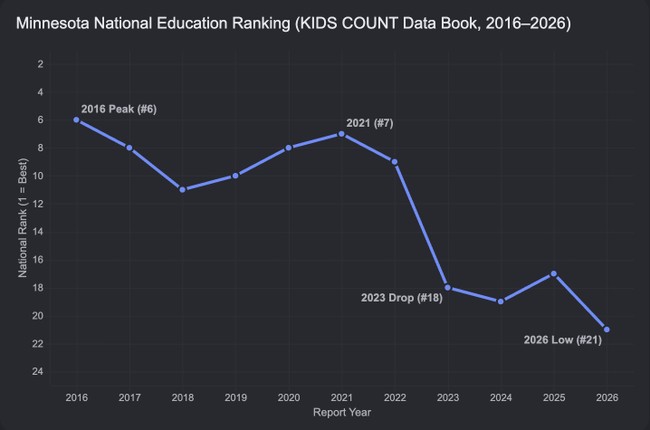
And speaking of classrooms, Minnesota ain't doing so hot there. Walz, who loves to tell you about how he was a teacher, has presided over a dramatic decline in Minnesota's education ranking. And it's worse than it looks, because almost every state has been doing more poorly on education since the pandemic hit, so Minnesota has fallen even farther than it looks when it comes to achievement.
 Most Minnesotans still haven't grasped how disastrous the Walz terms have been for our state. It takes far longer for people to realize either a significant increase or a significant decline than you would imagine. The lag between perception and reality can be fairly long because people assume things move in a straight line, and small tells don't register.
But the tells are getting larger, and Minnesota is declining, objectively, on just about every measure.
The Democrats live off the fat of the land and are often only kicked out when things are bad. Republicans have to come in and clean up the mess, and there is usually a delay between the time they come in and when things get better. Often, things keep going down for a while until things correct. Imagine if Reagan faced reelection in 1982, when the worst of the recession he reversed was still going on.
He would be remembered as a terrible president, not the guy who revived the economy.
Democrats ride the waves of prosperity that Republicans create, spend down the wealth, get kicked out, and the cycle repeats often enough.
Unfortunately, both for us and perhaps for Amy Klobuchar, who will have to satisfy her constituents AND try to clean up this mess, she got elected. That means more years of Democrat dysfunction, even though Amy is nowhere near as liberal (or as indifferent to business interests) as Walz was.
Her legislature, though, is far-left; her constituents want far-left policies, and her economy can't sustain the spending.
Amy Klobuchar inherits an economy in deeper trouble than most in the country, and her ability to fix it is very limited.
She won the job, but she may not enjoy it much.