

Did you know that Abdul El-Sayed is a doctor?
Well, not a DOCTOR-doctor, but a doctor. Some kind of doctor. He graduated from medical school, so that means something, right?
Well, maybe. I'm not certain what the rules actually are, because if you graduate from law school but never pass the bar exam, you can get trashed for calling yourself a lawyer and be smeared in the media as an incompetent boob, as long as you work for Donald Trump. So the rules on professional titles are a bit murky.
Until you realize that the "rules" are different from what you thought.
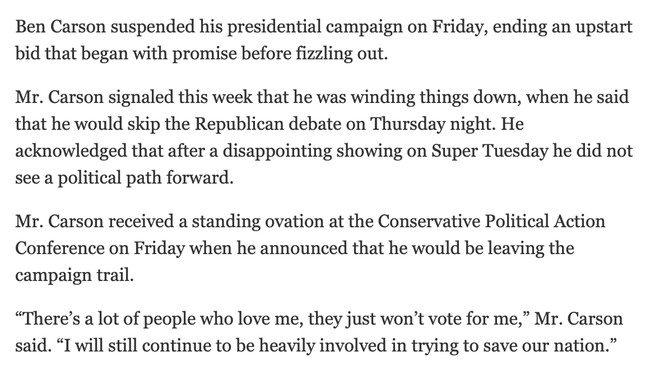
Perhaps there are reasons of style policy involved, but reading New York Times coverage of Dr. El-Sayed, and remembering Times 2016 coverage of renowned brain surgeon Ben Carson makes you wonder: Did Carson ever get an MD? https://t.co/E5Ol6LV8Fx
— Byron York (@ByronYork) October 16, 2026
As Ed wrote earlier today, Katie Zacharia is going the Anthony Scaramucci route, it seems, and I'm not surprised. While the focus has been mainly on her credentials as a lawyer, because she seems to have inflated them a bit, Trump dumped her and will find her a nice position out of the spotlight because, well, she also isn't very good at the job.
But the lawyer-credential issue is worth focusing on for a bit, because it reveals something about the media: as much as they love to promote credentials, their standard for what counts as important depends entirely on whether they already like you for other reasons.
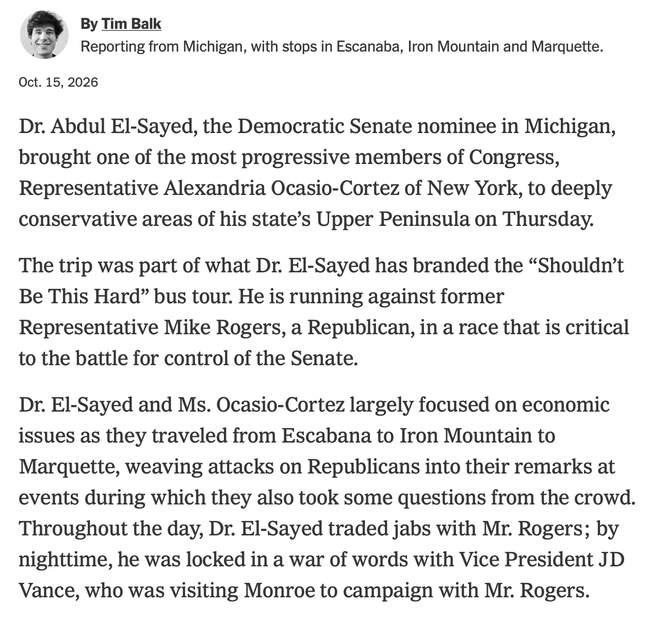
Byron York brought the receipts, and his point is dead on. People in the cultural elite love to focus on credentials as a class signifier, but it's easy to miss that class comes first, and the signifier is just the endorsement that a person belongs. If somebody has the credential — even a far better one by normal standards — but isn't seen as a member of the class, the credential gets memory-holed.
 Doctor El-Sayed could go to jail if he prescribed a drug or practiced medicine, because his claim to be a doctor is a degree, not completion of all the requirements to practice medicine legally. He is not, in fact, a doctor who can practice medicine, as implied. He appends the title to his name to add prestige, not to recognize prestige he has earned.
The opposite is true of Ben Carson, who wasn't just a medical doctor, but a world-renowned one. That alone tells you nothing about his qualifications for the presidency, but the fact that the Times emphasizes that the guy who couldn't legally practice medicine is A DOCTOR!!!!, while ignoring the medical degree of the guy who can successfully separate conjoined twins at the head, tells you quite a bit.
Ben Carson led a team of 70 in a 22-hour operation to perform the first successful separation of twins conjoined at the head, but to the Times he was "Mr. Carson."
Abdul El-Sayed was a bureaucrat, and the Times calls him "Dr. El-Sayed."
It's easy to think that the Left is credential-obsessed, and they can be, but it is also easy to miss that they only pay attention to credentials when they back up their own class' beliefs. We saw that during COVID, too: we were told to "trust the experts," but whenever an expert like Jay Bhattacharya disagreed, he was a "fringe epidemiologist."
Credentials, in other words, can serve as a class signifier, but class matters more than the signifier.
Look for these tells. They are everywhere.