
If I ever want advice on how best to create a world safe for human beings, especially young women, I first try to find out what Reid Hoffman and Hillary Clinton think. Both are well known for their intellectual depth and subtlety, altruism, concern for the vulnerable, and prescience in seeing the longer-term consequences of their actions.
Luckily, as we are deeply enmeshed in a truly idiotic debate about the dangers of AI and the need for government regulations, Reid and Hillary have entered the conversation. And they are here to tell you that the companies which are incapable of running network security, managing their balance sheets, and telling their AI models not to break laws (in fact, they tell them explicitly to do so), are the only ones responsible enough to do AI research and implementation.
Riding the huggingface AI safety wave to justify a crackdown on open source is abominable. Not only was an open-source platform victimized in that attack, but they relied on open-source models to defend.
— Emerson Alden (@emersonalden4) September 24, 2026
These people know this, of course. They simply don't care. https://t.co/BFtQf5u85H
Yep. Makes sense. They are now doing exactly the bidding of Anthropic and OpenAI, arguing that the government should create a moat around their businesses and create an oligopoly because Open Weight/Open Source AI models, which have not been involved in any of the dangerous hacking incidents we are told to fear, present the real danger.
Yeah, a danger to OpenAI and Anthropic, which are tossing around a lot of money to create this panic and get a government bailout.
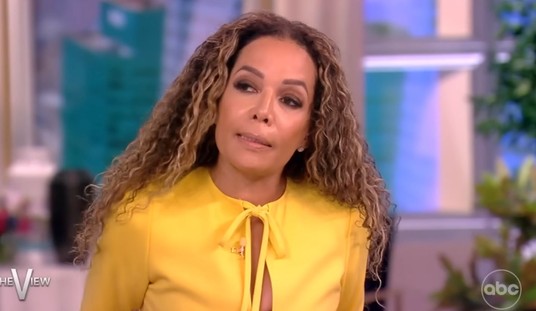
Democrats ran a candidate in 2024 who was similarly wise in understanding and explaining AI, and it pains me to say I wasn't wise enough to see that she would have been a truly great president.
Ladies & Gentlemen,
— ThePersistence (@ScottPresler) September 18, 2026
America dodged a bullet.
“AI is kind of a fancy thing. First of all, it’s 2 letters.”
-Kamala Harris pic.twitter.com/omty3sWfD8
I have been writing a lot about the AI controversy lately, and frankly, they haven't been my best-performing posts. If I cared more about "the algorithm," I would drop the subject and move on to other, juicier topics.
But AI policies matter, and not just in the ways that the opposing sides of this stupid debate want you to believe. The proliferation of AI is neither an unalloyed good as some argue, nor a likely existential threat as the scaremongers want you to believe. Both sides have ulterior motives, blind spots, and often ignore the details that truly matter.
They have other fish to fry, and what happens to you, me, and civilization is all a sideshow to them.
Kamala Harris just attempted to explain AI & social media algorithms
— End Wokeness (@EndWokeness) September 25, 2026
𝗪𝗔𝗥𝗡𝗜𝗡𝗚: You will lose brain cells
(It's worse than you think) pic.twitter.com/7FMiX80kN8
There are many dangers that are associated with poorly deployed AI, both because the technology itself is very powerful in limited but important ways, and because the people who are deploying it in businesses don't really understand what it can and can't do. Companies have fired whole departments assuming AI will replace the workers, only to find out that they misunderstood the strengths and weaknesses of the technology.
These people are making the same mistake that Geoffrey Hinton, the so-called "godfather of AI," made about the idiocy of training radiologists because AI would make them obsolete. He was 100 percent wrong — since that prediction, demand for radiologists has gone up, as has their pay, because AI replaced a TASK, not a job, and tasks are merely steps toward accomplishing a goal that computers cannot do.
God bless @JensenHuang for being a voice of reason. In 2016, Geoffrey Hinton said we should stop training radiologists b/c AI would "make them obsolete in 5 yrs, maybe 10." There are 28,700 in the US today, BLS projects 29,600 by 2035. We need an @OldTakesExposed but for tech pic.twitter.com/UjJzYJnSrY
— Adam Singer (@AdamSinger) September 24, 2026
But the misallocation of resources and the upheavals in the job world are only one problem AI will bring. Others come from poor AI training, information control, handing powerful tools to bad actors, and dumbing down the populace by telling them to rely on AI to do their thinking for them. No powerful technology is an unalloyed good, and to maximize benefits and minimize harm, you have to start by understanding what is real and what is false.
Airplanes are good. Flying them into buildings is bad. You don't give up airplanes to prevent the next 9/11; you develop systems to minimize harm and maximize good, and the only way to do that is to think about the entire picture clearly and creatively.
Until recently, I mostly ignored AI because the use cases for me were minimal, and the most interesting consequences of its spread were limited to the societal psychoses it spawned. Now, I am actually interested in how it works, its potential uses and dangers, and its economics (given how the rapid development of AI and the mania surrounding it have distorted investment psychology), and, of course, the political battle.
It's fascinating, and somewhere between 75 and 90 percent of what is said is complete BS, hype, or spreading FUD (fear, uncertainty, and doubt).
It's the internet bubble, Y2K, and COVID wrapped up into one big package.
But as with each of those, there was a kernel of truth hidden within all the blather. The tech bubble was based on a real phenomenon — the growth of the internet, which really has revolutionized the economy and daily life; Y2K was a real but limited problem that was blown all out of proportion, making billions for people and scaring the world unnecessarily; and COVID was a real disease that killed real people, but hardly the danger it was made out to be. Plenty of flu seasons were worse, and hardly anybody noticed.
The growth of AI presents real challenges and opportunities. The irony in the discussion is that the least responsible actors right now are the companies that the politicians are moving heaven and earth to protect, largely because a lot of venture capitalists have placed really big, really bad bets on their revenue growth projections.
The real crisis they are trying to solve is that many people could get wiped out by a market crash and bond defaults.
Data center projects, of which there are now trillions of dollars' worth of promised investments, are facing real challenges, and the bottom line is that massive loans and profit projections are based on entirely notional (and questionable) construction and sales. Most of the projected revenue increases at the big "hyperscalers" (Oracle, Amazon, Microsoft, Google, and xAI) are based on sales of computing capacity to Anthropic and OpenAI, neither of which right now has the actual revenue to PAY for what they have purchased.
The insurance markets are skeptical in a way that lenders and especially equity investors are not, and I would bet that the equity guys are wrong on this one.
I watched an interesting video by an AI investor who doesn't believe that it is a bubble, and he has an interesting yet flawed analysis (ignore the YouTube graphic that makes it look like he is predicting a popped bubble — AI has told Google that graphics have to grab attention, even if they are deceptive.)
His argument is simple: the demand for compute still exceeds the supply, and in that he is 100 percent correct. He just misses the most important point while proving that dot.com was a bubble, but AI is not: the demand for compute is based on giving it away. If you hand out lots of free or reduced-cost goods, of course people snap it up, even when it isn't that useful.
How many tchotchkes have you picked up at a convention or fair that you toss in a drawer and forget? Pens with logos on them, or other doodads that you would never pay for? You pick it up because it is free.
Most demand for AI is like that. It is given away, or sold at well below the cost of providing the service. The costs of providing AI are in the trillions, and the revenue is in the billions. That is not a business that can survive without massive inflows of money from somewhere, and that somewhere is investors, who are running out of patience.
It turns out that AI has some real value, just not, for now, many trillions of dollars' worth. Maybe someday, but not soon enough to save OpenAI and Anthropic from collapse without massive help from somebody outside the VC world.
Worse, cheaper, open source/open weight models are getting "good enough" to replace the "frontier" models for many use cases, meaning that the market is much smaller for them than predicted. Gobs of software companies are pulling back on AI spend either because it doesn't pay financially, or because they can use low-cost or free models to do the work much cheaper.
Which gets us to Hillary Clinton, Reid Hoffman, the Democrats selling doom, the entire PR infrastructure pushing doom, and the grasstops campaigns to slow or stop progress. Lots of interested parties want to change the game, since they are losing it.
Does anybody think that Hillary Clinton or Chuck Schumer, who were born before there was even the idea of a computer, understand the ins and outs of frontier models vs open weight models? Yet there HRC is, discussing the dangers of models not run by the top-tier companies, which are the only ones to have done actual damage.
It's about money. It's about control. It's about saving investments. And it is about controlling people's perceptions of reality.
Panic is the best way to short circuit people's skepticism and convince them to hand over all the money and power in the world to the Clintons and Hoffmans of the world.
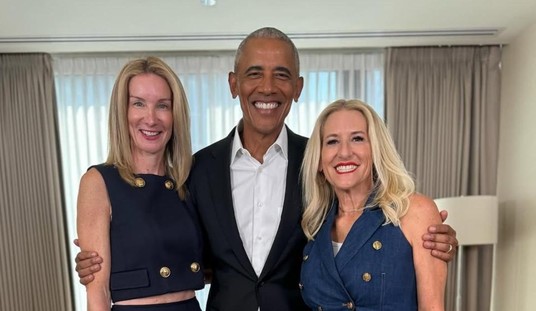
Are there real issues to contend with? Of course there are. Should we let Hillary, Barack, and Hoffman solve them?
You decide.
Editor’s Note: Every single day, here at HotAir, we stand up and FIGHT, FIGHT, FIGHT against the radical Left and deliver the conservative reporting our readers deserve.
Help us continue to tell the truth about the Trump administration and its successes. Join HotAir VIP and use promo code FIGHT to receive 60% off your membership.









Join the conversation as a VIP Member