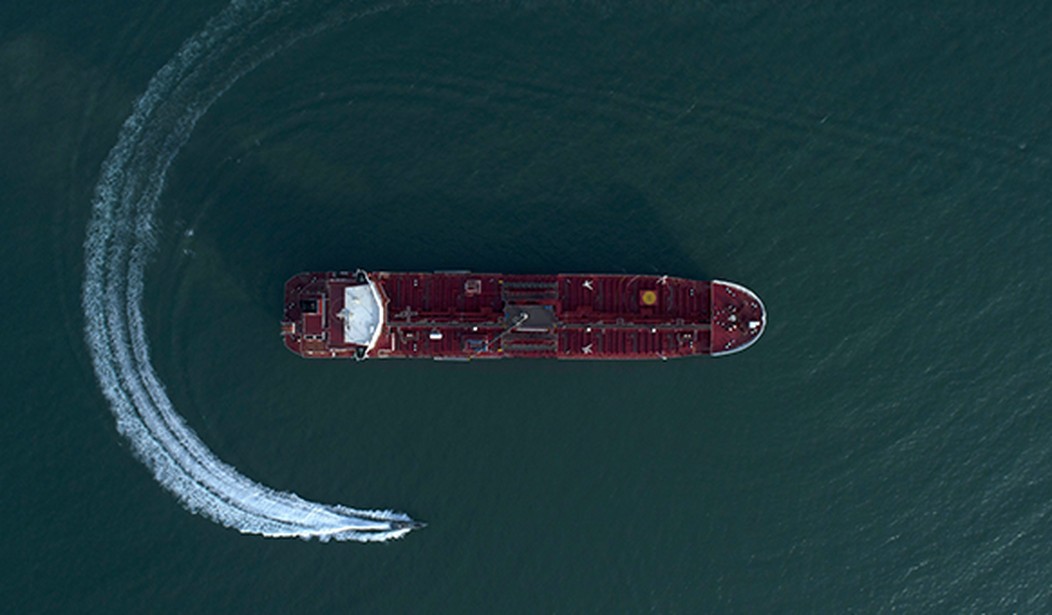
I have been waiting for the Iranians to harass shipping in the Strait of Hormuz, and it appears to have happened.
I should say, it's not CONFIRMED that the attack was committed by Iran, but SOMEBODY shot at the bridge of a tanker transiting the Strait, and the attack took place mere hours after Iran warned that ships that did not get permission from the Persian Gulf Strait Authority would face "consequences."
This is the current U.S. Air Force aerial picture over the Strait of Hormuz following the attack on a vessel in Omani waters earlier today, showing at least 5 KC-135 "Stratotankers" active. https://t.co/dWRi8m6ILo pic.twitter.com/kNh4Okbclx
— OSINTdefender (@sentdefender) June 25, 2026
While it's unconfirmed that Iranians are responsible, the link between the Iranian warning and the subsequent attack, which apparently used live ammunition but caused little damage, seems remarkably coincidental to Iranian warnings.
The United Kingdom Maritime Trade Operations (UKMTO) has issued an attack advisory after receiving a report that a vessel was struck on its starboard (right) side by an unidentified projectile 7.5NM off Oman, causing damage to the bridge.
— OSINTdefender (@sentdefender) June 25, 2026
No casualties or pollution have been… pic.twitter.com/OPlVjGqjcb
As I have warned, we should expect a pattern from Iran similar to what we saw during the "ceasefire" pre-MOU, with the IRGC "testing the waters," so to speak, to harass its adversaries, assert its dominance, and to remind everybody that it is in a position to do damage should they so desire.
Iran has made it clear that they own the Strait, nominally in cooperation with Oman, which borders the Strait on the South side. They insist that after the initial 60 days, they will demand "fees," and that for the moment, all ships must get permission from Iran before they transit.
Incredible.
— HFI Research (@HFI_Research) June 25, 2026
According to Windward AI, we had 62 vessels transit the Strait of Hormuz on June 24.
21 vessels in, 41 vessels out.
But as I wrote yesterday, the inbound tankers are still very restricted. The list was shared yesterday. That was the final figure now.
Most of… https://t.co/52N3zZvS19
Incredible.
According to Windward AI, we had 62 vessels transit the Strait of Hormuz on June 24.
21 vessels in, 41 vessels out.
But as I wrote yesterday, the inbound tankers are still very restricted. The list was shared yesterday. That was the final figure now.
Most of the vessels used the Oman route to exit. The IRGC was forced to implement the closure.
Now we wait and see for the US’s response.
This crisis is far from over. IRGC intends on using this leverage.
Ships that don't get permission from Iran are using the Oman side of the Strait, where this attack took place. It is likely a warning to everybody that Iran can strike even there, where ships assume they are more protected.
UKMTO: "A cargo vessel [7.5NM southeast of Dahit, Oman] has been hit on the starboard side by an unknown projectile, causing damage to the bridge. Master has reported no casualties and no environmental impact."
— Rory Johnston (@Rory_Johnston) June 25, 2026
Iran exerting its newly claimed control of Hormuz after yesterday's… pic.twitter.com/yBf3TABRJw
UKMTO: "A cargo vessel [7.5NM southeast of Dahit, Oman] has been hit on the starboard side by an unknown projectile, causing damage to the bridge. Master has reported no casualties and no environmental impact."
Iran exerting its newly claimed control of Hormuz after yesterday's Omani Route breakout.
Shipping has surged, getting ever closer to pre-war levels, with many vessels ignoring Iran's demand for permission. We can assume that the "consequences" Iran hinted at are now coming to pass.
I doubt that they intend to sink any ships, which would undoubtedly restart the kinetic phase of the war. What they are doing is trying to keep insurance prices higher, impose costs for defying them, spit in the eye of the United States and Gulf States, and harass shipping enough to pressure Gulf States into submitting to their demands.
After all, it's only money, right?
MORE | Iran is likely attempting to use talks with Omani and Saudi officials to segue discussions over the immediate management of the Strait of Hormuz and resumption of traffic into broader discussions about a new regional architecture in the Gulf region.
— Critical Threats (@criticalthreats) June 25, 2026
The Strait of Hormuz… https://t.co/ABblS0iWIE pic.twitter.com/06ZozV1V5N
MORE | Iran is likely attempting to use talks with Omani and Saudi officials to segue discussions over the immediate management of the Strait of Hormuz and resumption of traffic into broader discussions about a new regional architecture in the Gulf region.
The Strait of Hormuz is an international waterway under the UN Convention on the Law of the Sea (UNCLOS). Any effort to place the Strait under the control of a state or several states would erode long-standing international norms and maritime law.
Of course, giving in ratifies Iranian control over an international waterway and gives Iran more leverage to maintain its reign of terror.
The US has been sending its own signals for the past few days. Little noticed, we have stepped up our tanker presence in the region, with more-than-usual flying, indicating we have many planes in the air and are prepared to deploy more quickly should we need to. I have been keeping one eye on that, as it serves as sort of a "Pentagon Pizza" indicator; not definitive, but noteworthy.
BREAKING: A cargo ship has been attacked and hit, sustaining damage 7.5 nautical miles off Oman in the Strait of Hormuz southern corridor, per UKMTO.
— The Hormuz Letter (@HormuzLetter) June 25, 2026
This comes 5 hours after Iran's IRGC Navy issued a VHF Channel 16 broadcast warning against using the southern US-backed Omani…
BREAKING: A cargo ship has been attacked and hit, sustaining damage 7.5 nautical miles off Oman in the Strait of Hormuz southern corridor, per UKMTO.
This comes 5 hours after Iran's IRGC Navy issued a VHF Channel 16 broadcast warning against using the southern US-backed Omani corridor.
Three oil tankers were also seen turning around earlier today while using the corridor following Iran's warnings.
Iran's goal is to use its current leverage over shipping in the Strait to reconfigure the power dynamics in the region, and by extension, world trade. Strategically, this is a smart move.
As Donald Trump once said, "Iran never won a war, but never lost a negotiation."
Let's hope that he breaks the pattern. He has a habit of pulling off the seemingly impossible, after all.
UPDATE:
The United Nations had a plan to rapidly get ships moving again in the Gulf, as over 500 ships are still stranded there.
Iran has rejected UN-backed plans for the mass evacuation of ships through the strait of Hormuz , creating a new threat to the free passage of commercial ships through the strait.
The proposal, backed by Oman, was potentially the first phase of a broader Omani proposal to consult on setting up a new management of the strait based on voluntary fees and modelled on the Malacca and Singapore strait mechanism.
The intervention showed that Oman and Iran’s visions for the strait may differ, although they were consulting each other to try to align their plans.
Iran’s intervention also damaged efforts led by Saudi Arabia to convene a conference to normalise relations between the Gulf States and Iran in a new proposed non-aggression pact.
Shipping through the strait had been steadily increasing since a Memorandum of Understanding was signed last week by Iran and the US. As part of the deal, Tehran agreed that it would make its best efforts to ensure full freedom of navigation was restored to the strait and no fees or tolls would be imposed for a minimum of 60 days.
It's not over, folks. By a long shot.
A pre-existing transit separation scheme (TSS) route remains impassable due to mines. The International Maritime Organization (IMO) proposed two routes, one to the north of the TSS in mined Iranian sovereign waters, and another that was much more passable to the south in Omani waters.
The IMO and Oman had advised that the evacuation of hundreds of ships, some which have been trapped for months, had to be coordinated with both organisations so that transit days and waiting areas could be allocated. The statement issuing the coordinates was given by the Oman National Hydrographic Office, but it appeared from the IRGC’s negative reaction that it did not have Iran’s agreement.
The IRGC force described any alternative transit routes as “unacceptable and completely dangerous”.
“Traffic of vessels outside the official routes is prohibited, and we warn against any traffic outside the communicated routes,” it said.
The statement further emphasised that coordination with the IRGC Navy was “mandatory” for any transit through the strategic waterway.
Iran thinks it's won the war. At some point, Trump will have to correct their false impression.
Editor’s Note: Thanks to President Trump’s leadership and bold policies, America’s economy is back on track.
Help us continue to report on the president’s economic successes and combat the lies of the Democrats. Join HotAir VIP and use promo code FIGHT to receive 60% off your membership.







Join the conversation as a VIP Member