
In states like, say. California, Illinois, or New York, it's always a scramble for money because there's so much unchecked spending, with more being promised to special-interest groups all the time.
Some states are constantly being creative outside the box, thinking in future terms of benefits to be reaped (or raped) as the targets of their fees and taxes shift according to need and the justification for a money grab.
Sometimes the state will have already lost a pricey lawsuit over the attempt to squeeze an industry, watched as other states go down in flames, and still come back for another bite at that big, fat payday apple.
The lure seems irresistible, as my girl, NJ State Representative Dawn Fantasia, points out in her latest op-ed on the Dem-majority NJ legislature's recent gimme-gimme scheme.
In August, she flamed them for a plan to retroactively charge the state's fossil fuel industry members some $50 billion for climate remediation using the so-called 'Climate Superfund Act.'
🔥 ANOTHER expensive, embarrassing stunt that will soon throw added fuel on the dumpster fire of unconstitutional bills in NJ (forget the fun title and it's this): Trenton Dems want to slap fossil fuel companies with $50B in RETROACTIVE costs for oil, gas & coal that was legally produced going all the way back to 1995.
Oh, to be a fly on the wall when they drafted this thing:
🔵: “We’ll go back 30 years and make them pay FIFTY BILLION!!!” (high-fives all around) 🙌🙌
🔴: Um...you don't think there's a problem with punishing somebody today for something they legally did 30 years ago?
🔵: “Fine. We won’t call it punishment. It’s...remedial. A $50B mandatory contribution.”
New York State's own lawsuit has gone down in defeat in the interim, but, as she points out in her latest op-ed, for some reason NJ legislators think their cash grab is special.
New York loses in court. NJ progressives: “Hold my beer.” Apparently, reading is hard. Our Legislature is packed with attorneys, yet the Supremacy Clause and limits of state authority still elude them. Even NJs nonpartisan Office of Legislative Services put a giant warning label on this hot mess: “SUBSTANTIAL LEGAL RISK,” with “significant uncertainty” over whether the State can even legally collect the money. And how much will taxpayers spend defending this beast in court? Who knows. OLS says the legal costs are "indeterminate". That's a fancy word that means "a boatload" in this context. Nothing says “affordability” like hiring lawyers with your money to find out whether the Constitution still applies. Hint: It does. Read my latest in https://t.co/kALYOS7xFC ⬇️ https://t.co/ilXX47ewAq @NJAssemblyGOP @NJSenateGOP @NJBIA @njdotcom
— Dawn Fantasia (@DawnFantasia_NJ) October 26, 2026
How embarrassing when a state needs the money that badly, and the expensive lengths they'll go to to try to soak somebody, anybody, for it.
As Fantasia points out, contrary to all the warm assurances, the only ones who ever truly get soaked are the taxpayers.
In my state, on the other hand, our fantastic governor just made an amazing announcement that included a cautionary word to our local county and city governments.
In just the past seven years, property tax revenues across Florida’s 67 counties have increased nearly 100 percent. Local governments are taking in almost twice as much money—for more than the inflation in population has increased. The State of Florida has reduced its budget FOUR YEARS in a row. Local governments can surely do the same. Amendment 3 creates a path to full elimination of property taxes for homesteaded Floridians. It also provides immediate and meaningful relief for Florida residents by expanding the homestead exemption from non-school property taxes. Vote YES on Amendment 3!
— Ron DeSantis (@GovRonDeSantis) October 22, 2026
...The State of Florida has reduced its budget FOUR YEARS in a row. Local governments can surely do the same.
Amendment 3 creates a path to full elimination of property taxes for homesteaded Floridians. It also provides immediate and meaningful relief for Florida residents by expanding the homestead exemption from non-school property taxes. Vote YES on Amendment 3!
I mean, who would have ever thought no property tax could be a fever dream, never mind a reality? But here it is.
And, yeah. Our spend-happy county commissioners here are losing their minds over what to do if the amendment passes - they're currently in the middle of suing our dynamite county clerk because she cut off paying for their individual commissioner slush funds.
There are signs to extend the local option sales tax all over the county. That's the additional portion that comes directly to the county and doesn't have to go to the state for disbursement.
It's freakout time on a relatively tiny scale compared to a major city.
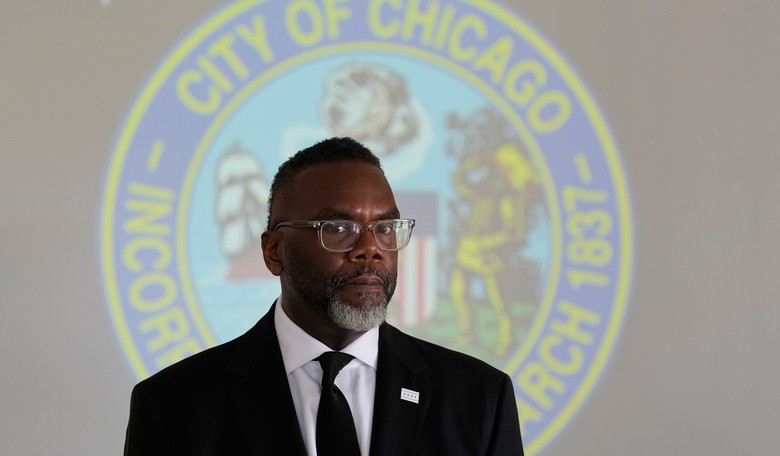
Speaking of which - you guys all know Chicago's Bear of Little Brains, Mayor Brandon Johnson, has been a favorite subject of mine ever since the teachers' union tool got himself elected to his current gig. The Bear's a fragile human being, possessing a minimalist intellect, an oversized ego, and an outsized sense of his own importance.
On top of being a flaming racist.
Quite the package.
I've been posting since the Bear took over about the city's increasingly dismal financial state, and it wasn't all his fault. The risible Lori Lightfoot left Chicago on less than solid footing, but Johnson has turned that into not-quite-set Jell-O. One good shake and over the whole thing goes.
But it's budget time again in the Windy City, and Brandon Johnson has turned in his proposals.
Thanks to a great Paul Vallas piece on the Illinois Policy site, you can actually see how a big city nickel-and-dimes mostly businesses, but also their middle class to death. Especially one in the throes of a crisis.
Paul Vallas is a financial expert and sometimes a political candidate, yes. But he's also been the CEO of the Chicago Public Schools, as well as the budget director for the city itself, among the myriad accomplishments on his impressive resume. So this isn't just a slap at Johnson - it's a by-the-numbers takedown, too.
I can hear the cha-ching in my head as these all add up.
...Johnson again wants a head tax, this time $25 per employee per month on companies with more than 125 full-time employees, with an offset credit for employees who work in disadvantaged areas. That’s a $300 annual charge per employee, making it more expensive to employ people in Chicago. He’s proposing this despite a group of 29 aldermen telling him last month that they would not support a head tax.
Johnson also again proposes raising the personal property lease transaction tax on cloud computing and software, which he did last year. The city increased the rate from 11% to 15% as of Jan. 1, 2026. Johnson wants to raise it to 20% next year, a move his office projects would bring in $235 million.
That makes it a major revenue source. It does not make it a tax reserved for the rich — it is not tied to income. A neighborhood business that relies on hosted software is not a technology giant. Neither is a freelancer paying for digital tools.
For larger companies, when a taxable subscription carries an additional charge, that cost can land on the customer. Higher software costs also give employers another reason to reconsider hiring, investment and business-location decisions. Johnson cannot dismiss the concern merely by repeating that the tax is aimed at “big tech.”
So if a firm has more than 125 people, it's going to cost them $3,000 per employee a year.
OUCH
If they use any sort of cloud software for whatever size business (!), the city wants to charge a 20 percent tax on that service (it's already going to 15 percent as of Jan 1).
WHUT
So far, that's incredible.
So small business owners are catching it along with whatever corporations stick it out.
Residents are in for it, too. A 15-cent tax on packages, as if getting stuff delivered wasn't already expensive enough, and you already pay that freight. Chicago wants a cut.
And always his overlords at the union get their geld.
...Some of his proposals reach directly into residents’ pockets. Despite Johnson’s “tax-the-rich” rhetoric, Chicago residents face several new fees and taxes if his budget is passed. The mayor is counting on $18 million from the expansion of the city’s Smart Streets program, which automates ticketing for cars illegally parked in bike and bus lanes.
Furthermore Johnson wants a 15-cent tax on packages, with exceptions for takeout food and medicines, and a higher tax on liquor purchased for off-site consumption. Neither distinguishes a wealthy household from someone living paycheck to paycheck.
The mayor also wants to nearly double the tax on sports betting. Together, his proposed tax and fee hikes would bring in an estimated $427 million.
Meanwhile, Chicago Public Schools remains deeply entangled in the city’s budget choices. Johnson’s proposed a $522 million surplus from tax increment financing districts that would send more than $286 million to CPS. Even though the district has regularly received increases in state funding and property tax revenues and got $2.8 billion in COVID relief, Johnson continues to ask for more.
Vallas says there is little cost-cutting to be found.
...It’s clear that Johnson and his supporters have no appetite for attacking the spending side of the city’s financial crisis, and the City Council has limited capacity to propose its own budget or scrutinize the mayor’s. Neither is there a desire to reduce subsidies to CPS or even evaluate the school district’s spending. The mayor and his supporters want more spending.
Johnson can keep calling his approach “tax the rich,” but a tax should be judged by who pays it and what it costs them. His budget would make everyday purchases, running a business and employing Chicagoans more expensive.
Just 'taxing' all those 'rich' until they cry 'uncle.'
And if others get caught in the middle, well...they have to pay their fair share, too, to help fight the oligarchy.