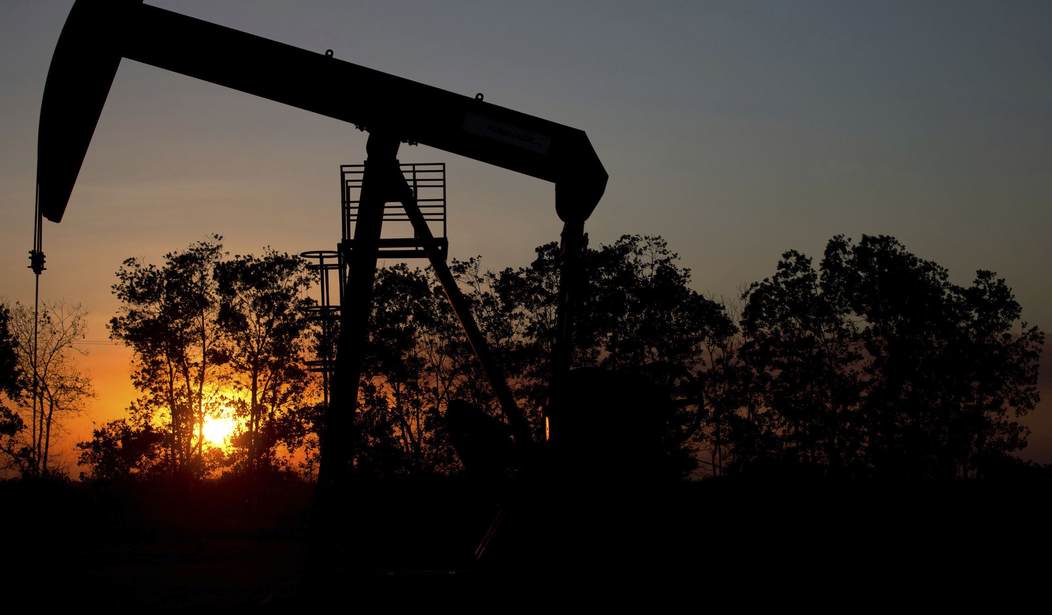
Venezuela.
Bringing that country back into the Monroe Doctrine fold looks as if it's about to pay off spectacularly. And just as the entire region, with only a few snarling commie holdouts hanging on, turns to the United States, freedom, and capitalism after decades of communist and Marxist insurgencies, drug cartel tyrannies, and poverty.
Scoop: The Trump Admin is close to striking a “massive” deal for Venezuelan oil fields that could double U.S. proven petroleum reserves overnight https://t.co/JylD3nqLK9
— Marc Caputo (@MarcACaputo) August 27, 2026
What a time to be an American.
And what a time to be a citizen of a South American country standing on the cusp of a monumental rejuvenation.
If finalized, the arrangement would mark a structural evolution in the White House’s "Energy Dominance" paradigm. Initially focused on domestic deregulation, pipeline expansions, and maximizing shale output, the strategy is shifting toward direct equity acquisition and resource control within the Western Hemisphere.
A $180 Billion Commitment
The White House’s push for direct equity in Venezuelan oil assets comes at a particularly opportune moment, as supply disruptions, elevated energy prices and broader macroeconomic pressures increase the strategic value of Venezuela’s vast reserves. With the U.S. SPR depleted to historic lows and transit routes in the Middle East under ongoing threat, direct physical control over Western Hemisphere heavy crude offers a strategic hedge.
Converting those paper reserves into physical liquidity, however, faces severe friction. Legacy underinvestment under PDVSA has left the nation's midstream and downstream assets heavily degraded. Even with U.S. capital moving in, companies face a number of operational challenges to produce beyond the current 1.25 million bpd. Energy analysts at Rystad Energy have pointed out that meaningful improvement of nameplate production capacity will require an investment of around $180 billion through the next decade. Even if Caracas were looking to keep current production levels flat, total capex would have to amount to more than $50 billion over the next 15 years.
90 billion bbls of oil (I don't know why - all I can hear in my head is Harry Chapin's Thirty Thousand Pounds of Bananas.). That's an astonishing number and just a minor chunk of Venezuela's proven 303 billion bbls reserves, which are about a fifth of all the known reserves in the world.
We want oil. They need jobs and opportunity.
— Hatman7 (@Hatman19225538) August 27, 2026
Sounds like the perfect place to spread Democracy and Capitalism.
People set free from Socialism/Communism tend to be grateful.
Canada should watch.
Venezuela state media is reporting that two Texas companies - SLB and Hunt Oil - have signed deals with the Venezuelan government's state oil company, Petróleos de Venezuela, S.A. (PDVSA), and that Hunt has also locked in an exploration contract.
The big guys, like Exxon and ConocoPhillips, who've been burned so badly in Venezuela before, are playing it cool for now, understandably leaving the field to smaller, more nimble operators to try their luck.
And it isn't all a rapacious American colonizer coming in after conveniently booting the dictator - there is a revenue-sharing framework already in place.
...Under the framework currently under negotiation, private international firms would handle field development and operational logistics, with a portion of revenues returned to Caracas. According to Axios, Energy Secretary Chris Wright is scheduled to meet with officials in Caracas next week to discuss logistics for accelerating field rehabilitation. However, analysts maintain that short-term production gains will likely remain incremental until broader infrastructure and legal frameworks are stabilized.
One analyst says the best-positioned company to take advantage of the deal if it goes through will be Chevron. Having survived the fire and won multiple rounds against the Maduro government in federal court, Chevron is still active on the ground in Venezuela. So it is perfectly situated to get the ball rolling on the long road to getting these fields up and productive.
🇺🇸🇻🇪🛢️Chevron is reportedly close to adding 2 heavy oil fields to its existing PDVSA joint ventures.
— Jack Prandelli (@jackprandelli) August 28, 2026
Halliburton is separately in talks to invest billions rebuilding parts of Venezuela's oil industry.
The timing lines up with the US Treasury issuing General License 50C on… https://t.co/oyHq4ZrIIU pic.twitter.com/TUL3wfGfZ8
...The timing lines up with the US Treasury issuing General License 50C on August 27, replacing an earlier version and explicitly naming BP, Chevron, Eni, Maurel & Prom, Repsol and Shell as authorized to conduct oil and gas transactions in Venezuela, including with PDVSA.
It's a conditional authorization, not a broad reopening payments must route through designated government funds, dispute resolution has to sit in the US, UK, France or Singapore, and dealings involving Russia, Iran, North Korea, Cuba or China are explicitly barred.
Chevron is the best positioned player here.
It's the only major US oil company still operating in Venezuela, already runs three PDVSA Petróleos de Venezuela S.A. joint ventures, and has the field knowledge and export experience to move quickly.
Venezuela's extra heavy crude is also a natural fit for complex US Gulf Coast refineries built with cokers designed for exactly that kind of barrel, unlike the light shale crude out of the Permian.
None of this happens fast.
Turning a field award into real exports means legal agreements with PDVSA, sanctions compliant payment structures, diluent supply, power and pipeline repairs, and export-terminal logistics.
Years of underinvestment mean production growth here is typically measured in years, not weeks, even once a deal closes.
The caveats matter as much as the news.
This is still an early-stage report, not a signed contract and the fields, investment size, production targets and contract terms haven't been disclosed.
The clearest read: Washington is enabling tightly controlled re engagement with Venezuelan oil and whether it becomes investable production growth depends entirely on the contracts that follow.
Besides locking on oil for the country, another benefit to unleashing the power of a free and economically viable Venezuela is taking shape - the country is considering withdrawing from the Organization of Petroleum Exporting Countries (OPEC), in what might almost constitute a body blow for the beleaguered oil cartel.
Having lost the United Arab Emirates in April, and with other OPEC members (like Qatar) chatting among themselves about their exit plans, Venezuela pulling out might well be the straw that breaks the Saudi camel's back.
Venezuela is considering whether it should quit OPEC, according to people familiar with the matter, potentially delivering a fresh blow to the oil cartel it helped create more than six decades ago.
The idea of an exit has been a topic in conversations with US officials, and no final decision has been made, said some of the people, asking not to be identified discussing private information.
A decision to pull out of the Organization of the Petroleum Exporting Countries would underline the sweeping political realignment in Caracas since President Donald Trump ousted the longtime leader Nicolás Maduro and took control of the nation’s oil sales.
Washington’s growing influence is also reflected in US talks with Venezuelan leaders to take a large stake in the nation’s oil fields — a development that would have been unthinkable just two years ago.
Negotiators from both countries are discussing that proposal, according to people familiar with the matter who asked not to be identified because the discussions are private. Some of them said a possible arrangement that has been discussed is a 100-year-lease on several oil fields.
As energy analyst David Blackmon said, Trump is closing in on the biggest energy security deal of all.
🚨Trump’s Biggest Energy Deal Yet Is Taking Shape in Venezuela 🚨
— ⚡️David Blackmon⚡️ (@EnergyAbsurdity) August 28, 2026
President Trump has already locked down major 2nd-term wins on rare earths, nuclear, and critical minerals.
Now he’s closing in on the biggest prize of all: a direct U.S. stake in Venezuela’s oil fields with the… pic.twitter.com/t6GkThTdUp
...Key points:
- Fields previously controlled by former Venezuelan insiders (some now indicted) and Chinese interests
- Private U.S. companies would develop the assets and send more revenue back to Caracas.
- Talks led by Secretary of State Marco Rubio and interim President Delcy Rodríguez.
- Energy Secretary Chris Wright may travel to Caracas next week Details still being hammered out.
- The deal could still fall apart but the very fact it is under discussion is an astonishing development no prior American president would have envisioned.
This is the logical next chapter after the January removal of Nicolás Maduro. Venezuela’s oil sector was wrecked by two decades of socialist mismanagement under Chávez and Maduro.
American capital and know-how can reverse that decline while securing heavy crude for U.S. Gulf Coast refiners and locking in Western Hemisphere energy dominance....
...If this lands, it will be a generation-defining energy security win, bigger than the rare earth and nuclear deals that preceded it.
This is #EnergyDominance in the Western Hemisphere. #DrillBabyDrill goes international.
This is yuuuuuuuuuuuge.
And once again, Marco Rubio is smack in the middle of it all - the best Secretary of State since John Quincy Adams or William Seward, I swear.
What a brilliant pick by Trump.
What a brilliant move by voters on November 5, 2024, huh?
It was YUGE.
And just as this was about to post, word came that the deal was DONE.
The US and Venezuela have agreed to a deal that would give Washington a major stake in Venezuela’s oil reserves, President Donald Trump said Friday.
“At my direction, Secretary of State Marco Rubio, and Secretary of War Pete Hegseth, working closely with Highly Respected Interim President of Venezuela, Delcy Rodriguez, and, through a partnership with private business, have secured majority U.S. control of more than 65 BILLION BARRELS of proven Oil Reserves in Venezuela, at no cost to the American Taxpayer,” Trump said in a post on social media.
The total volume cited by Trump exceeds the entire domestic US endowment of proved reserves. The president didn’t disclose the percentage of those under US control.
The announcement comes amid a worldwide race to secure oil supplies disrupted by the war in Iran, and as Trump confronts voter concerns about gasoline prices and inflation ahead of the November midterm elections.
But not without a WAAH for the record.
...The president’s plan represents an unparalleled modern-day intervention into another country’s economy, hearkening back to British government control of Iran’s oilfields and the division of Iraqi assets among US and European nations a century ago.
It’s also an untested maneuver — one that could be vulnerable to legal challenges and political shifts in Washington. It’s not clear that Trump’s arrangement would be fully embraced by a future American president, or how it might endure any future political upheaval in Venezuela.
Although I'm not sure that the colonial British were ever reinvesting and profit-sharing at this rate.
...“For the Venezuelan people, this deal will bring nearly $100 billion in private investment, support thousands of high-paying jobs, and drive the reconstruction of Venezuela’s economy,” Rubio said Friday evening in a post on X.
This deal is a huge win for both the American and Venezuelan people.
— Secretary Marco Rubio (@SecRubio) August 28, 2026
It demonstrates how President Trump's bold foreign policy is driving America First wins: securing stable reserves and low-cost oil in our Hemisphere and lowering gas prices here at home.
For the Venezuelan… https://t.co/SMSRYGWmVb
I'm going to have a cocktail.
Happy Friday.
Now, Sail Away.
Editor’s Note: Thanks to President Trump and his administration’s bold leadership, we are once again respected on the world stage, and our enemies are being put on notice.
Help us continue to report on the administration’s peace through strength foreign policy and its successes. Join HotAir VIP and use promo code FIGHT to receive 60% off your membership.









Join the conversation as a VIP Member