It's hard to believe that one of my favorite movie comedies, eh-vah (and admittedly, one of the silliest), is thirty years old.
In 1996, Down Periscope with Kelsey Grammer, Rip Torn, Bruce Dern, and Rob Schneider was released. It had a hilarious cast of occasionally foul-mouthed misfits, bringing to life an innuendo-packed fantasy script about a maverick submarine captain given that fabled 'one last chance to be a hero' against an avenging, unhinged admiral in a war game of the Norfolk, VA, coast.
Naturally, he didn't have a menacing, new, Dallas-class submarine or a battle-tested crew that had recently won a fleet award.
One of the more famous lines is when a prospective crew member sees the rusting hulk they're assigned to.
WHO ARE WE RESCUING? GILLIGAN?
The Stingray's a sad remnant of an earlier age.
And yet, for a pitiful bucket of rust and all the misfit recruits the admiral thought he'd saddled Lt Commander Dodge with, the Stingray triumphs in the end.
Oh, it's a gut-busting, underdog, feel-good movie.
If only British submariners could have that same, happy ending, even if it by necessity didn't come with Lauren Holly's button tight shirts and goofy Minnie Mouse heels.
The British have the buckets of rusty submarines, alright, but, as far as their hunter attack capabilities, they'd have to be able to get at least one of them in the water.
Embarrassingly enough, that's not possible right now.
Not a single one of their attack submarines is seaworthy.
All five of the UK's operational Astute-class nuclear attack submarines are currently stuck in port awaiting maintenance or repairs, while a sixth Royal Navy boat has yet to become deployment-ready.
— Clash Report (@clashreport) June 7, 2026
Former naval commanders warn the situation weakens Britain's ability to deter… pic.twitter.com/zceIGeSsKi
...Former naval commanders warn the situation weakens Britain's ability to deter and monitor Russian submarine activity.
TOOTHLESS
How on Earth does this happen to the nation of Nelson?
The Navy’s entire available fleet of nuclear attack submarines is stuck in port, leaving Britain vulnerable to Vladimir Putin’s underwater fleet.
All five of the UK’s Astute-class hunter-killer boats are awaiting maintenance and repairs. A sixth, which was commissioned into the fleet, is not yet ready to deploy.
Naval commanders have said the situation makes the UK look “toothless” in the eyes of Russia, which has ramped up naval activity around British waters by a third in the past year.
Cdr Ryan Ramsey, a former nuclear submarine captain, said the lack of available attack boats was a “serious wake-up call” for Britain.
Urging Sir Keir Starmer and “major industry players” to “get a grip”, he told The Telegraph: “We look toothless. The Russians know we can’t put submarines to sea.
So help me, I think this is more fodder for Trump's anti-NATO cannon.
In the submarine world, one hand washes the other.
...“The attack submarines are fundamental for looking after our ballistic missile submarines,” he told the Daily Mail. “They are fundamental for frightening and terrifying the Russians.”
Why this is such a devastating setback for the island's protection, and so utterly cringe-inducing, is explained in this piece on the doctrine the British have used for decades to protect the island from underwater incursions by the Russians. It's called the Continuous at Sea Deterrent (CASD).
CASD is even more critical now because Britain is alive but almost utterly dependent on the European continent today. With all the information. communication, cables, and especially energy pipelines that are running through the Channel, the security of that waterway should be one of the nation's top priorities instead of, like, regulating cow farts.
Historical Foundations: The Continuous At Sea Deterrent
— MtarfaLee (@MtarfaL) June 7, 2026
2/25 Since the commissioning of the first Resolution-class Polaris submarine in 1969, the United Kingdom has maintained the Continuous At Sea Deterrent (CASD). Today involves at least one Vanguard-class SSBN on patrol at… pic.twitter.com/ZaGDjIzo3w
...Today involves at least one Vanguard-class SSBN on patrol at all times, providing a credible minimum nuclear deterrent against existential threats the CASD capability goes far beyond the SSBN and it a truly grand strategic endeavour). For over five decades, this unbroken commitment has been a bedrock of British defence policy, ensuring strategic stability even during periods of heightened global tension. The patrols, conducted in utmost secrecy, represent one of the most demanding operational commitments in modern military history.
The SSN Contribution: Punching Above Our Weight
— MtarfaLee (@MtarfaL) June 7, 2026
3/25 Complementing the SSBN deterrent has been the fleet of nuclear-powered attack submarines (SSNs), or hunter-killers. These vessels offer unparalleled stealth, endurance measured in months rather than days, and multi-role… pic.twitter.com/LRMetYzWFy
...These vessels offer unparalleled stealth, endurance measured in months rather than days, and multi-role versatility including anti-submarine warfare, intelligence gathering, special forces insertion, and land attack with Tomahawk missiles. They have enabled us (the UK) as a medium-sized power with limited overall resources, to exert disproportionate strategic influence across the globe and within NATO alliances.
When fighting cow farts wins, this is what you lose. You can't begin to punch at strength anymore, let alone mind above it. And you most surely cannot keep up with your NATO commitments.
It's one mortifying, terrifying thing after another for the navy that once owned the Seven Seas and spawned a mighty, worldwide empire.
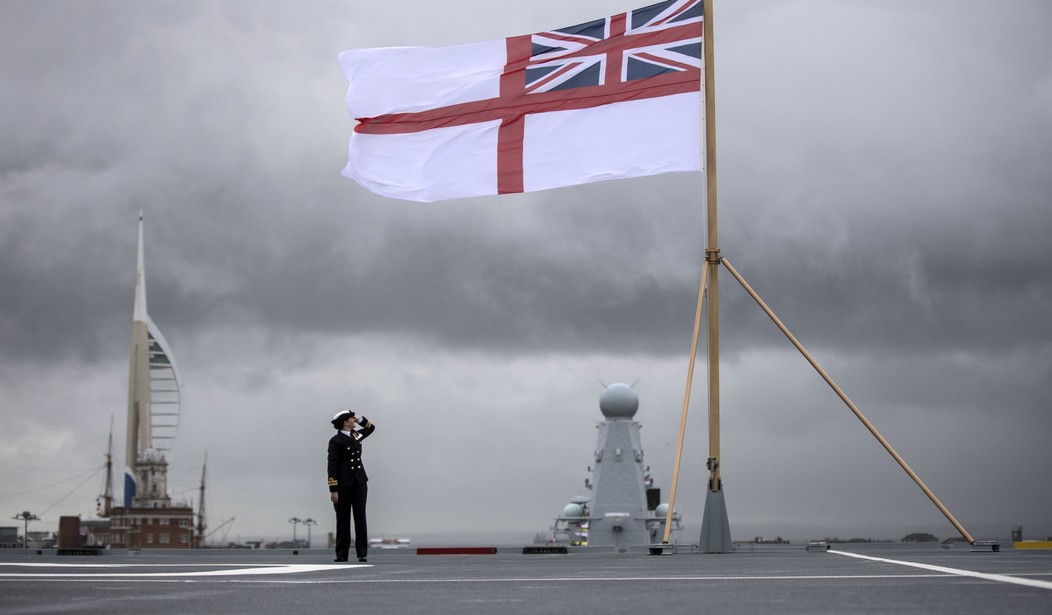
Their pride and joy, the aircraft carrier HMS Prince of Wales, had finally steamed out of a massive overhaul to lead what passes for a British carrier group (they don't actually have enough ships to fill out a real one) for a NATO exercise when more problems - 'technical' glitches - popped up, and the carrier found itself berthed in Norway.
The Royal Navy has a problem—or, more accurately, many problems. For one, it has more admirals in service than actual warships. The British vessels that are still active are aging and are increasingly unreliable or barely operational, and their eventual replacements are in many cases running years late.
However, the biggest problem the Royal Navy faces is that neither of its two conventionally-powered aircraft carriers can be considered ready to deploy at a given time. The main problem is that the UK simply does not have enough escort vessels to form a “carrier strike group,” and must rely on foreign partners to protect its vessels. But on an even more fundamental level, the inability to protect the carriers does not matter if they cannot get to sea in the first place.
HMS Prince of Wales, the current flagship of the UK’s senior service, is now sidelined in Stavanger, Norway, where engineers are seeking to address a “technical defect,” Navy Lookout first reported on Saturday. What was described as a “minor technical issue” was spotted while the flattop first made a port call to Stavanger earlier last month, but it wasn’t significant enough that it required the cancellation of HMS Prince of Wales’ participation in the 10-day Dynamic Mongoose (DMON26) drills, the first phase of the planned Operation Firecrest joint NATO exercises.
However, the carrier has since returned to the port for repairs, which could take longer to address than previous estimates. It will likely lead to the cancellation of the Prince of Wales’ port call to the Danish capital city of Copenhagen.
“The ship could still sail if required but the decision has been taken to carry out the repair now to ensure availability in the future,” Navy Lookout added.
That's kind of embarrassing.
In a recent little snippet of good news, the Ministry of Defense announced HMS PoW was back at sea, with repairs taking less time than originally thought. But since no one believed them, they were forced to issue 'proof of life' photos of the ship in the open water, and you know everyone at the Admiralty is holding their collective breaths.
The UK Carrier Strike Group has released new images confirming that one of the Royal Navy’s largest warships, the aircraft carrier HMS Prince of Wales, is back at sea, marking its return to operational activity following recent naval movements in the North Atlantic and High North.
The UK Carrier Strike Group has shared the imagery showing the 65,000-tonne aircraft carrier back underway, following announcement from the Ministry of Defense that the warship experienced a “minor technical issue” during a port visit to Stavanger, Norway.
According to the MoD, the issue was identified while the aircraft carrier was docked as part of its deployment across the North Atlantic and High North, where the UK Carrier Strike Group is conducting operations in coordination with NATO and the Joint Expeditionary Force.
Oh, look - it's alive!
Let’s hope those engines by BAE don’t break AGAIN
— JT (@JTWH2016) June 9, 2026
With hearty skepticism peppering the comments, as you can see.
'Fresh humiliation' is also a fan favorite.
SECOND BOTTOM TO ICELAND
In the 18th and 19th centuries Britain rose to a position in which it controlled the world’s oceans. Now it has emerged that the Royal Navy’s entire available fleet of 5 nuclear attack submarines are stuck in port awaiting maintenance. 😳 🤦♀️
— Gail Kirby (@GailKir94323570) June 8, 2026
Britain is second bottom in a NATO… pic.twitter.com/bH3AHSJh01
...Britain is second bottom in a NATO league table based on the extent they are meeting their rearmament promises. We are 31 out of 32 countries, just above Iceland.
This doesn't get fixed overnight. There's no magic wand that can materialize a new submarine or more frigates (they only have five) or even, starting with what they do have, clear up the obvious problems in their rework facilities.
Why is the maintenance so slow and appallingly atrocious?
The British Navy is a joke now - a sick, sick joke. One that becomes desperately unfunny the second someone actually really needs the British Navy to have a boat in the water.
Not a happy ending in sight.
This decline was a choice made by British governments well before Keir Starmer ever moved into 10 Downing Street, and it has no doubt been masked by the largesse of the American people and our bolstering of NATO purse strings for so long. That allowed these governments in the British Isles and in Europe to divert spending to everything but defense, because no matter what they let lapse or rust, the US was there with a checkbook, or personnel and equipment to cover for the obvious holes.
The biggest ones are only now appearing as our checks disappear.
Like a sinkhole where the patio just went, the living room is next, and all you can hear from the kitchen is something about snausages.
Editor's Note: Thanks to President Trump and War Secretary Pete Hegseth's leadership, the warrior ethos is coming back to America's military.
Help us report on Trump and Hegseth's successes as they make our military great again. Join HotAir VIP and use promo code FIGHT to receive 60% off your membership.













Join the conversation as a VIP Member