I've been pretty fascinated by a seemingly stray remark that Putin made during last Saturday's Victory Parade in Moscow. Putin said that the Ukrainian conflict “was coming to an end.”
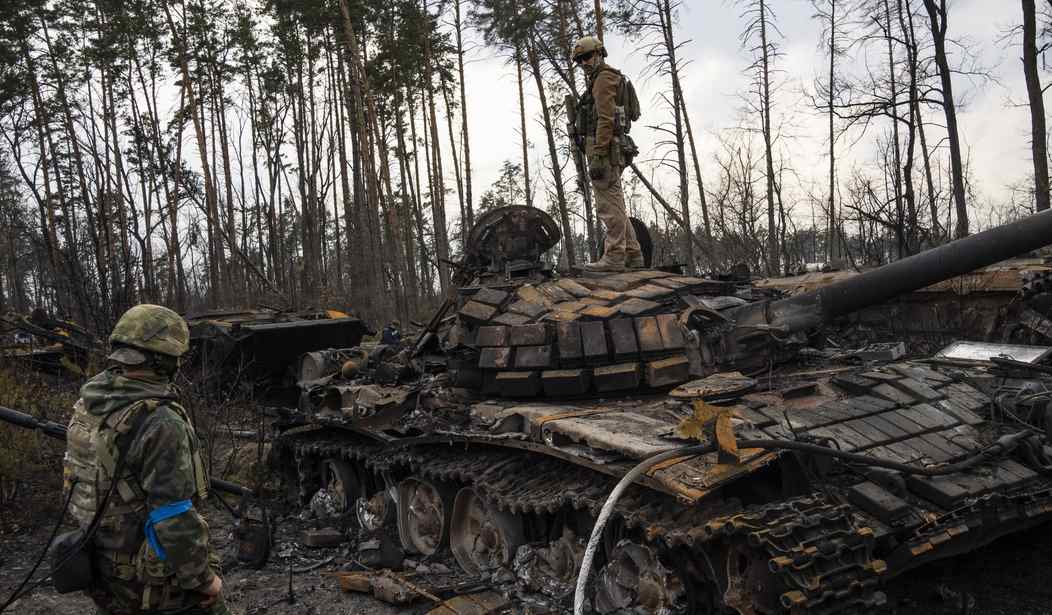
Since then, Putin has made a bunch of efforts to look tough (testing a new tactical nuke) and to back away from any suggestion that he's softening his stance on "de-Nazification" of Ukraine. And yet, as I suggested here, there are lots of reasons to think that Putin really is under immense pressure right now. Things are not going well for Russia on the battlefield and they aren't going well for the economy either.
Today, I learned of another bit of evidence which seems to confirm that Putin really is serious about ending the war in Ukraine, and not with a nuclear weapon. But Putin has a big problem in trying to climb down from this particular tree. He has invested the entire Russian economy and about 350,000 Russian lives in the promise of victory.
Vladimir Pastukhov, Russian political scientist and honorary senior research fellow at University College London, said that Putin faces a quandary: The Russian public is tired of the war but also wants to win.
“This phrase signals that internally they are genuinely entertaining the prospect of ending the war — seriously enough, in enough detail, that they felt it necessary to quietly signal to society that such a scenario is theoretically possible,” Pastukhov said. “It doesn’t mean he intends to end the war on just any terms, or that he’s firmly decided anything.”
In making a decision, however, Putin must confront the conflict in public expectations, he said: “People want the war to end, but they still expect victory.”
People are tired of the war but still expect victory. Put another way, Putin can't admit defeat but what he's actually achieved doesn't look like the kind of victory he promised. So what can do? The answer being considered now in Moscow is hot to redefine an "image of victory" that can be sold to the public.
According to a report by the Dossier Center, an investigative group founded by exiled Putin opponent Mikhail Khodorkovsky, the Russian administration has begun developing what it calls an “image of victory” — narratives designed to sell Russians on a peace deal despite high casualties and minimal territorial gains.
Here's what what the Dossier Center reported last week.
"WE MUST KNOW WHEN TO STOP. Too much is a defeat; continuing the SVO would be a Pyrrhic victory," read one point of a presentation shown to a small group of Sergei Kiriyenko's confidantes at Staraya Ploshchad in late winter 2026.
The SVO is the special military operation, i.e. the war. The Staraya Ploshchad is the place in Moscow which used to be the headquarters of the communist party and now is the executive office of the President. It's where Putin's propagandist hold meetings to work out their plans.
As Dossier learned from a source close to the presidential administration, those at Staraya Ploshchad are seriously concerned about the developments at the front and in the economy, so the curators of the political bloc have been tasked with developing informational support for a possible end to the war. The presentation, which Dossier has seen, states that continuing the war in Ukraine may require a reconsideration of "fundamental positions"—a general mobilization and a complete transition of the entire economy to a war footing...
The document highlights the risks of continuing the war: resource depletion, the need to raise taxes, business cuts, the threat of drone attacks, deep-seated strikes, and terrorism, a demographic crisis, the displacement of Russians by migrants, and the possibility of losing to the US in the re-division of the new world order.
In other words, continuing the war could be catastrophic. The other alternative is a peace deal where Russia mostly settles for what it has.
The Presidential Administration anticipates the possible signing of agreements between the US and Russia and the US and Ukraine, according to which the territories of the Donetsk and Luhansk regions would be transferred to Russia, and the division of the Kherson and Zaporizhzhia regions would be fixed along the front line (Russia currently controls approximately 75% of these regions). Russian troops would be withdrawn from the Sumy and Kharkiv regions, European sanctions would remain in place, and American sanctions would be lifted. "Denazification," the document states, would be merely symbolic, and Ukrainian President Volodymyr Zelenskyy would remain in power.
If this is accurate, then Putin is really responding to the pressure he is under. He's looking for an off-ramp because continuing this has finally become too costly. But, again, having promised complete victory for so long and at such a high cost, how do you back down?
The biggest problem is what is referred to as the "Z-community" the hardliners who are sold on a complete military victory. Those people need to be emotionally retrained:
The Z-community is considered the most problematic audience—the document describes them as extremely emotional "armchair patriots" who did not participate in the war themselves and are overly focused on taking Kyiv. To neutralize this audience, the PA plans an "emotional retraining" of the Z-bloggers under its control and support for moderate voices in the media. The rest will be threatened with liability for discrediting the army. Judging by the document, if peace is signed, "ultrapatriots" in public rhetoric could transform from the mainstay of the government into enemies of Russia, demanding a war of attrition. The presence of Z-bloggers in the media is planned to be reduced, and the most radical ones will be marginalized. Those who, as the AP puts it, devalue the victory, are planned to be “written out” from the patriots.
So all of the goons who've been supporting this war all along will suddenly disappear from Kremlin controlled media. Those who refuse to tone down their rhetoric with be framed as enemies of Putin's great victory over the west.
None of this is directly connected to negotiations for peace in Ukraine. In fact, Putin hasn't tied himself to anything really and could back away from this the moment it suits him. But it does show two things 1) that Putin really is planning for a way out of his own mess and 2) how Putin will handle the pro-war patriots who have spent 5-years supporting him once they are no longer needed.