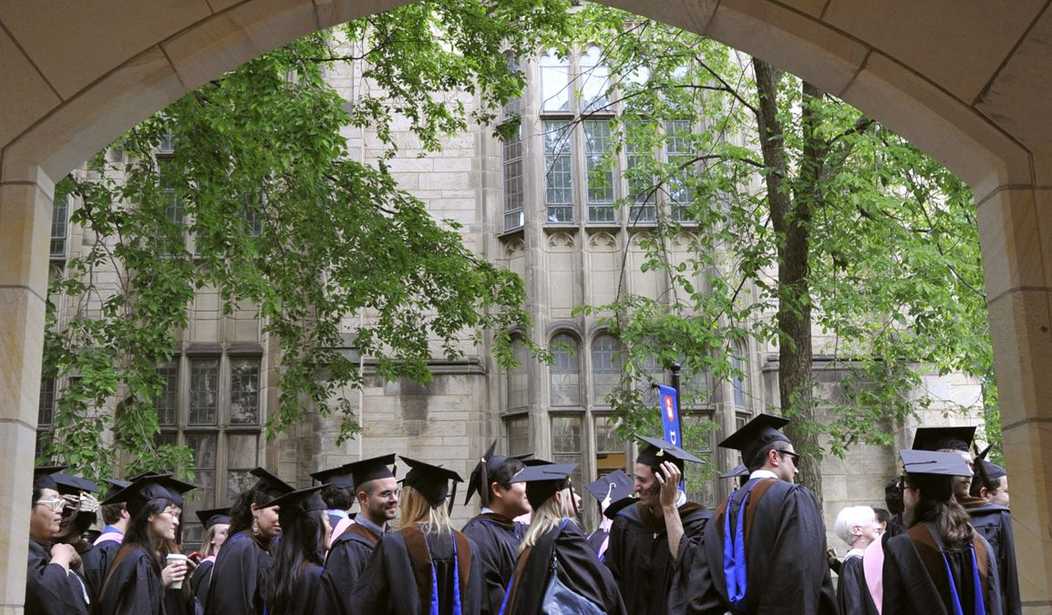
It has been three years since the Supreme Court ruled against affirmative action in college admissions. But by the following year there was evidence suggesting that some schools might be cheating, i.e. finding other ways to circumvent the court's decision. As I described here back in 2024, it all came down to the percentages of incoming classes by race which, at some schools, didn't change after the decision.
Plaintiffs in the Supreme Court case expected black enrollment to drop and Asian enrollment to surge if affirmative action was eliminated. And significantly, many of these Ivy League schools argued the same outcome was inevitable if affirmative action were overturned in amicus briefs they submitted to the court. Yale in particular said there was no way to maintain current enrollment levels without affirmative action:
In a joint amicus brief that the University submitted to the Supreme Court, Yale argued that racial diversity would not be possible without directly considering race. Yet, Yale’s class of 2028 did not see a dramatic decrease in diversity as the University predicted it would.
The amicus brief stated that “no race-neutral alternative presently can fully replace race-conscious individualized and holistic review to obtain the diverse student body Amici have found essential to fulfilling their missions.”
But Yale's enrollment numbers didn't really change and one UCLA law professor directly accused the school of cheating.
“What Yale is doing is either they’re reporting a very misleading number or they’re cheating in some way,” Sander wrote to the News. “If their race numbers really don’t change, I think that means that they’re looking for any evidence they can find that a student is African American or Black, and they’re admitting them under the same criteria they were before.”
Other outside observers reached the same conclusion:
“They’re cheating. Everyone knows they’re cheating. They know they’re cheating. What they are trying to do is cheat in a way that doesn’t get them caught in court.”
That was John Yoo’s response when I asked for his reaction to the racial breakdown of freshmen at some of the most selective U.S. colleges and universities...
Citing data from the College Board, which administers the SAT, Nicholas Lemann recently wrote in the Chronicle of Higher Education that in 2023 “the gap between average Asian and Black test scores on the SAT was more than 300 points, and . . . nationally, fewer than 2,300 Black students got combined scores of 1400 or above, which is generally considered what a student needs to be admitted to an Ivy Plus school.” Nevertheless, black enrollment at Duke, Yale and Princeton was essentially flat this year...
All of that is the backstory for something that happened today. The Department of Justice has concluded that Yale's Medical School has been using race in admissions, contrary to the Supreme Court's 2023 decision.
After a year-long investigation, the Justice Department concluded that Yale School of Medicine discriminated based on race in its admissions, favoring Black and Hispanic applicants over White and Asian ones, the agency said Thursday.
The department requested documents from Yale to determine whether its admissions practices were in compliance with federal civil rights law, and determined that the medical school “continues to intentionally discriminate against applicants based on their race,” despite a 2023 Supreme Court ruling rejecting race-conscious affirmative action in college admissions.
As is often the case with stories like this, the summaries offered by newspapers like the NY Times are heavy on rationalizations and light on details.
Spokeswomen for Yale and its medical school did not immediately return a request for comment. But many in academia have argued that the Trump administration is imposing an incorrect interpretation of the ruling, and that the Supreme Court decision allowed for schools to consider race while weighing factors beyond test scores, such as character or personal growth.
This kind of holistic review process is viewed by the Trump administration as a workaround. In a six-page letter describing her findings, Ms. Dhillon said Yale was using holistic reviews “to uncover and then use applicants’ race through direct and indirect means. It then conducts interviews that enable the committee to know applicants’ race and ethnicity.”
The Times is practically putting words in Yale's mouth. And while they do link to Dhillon's letter, they don't expend a lot of effort relaying the details. There's a reason for that. The details suggest that Yale was intentionally cheating and also intentionally hiding that fact.
After the Harvard decision, Yale’s documents include references to increasing student diversity using means other than admissions selections.2 An updated 2024 admissions guidance presentation has a slide with only the words “Admissions post-SCOTUS.”3 This suggests that admissions personnel are given verbal instructions during this presentation encouraging the use of race/ethnicity in admissions, and such instructions are not put in writing. Yale has also redacted for privilege (without explanation) several documents on this topic that are dated after the Harvard decision,4 including a document labeled “Guidance on Consideration of Race Updated 8.15.25.”5...
The Department also has evidence that Yale attempted to circumvent the Harvard decision by using racial proxies to indirectly discriminate against applicants based on race. This intent is confirmed by our data analysis below showing no change in racial disparity between admitted students before and after the Harvard decision.
As mentioned above, they also found clear evidence that applicants were held to lower or higher standards depending on their race.
As with the incoming classes of 2023 and 2024, the Median MCAT scores for the incoming class of 2025 exhibit significant differences across racial lines. Black and Hispanic scores declined to the 94th and 95th percentile, while White and Asian scores increased to the 100th percentile...
The applicant-level data produced by Yale indicate that a Black or Hispanic student has a substantially higher likelihood of being offered admission than a White or Asian student with the same academic credentials. This consistent difference in the test scores between students of different racial groups is substantial and cannot be explained by a coincidence. Based on our preliminary review of the applicant-level data, Yale’s use of race resulted in a Black applicant being as much as 29 times higher odds of getting an interview for admission than an equally strong Asian applicant with similar academic credentials.
Why would the NY Times skip over all this damning information in its coverage of this story, instead relying on readers to follow a link and find it for themselves? I think we all know the answer to that one.
Editor’s Note: Help us continue to report the truth about corrupt politicians.
Join HotAir VIP and use promo code FIGHT to receive 60% off your membership.










Join the conversation as a VIP Member