








This story is a ball of snakes that stretches back about 2 1/2 years and is still making news this week. I don't think it can be summarized very easily so, if you're not already familiar with it, you're going to have to just read along. I'm going to start at the beginning and work my way to the present because without some background the news this week won't make any sense at all.
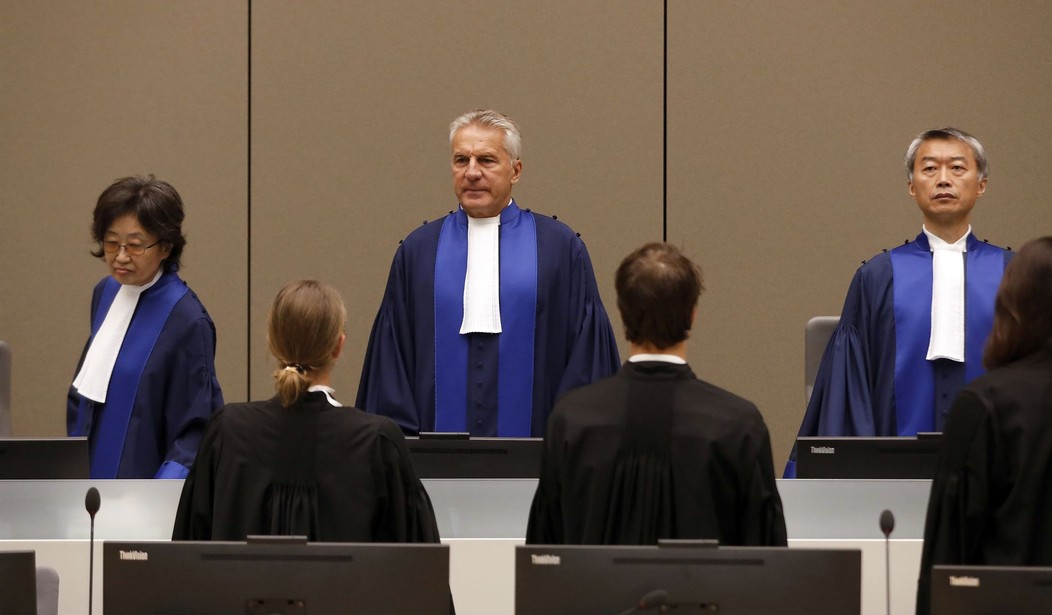
The central figure in this story is Karim Khan a British lawyer who works for the ICC. Khan is best known for two things: First, he's the lawyer who issued arrest warrants on behalf of the ICC for Israeli leaders including Benjamin Netanyahu. So, for instance, when Zohran Mamdani suggests he'll arrest Netanyahu in keeping with international law, he's referring to Karim Khan's work.
BREAKING: NY State Assemblyman Zohran Mamdani who is now running to be NYC mayor says that he would arrest Netanyahu if he enters NYC.
— Eyal Yakoby (@EYakoby) November 26, 2024
This lunatic thinks he can arrest a foreign head of state, when the U.S. isn’t even a party to the ICC. pic.twitter.com/muomlmiDxR
The other thing Khan is known for is the allegations of coerced sex which were leveled against him by a younger lawyer who worked with him.
Two months after the Hamas attack of Oct. 7, pressure was mounting on Karim Khan, the chief prosecutor of the International Criminal Court, as he considered charges against Israeli officials for their conduct of the war in Gaza.
Pro-Palestinian activists who had labeled him a “genocide enabler” and a bloc of ICC member countries in the developing world insisted that action was long overdue, pushing Khan into conflict with Israel’s staunch allies in Washington and other Western capitals.
Khan, a hard-charging British lawyer, was in New York in early December 2023 for the court’s governing body meeting at United Nations headquarters. Stung by the criticism, the 55-year-old prosecutor was increasingly lashing out at his team, according to ICC officials.
One assistant, a woman in her 30s who often traveled with him for her job, asked to meet with Khan to urge him to ease up. He called her that evening to his corner suite high in the Millennium Hilton hotel next to the U.N.
There, she said in testimony to U.N. officials, Khan began to touch her sexually, a pattern of behavior that she said had been going on for months.
She said she attempted to leave the room several times, but he took her hand and eventually pulled her to the bed. Then he pulled off her pants and forced sexual intercourse, according to the testimony.
This story (allegedly) played out multiple times with the woman, who is married, trying to leave and Khan, who is also married, dragging her toward his bedroom in locations around the globe. Khan would eventually deny all of this.
The lawyer, who was from Malaysia, claims she didn't quit the job for multiple reasons, including needing the money to pay for her mother's medical care, fearing retaliation from Khan and being invested in the work he did at the ICC. In particular, she was eager to see Israel targeted by the ICC.
So the two things Khan is known for became intertwined. Because he learned that the woman had accused him of sexual misconduct just 2 1/2 weeks before issuing the arrest warrant for Netanyahu. Khan denied the two things were related, but the woman lawyer says he used the promise of the warrants to get her to back off her story.
The warrant shored up support for Khan among anti-Israel ICC nations that would likely back Khan if the allegations ever became public, according to court officials. The warrant also discouraged his accuser for a time from pushing her allegations, officials said, because she strongly supported the investigation of Israeli leaders.
As the abuse allegations were swirling among ICC staff and others, Khan allegedly tried to get his accuser to disavow them by telling her the charges would hurt the Palestinian investigation, according to her testimony.
The casualties of the allegations would include “the justice of the victims that are on the cusp of progress,” he said to her, according to a record of a call that is now part of an independent U.N. investigation into her allegations. “Think about the Palestinian arrest warrants,” she said he told her on another occasion, according to the testimony.
Those (alleged) requests obviously didn't work, but after the allegations against him came out, Khan began claiming that they were part of an effort to undermine his efforts at the ICC.
For a time, Khan remained in his position at the ICC, but after the Wall Street Journal published the story I've just quoted from above, he stepped aside while an investigation into his behavior was undertaken.
And that's really just the beginning of this story. Last November we learned from news reports that Qatar funded an intelligence operation against Khan's accuser. The goal of the operation was to find some connection between her and Israel which could then be used to undermine her credibility.
The woman who alleges she was sexually abused by the chief prosecutor of the international criminal court has been targeted by private intelligence firms as part of a covert operation said to have taken place on behalf of Qatar...
Khan, a prominent British lawyer, has denied the abuse allegations and people close to him have suggested the claims are part of an Israel-backed smear campaign in response to his decision in 2024 to obtain an arrest warrant for the Israeli prime minister, Benjamin Netanyahu.
The private intelligence operation was led by Highgate, a discreet company based in London’s Mayfair district. It describes itself as a “strategic advisory firm” that advises chief executives and political leaders to manage “high-stakes issues”.
Working with at least one other firm, Highgate sought to establish connections between the woman and Israel. However, documents seen by the Guardian suggest no such evidence was found.
You can see how this was going to shape up. They would find the woman had visited Israel or had a friend in Israel or something and then use that to insinuate her claims of abuse were part of a Mossad plot. Only there wasn't any plot and the lawyer making the allegations was on Khan's side when it came to the arrest warrants.
Which brings us to this week when the Wall Street Journal did a follow up about the intelligence operation against the accuser.
The new witness statement is by a person familiar with that operation who requests anonymity. We’ve reviewed it along with supporting audio recordings. The statement was submitted to the FBI to request an inquiry and is known to several Members of Congress. It suggests the private intelligence operation also sought to target two Americans: Tom Lynch, the senior ICC official who first reported the assault allegation, and Sen. Lindsey Graham.
But the bigger reveal is that people who were part of the private intel operation knew Khan was being supported by Qatar, i.e. the people funding the operation.
In recordings, private investigators discuss their intelligence operation’s connection to what seems to be Qatar, which they call the “client country.” In writing, one investigator instructs others to say “client” to describe “Q country.” Two sources familiar with the intelligence operation tell us Qatar was ultimately the client...
“I spoke to the client about it,” the intelligence operation’s manager is heard saying in an Aug. 5 recording, “and they weren’t surprised that it had leaked that they were wrapping their arms around him.”
Around “KK”—Karim Khan—a researcher clarified.
“It’s not that long that they wrapped their arms around him,” the manager continued, per the recording and the witness statement. “It’s all in the context of issuing the warrant. That was basically the deal. He was like, ‘I want to issue the warrant, but I’m terrified to do it.’ And they said, ‘if you do it, then we’ll look after you.’”
So, arguably, that came true. Khan did issue the warrant and Qatar then funded the intelligence operation in an effort to look after him. But as mentioned above, it didn't turn up anything because the accuser wasn't a secret agent. The audio recordings also include a member of the intel group saying that the accuser "“didn’t have a Jewish grandmother." Presumably that was the kind of thing they were hoping to find and were disappointed when they couldn't find it.
Meanwhile, the underlying allegations were being investigated. Eventually two reports were produced with different conclusions:
The first report, written by United Nations investigators, found that there was a “factual basis” to allegations of sexual misconduct made against him by a female aide and that witness accounts of the victim “lend support to her claims,” according to a summary of the report viewed by The Wall Street Journal. The report also found evidence that Khan retaliated against two officials who first reported the aide’s allegations to court oversight bodies.
But the second report, by a panel of three judges tasked by the ICC with analyzing the U.N. report, found that the evidence gathered by the U.N. was insufficient to establish the truth of the allegations “beyond a reasonable doubt,” the standard in British and American law for convicting someone of a crime, according to a summary of the report reviewed by the Journal.
Khan was clearly hoping the ICC would accept the findings of the second report and clear him but that didn't happen. On the contrary, earlier this month the members states of the ICC (which do not include the U.S. or Israel) voted to move toward disciplinary proceedings.
A group of African states that have supported Khan argued that the judges’ report exonerated Khan and the disciplinary proceedings should be ended, officials said.
But wealthy nations including Italy and Japan, the court’s largest donor, voted to continue the disciplinary proceedings, officials familiar with the vote said. They were joined by most of the other nations in the 21-member group of diplomats that oversee the court’s operations on a rotating basis.A group of officials from the prosecutor’s office drafted a letter opposing Khan’s continuing to serve as chief prosecutor that was read at Wednesday’s meeting. The letter argued that the legal standard for convicting someone of a crime shouldn’t be used when deciding whether Khan should continue to serve as chief prosecutor.
“We are of the view that the reported (U.N.) findings are incompatible with continued confidence in the prosecutor’s leadership,” said the letter, which was viewed by the Journal.
Finally, the story indicates that a second woman who worked with Khan came forward.
The U.N. investigators also note that another woman who worked as an unpaid intern for Khan in 2009 when he was a defense attorney came forward to speak to them about “adverse experiences of a sexual nature” with Khan, according to the summary.
All of this is reminiscent of other similar situations where progressive heroes get in trouble for their behavior toward women and then immediately position themselves as victims of people trying to undermine their important work. Harvey Weinstein did it when he was first accused, promising to devote all his effort to attacking the right if people could just give him a pass on the allegations. Eric Swalwell did it more recently when he tried to claim the allegations against him were an attempt to knock him out of the governor's race. It really sounds as if Khan and his Qatar backers have been trying to run the same narrative, albeit with little success.
Join the Conversation
VIP members get the ability to comment on articles.