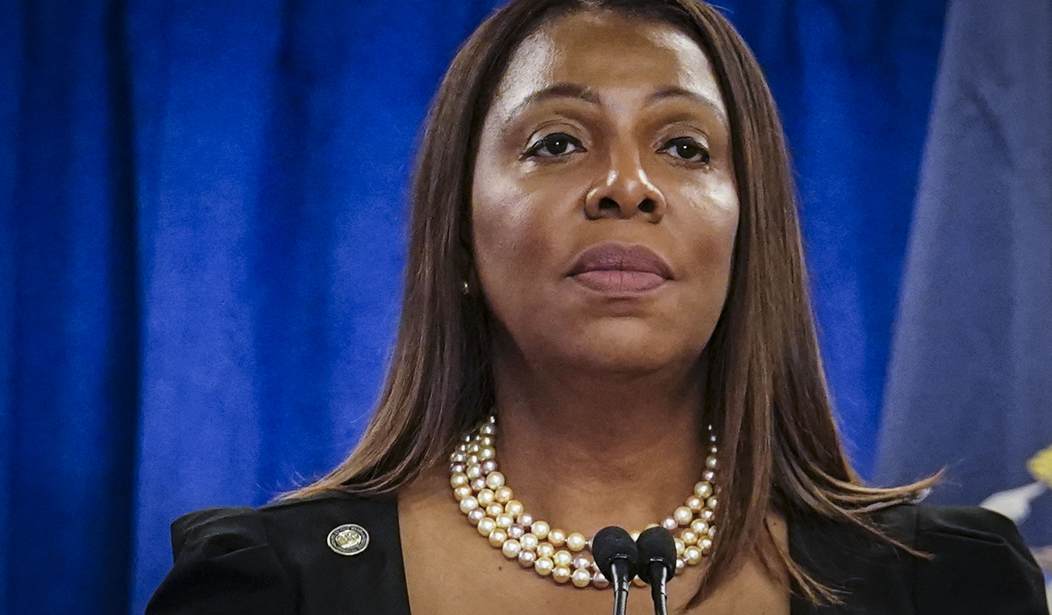
Back in October, New York AG Letitia James was indicted with two charges related to mortgage fraud. But by the end of November that indictment, and one against former FBI Director James Comey, were tossed out after a judge ruled the appointment of Lindsey Halligan as prosecutor was improper. Both cases were dismissed without prejudice.
That left the DOJ with two options. They could appeal the ruling dismissing the two cases or they could essentially start over with a new prosecutor. Yesterday, they attempted to start over on the case against Letitia James but the new prosecutor failed to secure an indictment.
On Thursday, Halligan was not involved in the grand jury proceedings. Instead, the administration recruited a Missouri-based prosecutor, Roger Keller, to handle the case.
The old saying goes that a lawyer can indict a ham sandwich which is a recognition of the fact that the grand jury process is really stacked in favor of prosecutors. In fact, it's extremely rare for a prosecutor to fail to get an indictment. But in this case, the grand jury refused to indict Letitia James.
A grand jury in Virginia on Thursday rejected Justice Department efforts to charge New York Attorney General Letitia James with mortgage fraud, declining to indict her again after a judge dismissed the charges last week, according to two people familiar with the matter, who spoke on the condition of anonymity because they were not authorized to speak about the proceedings...
It is extremely rare for a grand jury to refuse to indict a case. In 2016, for example, the Justice Department brought charges against 130,000 suspects. Grand juries rejected indictments only six times, according to agency statistics compiled by Niki Kuckes, a professor at Roger Williams University with expertise in the grand jury process.
Grand juries work in secret so we don't know what happened here, but we do know that a grand jury doesn't even need to be unanimous to indict someone. Usually all that's needed is a simple majority. So it's not like a trial where a jury needs to be unanimous to convict someone and therefore one ideologically motivated juror could throw the verdict out of whack. In this case they probably just needed 12 out of 23 grand jurors to agree an indictment was warranted. If the prosecutor couldn't get the case over that low hurdle then he probably had no chance of getting a conviction anyway. James' attorney took it as a vindication.
James’s attorney called the grand jury’s refusal to reindict “a decisive rejection of a case that should never have existed in the first place.”
“This should be the end of this case,” attorney Abbe Lowell said in a statement.
But we may not be done yet. An anonymous person connected to the case said the DOJ warned against premature celebrations.
“There should be no premature celebrations,” said a person familiar with the matter, who spoke on the condition of anonymity because they were not authorized to speak publicly, implying that the administration could try a third time to obtain an indictment.
Third time's the charm? That's one option. Or, as noted above, they still have the option of appealing the decision to toss out the initial case. So we'll have to wait and see what comes next but for the moment it appears that Letitia James has dodged an indictment twice.
This isn't the only case being built against James, but the other one also ran into some potential problems this week.
Even as a federal grand jury in Virginia voted down a new indictment, lawyers representing Ms. James’s office appeared before a federal judge in Albany, N.Y., where the Justice Department is pursuing a separate civil rights investigation into her work as the state’s top lawyer. Lawyers for Ms. James’s office are seeking to block the investigation.
That appearance also appeared to have gone poorly for the government. The judge, Lorna G. Schofield, expressed skepticism about whether the interim U.S. attorney overseeing that case was lawfully appointed by the administration — an issue that is becoming increasingly difficult for the president in his quest to use the Justice Department to seek retribution.
While the government sought to argue that the unusual appointment of that U.S. attorney, John A. Sarcone III, was a technicality, a lawyer for Ms. James’s office, Hailyn J. Chen, strongly disagreed, quoting a concurring opinion from Justice Clarence Thomas about the importance of following the law with appointments.
The judge in that case was appointed by President Obama, so it's possible there's a bit of resistance judicial activism taking place here.
Editor’s Note: Do you enjoy Hot Air's conservative reporting that takes on the radical left and woke media? Support our work so that we can continue to bring you the truth.
Join Hot Air VIP and use the promo code FIGHT to get 60% off your VIP membership!







Join the conversation as a VIP Member