
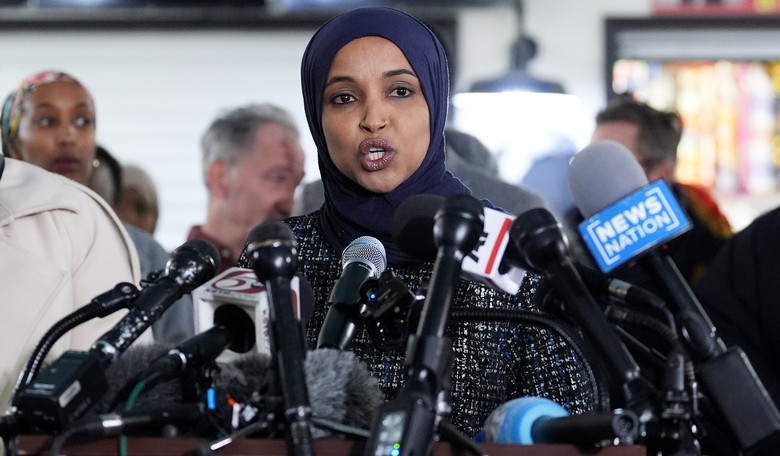
A federal judge unsealed the warrant applications that resulted in searches of a sitting congresswoman's residences. It turns out that Ilhan Omar faces significantly more legal jeopardy than she and her allies have been willing to admit. Or, more accurately, Ilhan Nur Said Elmi is in a deep legal hole that goes back "decades," and at least according to the Department of Justice, has nothing to do with her work in Congress.
That point becomes important in the minutiae of the search. The big picture, as alleged by the DOJ, paints Ilhan Whatshername as the target of investigations into "crimes over decades":
The records unsealed Monday show the government first sought a search warrant in the case on Oct. 2, 10 days before the Trump administration eventually secured the warrant. Dozens of the 169 pages released Monday were redacted entirely. Others contained significant redactions which made much of them unreadable.
The records show that the presiding judge in the case, U.S. Magistrate Judge Matthew J. Sharbaugh, questioned the government about how it would handle the “Speech or Debate implications” of the search.
The Speech or Debate Clause is a provision of the Constitution which gives sitting members of Congress immunity from being charged or even having to testify about anything dealing with “speech or debate” in Congress.
The unsealed document says the government does not think the investigation touches on Omar’s work as a member of Congress at all, and engaged in a weeklong back-and-forth with Sharbaugh about what, if any, alterations to make to the search warrant.
“The United States believes that ILHAN has committed [REDACTED] crimes over decades — beginning long before she was ever in Congress,” one government motion included in the documents says.
The Speech and Debate Clause issues have percolated on the edges of this story ever since the DOJ and Homeland Security raided Ilhan Whatshername's DC residence. The U.S. Constitution prevents the executive branch from investigating the legislative branch's operations with limited exceptions. Courts have given Congress significant consideration in protecting its work products and deliberative materials from executive-branch seizures. Corruption is one exception to this, but even then, courts tread carefully on the separation of powers issue, and usually defer to Congress' authority to investigate itself. The effort to pierce William "Cold Cash/Dollar Bill" Jefferson's congressional privilege became long and complicated even in a corruption context.
The DOJ apparently satisfied Judge Sharbaugh's concerns, with some adjustments to allow for Ilhan Whatshername to identify and protect legitimate legislative work products. That was not the focus of the warrants nor of the investigations anyway:
Federal agents searched Omar's residence as part of an investigation into potential fraud in her family's immigration paperwork, according to earlier reports. The unsealed records do not identify the specific offenses sought. Authorities have issued grand jury subpoenas to some of her relatives, a source close to the matter told the Associated Press last month on condition of anonymity. Attorneys for Omar did not return requests for comment following Boasberg's ruling last week....
The warrant authorized agents to seize papers, records, computers, storage devices and cellphones "registered to or used by" Omar, and to copy and search any of her digital devices under special procedures meant to protect legislative materials, according to a list of items to be confiscated. Three of the seven categories on the list are fully redacted.
In their filings, prosecutors described the planned search as one of a lawmaker's private residence for evidence of "her explicitly private conduct." In a later filing, they told the court that nothing in the affidavit, briefing or oral argument indicated their case "has anything to do with ILHAN's professional life."
The DOJ has since fought to keep the records of the warrant applications sealed, arguing that the information within them would compromise the probes. Sharbaugh initially agreed, but Judge James Boasberg – yes, that Judge Boasberg – ruled this week that redacted portions could be unsealed after media outlets and one "advocacy group" sued to unseal the entire package.
No one has covered the Ilhan Whatshername story as diligently as Power Line's Scott Johnson and Alpha News in Minnesota. Scott calls the partial release of the court filings "a time-consuming distraction," but then parses through the material for an expert analysis of what it means:
• The prosecutors state that they are investigating Omar in connection with crimes that go back to 1980. The investigation must cover a lot of ground. I infer that the issues relate to Omar’s naturalization and citizenship as well as crimes deriving from the use of a false identity.
• Omar now asserts that she was born in 1982. In its current story on the search warrant documents, the Star Tribune states it as a fact, but the reporters have no idea when she was born apart from Omar’s say-so.
• The government identifies Omar as Ilhan Nur Said Elmi Mohamed. I infer that the government has reconstructed Omar’s real family and real name. “Omar” is not in the mix. Contrary to Omar’s repeated statement that she is one of seven siblings, she is one of five and we know who they are (as do the prosecutors). One of them is her brother — the brother she married in 2009 for fraudulent purposes. ...
• Authorization of the search warrant and adjudication of the related issues apart from the media’s petition for unsealing of the search warrant documents and the related docket have been handled by Magistrate Judge Sharbaugh. In his October 9, 2026 sealing order, Sharbaugh found that there are “reasonable gounds to believe the disclosure [of the search warrant documents] will result in flight from prosecution, destruction of or tampering with evidence, intimidation of potential witnesses, and serious jeopardy to the investigation[.]” I know witnesses in the Twin Cities who have been intimidated. That much I can tell you.
That is a thread worth watching. The massive frauds taking place in the Twin Cities, mainly centered on the Somali expat community, have the appearance of an organized crime environment. Ilhan Whatshername has not just benefited from community organization in that area; she has also been its benefactor in Congress. Some people may not want the gravy train to stop rolling out of Washington, D.C. And they might get ugly in attempting to prevent people from interfering with it – which, of course, would be witness tampering and intimidation, another potential crime for the DOJ to investigate.
As for the "decades" in the filing, this sounds as though the DOJ will argue that any alleged crimes resulting from her alleged deceptions around her identity and birthdate were not discrete events, but rather a continuous and ongoing crime. If the DOJ can prove deception in Ilhan's entry and then again in her naturalization, especially relating to her identity, then every instance of using a fraudulent identity becomes another link in a long, long chain.
Warrants are not indictments, of course, and indictments are not convictions. The material unsealed by Judge Boasberg just gives us a look at what the DOJ is pursuing, not whether it found evidence to match its suspicions. Two judges appear to agree, though, that the DOJ had enough probable cause for search warrants on a sitting member of Congress. Stay tuned.