
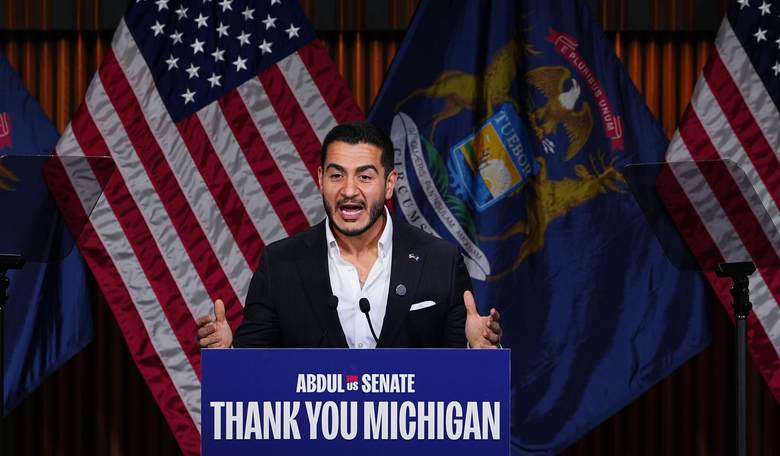
How bad is this argument? Even NBC's Kristen Welker didn't buy it on yesterday's Meet the Press.
Abdul El-Sayed has spent the last several months denying that his opposition to Israel is based on antisemitism. He succeeded enough to win a Senate seat in Michigan over Mike Rogers, and has spent the last couple of weeks on a victory lap in the media. That lap hit an obstacle course when Welker challenged El-Sayed to explain his opposition to Israel as a Jewish state. What follows is gobbledygook of the first order, starting with El-Sayed's unintentional admission that Israeli Arabs enjoy full civil rights in the world's only Jewish state:
El-Sayed: I’m saying that I don’t believe in ethnostates. I’m saying I believe in equal rights to peace, dignity, and self-determination Welker: But, Mr. Senator-elect, 43 countries currently identify with a particular religion. Pakistan, for example, is an Islamic Republic. El-Sayed: Well, I don’t believe in ethnostates generally. I don’t think we should be in the business of funding the military of Pakistan either.
— Acyn (@Acyn) November 22, 2026
El-Sayed: I’m saying that I don’t believe in ethnostates. I’m saying I believe in equal rights to peace, dignity, and self-determination
Welker: But, Mr. Senator-elect, 43 countries currently identify with a particular religion. Pakistan, for example, is an Islamic Republic.
El-Sayed: Well, I don’t believe in ethnostates generally. I don’t think we should be in the business of funding the military of Pakistan either.
Kudos to Welker for anticipating El-Sayed's argument, but she may have focused so closely on the "ethno-state" argument that she missed the clear hole in his response. El-Sayed complains that Gadi Eisenkot wants to form a government without the participation of the two Arab parties that won seats in the Knesset this month. That's actually not true – Eisenkot has said he's open to including them in an arm's-length relationship for a minority government, and Eisenkot has said in the past that he'd be willing to have them as full coalition partners.
That buries the lede, however. The existence of Arab parties and the fact that they routinely win seats in the Knesset demonstrates precisely what El-Sayed claims to prioritize – democracy and human rights. While Israel remains a Jewish state – the only Jewish state in the world, located in the ancestral homeland of the Jews – others can hold citizenship and participate fully in its democratic government, fully invested in its liberal civil-rights legal environment. El-Sayed's complaint is that the tiny minority of MKs from these parties can't dictate policy, which is exactly how democracy works.
As for the "ethno-states" argument, Aviva Klompas offers up a list extending Welker's thoughts. The Islamic states on this list notably lack Jewish and Christian parties, and for the most part, also lack democracy:
El-Sayed insists he opposes ethnostates generally. As in, “Guys, I’m not obsessively fixated on Israel. I’m against ALL ethnostates.” Cool. So how much time has he spent objecting to the national and religious identities of: 🇵🇰 Pakistan — Islam 🇮🇷 Iran — Islam 🇸🇦 Saudi Arabia — Islam 🇲🇾 Malaysia — Islam 🇧🇩 Bangladesh — Islam 🇯🇴 Jordan — Islam 🇪🇬 Egypt — Islam 🇮🇶 Iraq — Islam 🇦🇪 United Arab Emirates — Islam 🇶🇦 Qatar — Islam 🇰🇼 Kuwait — Islam 🇲🇦 Morocco — Islam 🇩🇿 Algeria — Islam 🇧🇭 Bahrain — Islam 🇴🇲 Oman — Islam 🇧🇳 Brunei — Islam 🇲🇻 Maldives — Islam 🇸🇴 Somalia — Islam 🇩🇰 Denmark — Lutheran Christianity 🇮🇸 Iceland — Lutheran Christianity 🇲🇹 Malta — Roman Catholicism 🇬🇧 United Kingdom — Anglican Christianity (England) 🇲🇨 Monaco — Roman Catholicism 🇨🇷 Costa Rica — Roman Catholicism 🇿🇲 Zambia — Christianity 🇰🇭 Cambodia — Buddhism 🇧🇹 Bhutan — Buddhism
— Aviva Klompas (@AvivaKlompas) November 22, 2026
🇵🇰 Pakistan — Islam
🇮🇷 Iran — Islam
🇸🇦 Saudi Arabia — Islam
🇲🇾 Malaysia — Islam
🇧🇩 Bangladesh — Islam
🇯🇴 Jordan — Islam
🇪🇬 Egypt — Islam
🇮🇶 Iraq — Islam
🇦🇪 United Arab Emirates — Islam
🇶🇦 Qatar — Islam
🇰🇼 Kuwait — Islam
🇲🇦 Morocco — Islam
🇩🇿 Algeria — Islam
🇧🇭 Bahrain — Islam
🇴🇲 Oman — Islam
🇧🇳 Brunei — Islam
🇲🇻 Maldives — Islam
🇸🇴 Somalia — Islam
🇩🇰 Denmark — Lutheran Christianity
🇮🇸 Iceland — Lutheran Christianity
🇲🇹 Malta — Roman Catholicism
🇬🇧 United Kingdom — Anglican Christianity (England)
🇲🇨 Monaco — Roman Catholicism
🇨🇷 Costa Rica — Roman Catholicism
🇿🇲 Zambia — Christianity
🇰🇭 Cambodia — Buddhism
🇧🇹 Bhutan — Buddhism
We do business with and subsidize a few of these "ethno-states," including Egypt, where El-Sayed has claimed dual citizenship. There are no Jewish parties in Egypt, nor much political cover for the Coptic Christians that have been targeted and marginalized by the Muslim Brotherhood. The same is true in the UAE, Qatar, Kuwait, Saudi Arabia, and so on, all of which are entirely Arab "ethno-states" without a hint of democracy. El-Sayed equated the threat from Iran with a supposed threat from Israel during the campaign despite the IRGC's constant suppression of religious and ethnic minorities, including competing sects of Islam, and – again – the lack of political representation for any groups outside the ruling radical Shi'ite cult.
The only target for El-Sayed's distaste for "ethno-states" is the only liberal democracy in the region. It's the only state in the world where Jews can protect themselves. That's not a principled stand; it's a call for ethnic cleansing to add yet another Arab ethno-state to an already very long list.
Addendum: Let's also take note of the vapidity of El-Sayed's "ethno-state" argument. Most nations are "ethno-states." Shared language, ethnicity, and faith provide for stability and cohesion. That has nothing to do with democracy; democracies function better, in fact, when nations have that stability and cohesion and when immigrants fully assimilate into it. European nations have been learning a hard lesson about multiculturalism over the last twenty years. When El-Sayed demands that Arab states start allowing Christians to open churches and form political parties, then maybe we can discuss the future of "ethno-states."