
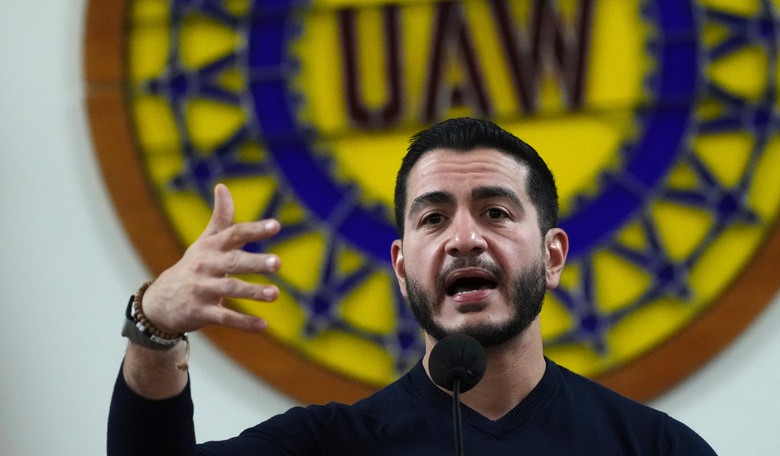
Abdul El-Sayed went the Full Kamala when it comes to male intrusion into female spaces. And you never go the Full Kamala.
On last night's 60 Minutes, correspondent Ross Douthat interviewed El-Sayed and Mike Rogers as the clock slowly ran down on the midterms. Douthat hit a number of hot-button topics with both Senate candidates, but the question of protecting girls in locker rooms and sports offered the greatest contrast. That's not because of the different postures of both candidates on the issue, which was assumed from the start.
It's because El-Sayed offered up a word salad that never answered Douthat's question. El-Sayed starts off by talking about smartphones and the internet, denies that the issue even exists, and then scolds Douthat for asking a question he was not prepared to answer rationally:
Abdul El-Sayed says men don't play in women's sports. That the transgender issue "doesn't happen" it's "manufactured" It happens every day. It’s a big issue for women's fairness. Surely CBS did not fact-check his answer like they have chosen to do for Mike Rogers. https://t.co/aRtDze2Gdh
— J (@JayTC53) November 2, 2026
DOUTHAT: What is taught in school? What happens with transgender kids on sports teams and so on, right? Like, these are places where rights are in conflict. Right? What do you think happens there?
EL-SAYED: I don't know if that's actually true. I think we manufacture these social issues, because here's the thing about it. Ross, you have an iPhone in your pocket, probably. Or is it iPhone or Samsung? You have a phone in your pocket, right?
DOUTHAT: Yeah.
EL-SAYED: You can get access to everything and anything in the whole world, all the world's information in your pocket. The notion, somehow, that you are going to prevent your child from being exposed to something that you may find disagreeable, and that that is going to be because of school, is so profoundly outdated. Because, of course, you have all the information, and they have all the information. So here's the thing about it. I think it's really important for us to recognize that the free flow of information is actually a beautiful thing. It's really important. And the most important thing you can do is not try to protect a person from seeing a thing. It's about trying to make sure you coach your kid through the world that you are engaging with them and saying, 'here's what I believe, here's what you may see in the world, you get to make your choices about who you're going to be in the world.' But that's going to require us to make do with the fact that, like, the internet is a real thing, and this debate about, like, quote-unquote what's taught in the classroom, I think has been made into a cultural flashpoint, because a lot of the folks who want to make this a topic of conversation don't want to be talking about the real issues that we face.
Ahem. Who made this an issue in the first place? Who insisted on having children sit for Deag Queen Story Hours, get taught in kindergarten that people can change their sex, and insisted on letting males compete in female sports at all levels of education? And why would that not be an issue of public policy? This is political gaslighting, only almost incoherently performed. Douthat seems amused at El-Sayed's attempt to justify intrusion into female spaces by the existence of smartphones, but does not appear prepared to ask El-Sayed to actually answer his question.
It's a stupid argument as well. What element is missing between the smartphone and the locker room? Consent. If a teenage girl uses her phone to look up explicit pictures of male genitalia, that's her choice, even if we think it's an unwise one. It also keeps that exposure limited to the person who initiated it, not an entire room of females who may not want to look at it.
Forcing girls to disrobe where men are present eliminates consent altogether. Forcing females to compete against males in sports or face disqualification for refusing also strips girls and women of their consent, not to mention stealing their opportunities to compete fairly and safely in athletics.
The issue isn't whether or when girls and women first learn about male genitalia. It's about the safety and security of females in spaces set aside specifically to respect their dignity, privacy, safety, and opportunities to engage in public activities. That relates directly to the biological differences between men and women and the risk of predatory behavior in spaces where women are more vulnerable. Those differences do not disappear merely because a male decides he "identifies" as female. It also has nothing to do with sex education or parental puritanism, as El-Sayed incoherently suggests, and everything to do with dignity and security. It also relates to equal access to sports and education guaranteed by Title IX, which – contra El-Sayed – has already resulted in a long string of complaints and challenges.
Interestingly, 60 Minutes and CBS News chose not to include this segment in its "transcript." I had to transcribe it myself. They did include El-Sayed's equally incoherent response to a question Douthat posed on Israel's right to exist:
CBS: “Does Palestine have the right to exist?” EL-SAYED: “Yes” CBS: “Does Israel have the right to exist?” EL-SAYED: “So, uh, yes, if there is a shared understanding…" CBS: "Wait, you said-" EL-SAYED: "Lemme just..." https://t.co/Ypqt0r6a38
— RNC Research (@RNCResearch) November 2, 2026
Mike Rogers: I passionately defend Israel's right to defend itself and to exist as a Jewish state. That sets me at odds with my opponent right off the bat. He refuses to even acknowledge that Israel has the right to exist.
Abdul El-Sayed: I don't ever get the question of, "Does Palestine have the right to exist?"
Ross Douthat: Does Palestine have the right to exist?
Abdul El-Sayed: Yes.
Ross Douthat: Does Israel have--
Abdul El-Sayed: And--
Ross Douthat: --the right to exist?
Abdul El-Sayed: S-- yes. If there is a shared understanding--
Ross Douthat: Wait. You said-- you said--
Abdul El-Sayed: Let me just-- let me just-- let me just-- understand. I believe-- and this is the-- this is the problem with this debate. We start from where we sit rather than start from principles. I believe in equal rights to peace, dignity, and self-determination for Palestinians and Jewish Israelis alike. If the Palestinian people decide and the Israeli people decide that they want two states for two people, and they decide that on equal terms, I'm for it. If they decide that they want one state shared in a different way, I'm for that.
In other words, El-Sayed thinks the Palestinians should have a veto on whether Israel exists as a Jewish state. If they agree to a two-state solution, then he'll agree, but if not, then El-Sayed will join the "from the river to the sea" brigade to wipe out Israel. It also ignores the fact that Israel spent decades offering the Palestinians a two-state solution, guaranteed by both Saudi Arabia and the US at more than one point in history, only to have the Palestinians refuse to take yes for an answer.
Matt Margolis scoffed at El-Sayed's incoherence:
Palestine got a clean yes with no strings attached. Israel, however, got a stammer and conditions. When Douthat pressed him, El-Sayed retreated into a speech about starting from principles. And did you notice what he slipped in at the end? A single state "shared in a different way" is the campaign-friendly phrasing for a world without a Jewish state, and El-Sayed says he'd be fine with it. In his framing, Palestine's existence is a given. Israel's existence is something conditional, something to be negotiated and possibly voted away. That's a remarkable position for a man asking Michigan voters to send him to the U.S. Senate, and it explains a lot about why he won't denounce antisemitic ads aimed at his opponents.
It also lines up with what a Michigan Democrat Party staffer said on hidden video last month. Abdoul Beckwith claimed that El-Sayed is reluctant to denounce Islamic terrorist groups because doing so would alienate his base. When asked specifically about the Muslim Brotherhood, Beckwith said condemning the organization could cost El-Sayed his Muslim supporters.
"So that's the whole thing. So when Abdul is going to denounce that [Muslim Brotherhood], they're [Muslims] going to think that he is siding with the genociders," Beckwith said.
The incoherence in this case is entirely intentional. It serves to obfuscate El-Sayed's radical nature and his sympathies and ties to Islamists, both in Michigan and abroad.
Speaking of incoherence ...
So men can be in women’s locker rooms but at his mosque women should be in a bag with a slit for their eyes while in the back of the room. Got it.
— Dave Rubin (@RubinReport) November 2, 2026