
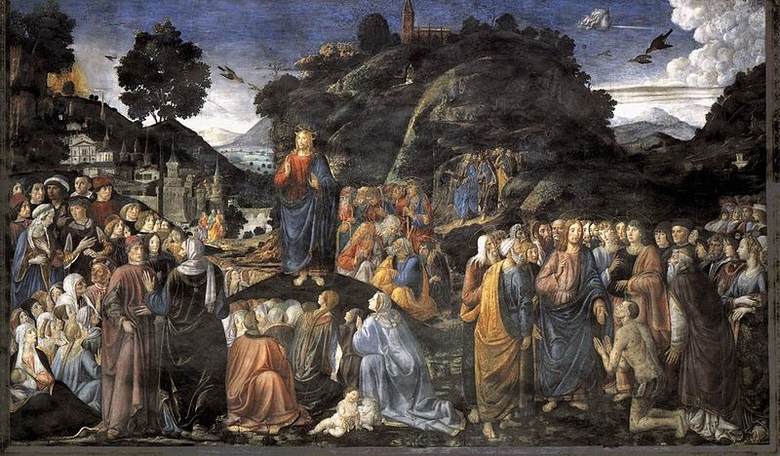
This morning’s Gospel reading is Matthew 5:1-12a:
When Jesus saw the crowds, he went up the mountain,
and after he had sat down, his disciples came to him.
He began to teach them, saying:
"Blessed are the poor in spirit,
for theirs is the Kingdom of heaven.
Blessed are they who mourn,
for they will be comforted.
Blessed are the meek,
for they will inherit the land.
Blessed are they who hunger and thirst for righteousness,
for they will be satisfied.
Blessed are the merciful,
for they will be shown mercy.
Blessed are the clean of heart,
for they will see God.
Blessed are the peacemakers,
for they will be called children of God.
Blessed are they who are persecuted for the sake of righteousness,
for theirs is the Kingdom of heaven.
Blessed are you when they insult you and persecute you
and utter every kind of evil against you falsely because of me.
Rejoice and be glad,
for your reward will be great in heaven."
Today the Church celebrates the Solemnity of the Saints, those who have passed before us in faith and fortitude to join in the eternal Trinitarian life. We tell the stories of the saints to inspire ourselves to holiness and faith during the entire year, but this day we set aside to contemplate their strength and virtue.
These stories are often dramatic and daunting as well as inspirational. We see the saints through the mists of history in most cases, where all of their humanity and failings have been forgotten and their virtues undimmed. And when I read these stories, especially those of the martyrs, my first reaction is: I could never handle that. Indeed, we are often reminded of our shortcomings when reading these stories and celebrating the saints, from the world-changers like Saint John Paul II to the gentle and quiet saints like Saints Bernadette and Therese of Lisieux.
The first saint story I ever read seriously was that of Saint Maximilian Kolbe, the Polish priest and Marian devotee who sacrificed himself to save another man condemned to death in a Nazi prison camp. It's a powerful story; I first read it as a young teen from Reader's Digest, and the story of St. Maximilian has remained close to me in the decades since, even when I didn't attend church at all in my teens and young adulthood.
While his story has inspired me for my entire life, it has also reminded me of how far short I have fallen of the glory of God. Sin has its hold on me, and it has its consequences. On no measuring stick would I fall into the same league as St. Maximilian or any of the other saints whose stories I read from time to time. The men and women in the communion of saints all have heroic demonstrations of virtue and faith, and seem in retrospect to have had no stains on their lives.
Those comparisons are more than just inspirational. They are daunting to the point of discouragement. How can we hope to measure up to the sainthood our faith calls us to pursue in our ordinary lives? How can we hope to be saved while mired in the material world, stumbling in sin and acedia rather than rising above it in faith and strength? Very few indeed would rise to the level of sainthood in the broader sense, in coming to the Lord to live in His eternal presence, if these are the standards.
Today's readings give us that hope, and our Gospel today reminds us that we will not have to come home by our own power. Our first readings today are both from John, the first from his Revelation and the second from his first epistle. In the second reading (1 John 3:1-3), John exhorts us to faith and trust in Christ, and promises that will be enough, emphasis mine:
Beloved, we are God's children now; what we shall be has not yet been revealed. We do know that when it is revealed we shall be like him, for we shall see him as he is. Everyone who has this hope based on him makes himself pure, as he is pure.
It is faith that brings us to salvation, John teaches us – faith in Christ transforms us, even in our failures. And this makes sense when we see the people Jesus called to be His apostles and disciples. He did not come for those who had already been perfected; Christ chose a tax collector, some fishermen, and others who came to Him broken. In faith and imbued with the Holy Spirit, they went on to perform miracles and sacrifice themselves so that all men and women could hear the Good News, but faith came first before the calling to martyrdom.
As for the scope of salvation, John assures us of the Lord's generosity in Revelation (7:2-14, 9-14). In the vision granted to him by the Lord, John does not see a small clique of saints, but rather more people than could ever be counted:
After this I had a vision of a great multitude,
which no one could count,
from every nation, race, people, and tongue.
They stood before the throne and before the Lamb,
wearing white robes and holding palm branches in their hands.
Let's reflect on this for just a moment. When we think about saints, we usually think of those recognized by the Church through canonization. That, however, is only a formal recognition of sainthood. The church does not create saints; it canonizes those who have demonstrated their entry into the divine life. For the last 400-plus years, that process usually requires two confirmed miracles that demonstrate the saint's intercessionary power. The canon has never been intended as a definitively comprehensive roster of Heaven's citizens.
To that point: care to guess how many canonized saints the Church recognizes? The Vatican does not have a precise count, but the number is somewhat north of 10,000 saints. That makes John's vision even more revealing about the generosity of the Lord in His mercy. John gets a precise count of those present "marked with the seal," who entered Heaven under the original covenant with Israel: 144,000. When it comes to all other peoples, John does not offer the much smaller number of 10,000, but an uncountable "great multitude" of saints from every corner of the world.
The Holy Spirit granted John this vision as a sign of hope. The Lord wants us all to become saints – those who form themselves to eternal Trinitarian life, within the divine presence of the Father who loves us.
So what does it mean to become a saint, apart from the lessons given us in heroic and compelling biographies of those whose faith carried them to that status? Jesus tells us how we can form ourselves to the divine caritas in the Beatitudes, our Gospel reading today, but it goes beyond behavior or even formation. It requires faith, and faith requires perseverance. St. Maximilian lived a life of faith that prepared him for the moment in which he literally chose to love another more than himself. Bernadette and Therese persevered in their faith through other trials far less dramatic but no less meaningful. The saints whose stories both inspire and daunt us did not lose faith or heart, even through their trials, but persevered through adversity in faith and charity.
That doesn't mean they were perfect, even in those moments. It meant that they let go of their own will and allowed the Lord to use them as instruments of love, and in that surrender, allowed themselves to be perfected even where sin exists.
We know their stories because of that surrender. Those stories come to us not as measuring sticks to show our failures but as examples of how the Lord can work in our lives when we allow Him to do so. It takes as much perseverance as faith, as much intention to set aside our own ambitions in exchange for service to the Lord, to come to salvation. The Lord does not want to elect an elite but to bring as many of His sons and daughters to Him, and all we have to do is place our hope and faith in Him to prepare ourselves for the great banquet in the eternal life to come.
Today we recognize and celebrate the saints as our brothers and sisters, not as our scolds and judges. They pray for us to join them, and they pray for the perseverance we need to do so.
Previous reflections on these readings:
- The Strength in Meekness: Sunday Reflection (2026)
- The Calm Before the Storm: Sunday Reflection (2025)
- Poor in spirit, rich in wisdom: Sunday reflection (2023)
- White robes in the time of great distress: Sunday reflection (2020)
- Sunday reflection: Matthew 5:1-12 (2017)
- Sunday reflection: Matthew 5:1–12 (2015)
The front page image is "Sermon on the Mount" by Cosimo Rosselli, c. 1481-2. On display in the Sistine Chapel. Via Wikimedia Commons.
“Sunday Reflection” is a regular feature that looks at the specific readings used in today’s Mass in Catholic parishes around the world. The reflection represents only my own point of view, intended to help prepare myself for the Lord’s day and perhaps spark a meaningful discussion. Previous Sunday Reflections can be found here.