







If at first you don't succeed, apply apply again. However, if at second you don't succeed, you may just be out of options.
Missouri Republicans find themselves in a jam, especially Secretary of State Denny Hoskins. After the Missouri Supreme Court ruled the new mid-cycle congressional maps passed this year invalid, Hoskins attempted to get an intervention from the U.S. Supreme Court, only to have Justice Brett Kavanaugh deny him relief. Hoskins then ordered the state to use the new maps anyway, given the short period of time to the election – and the fact that the state held its congressional primaries based on the new redistricting rejected by the state Supreme Court.
The justices then ordered Hoskins to appear on potential contempt charges, which Hoskins appealed in federal court:
In a new filing submitted by Missouri Attorney General Catherine Hanaway on Wednesday, she and Secretary of State Denny Hoskins asked the U.S. District Court for the Eastern District of Missouri to enjoin the Supreme Court of Missouri from holding Hoskins in contempt.
This comes after two courts issued conflicting rulings Tuesday.
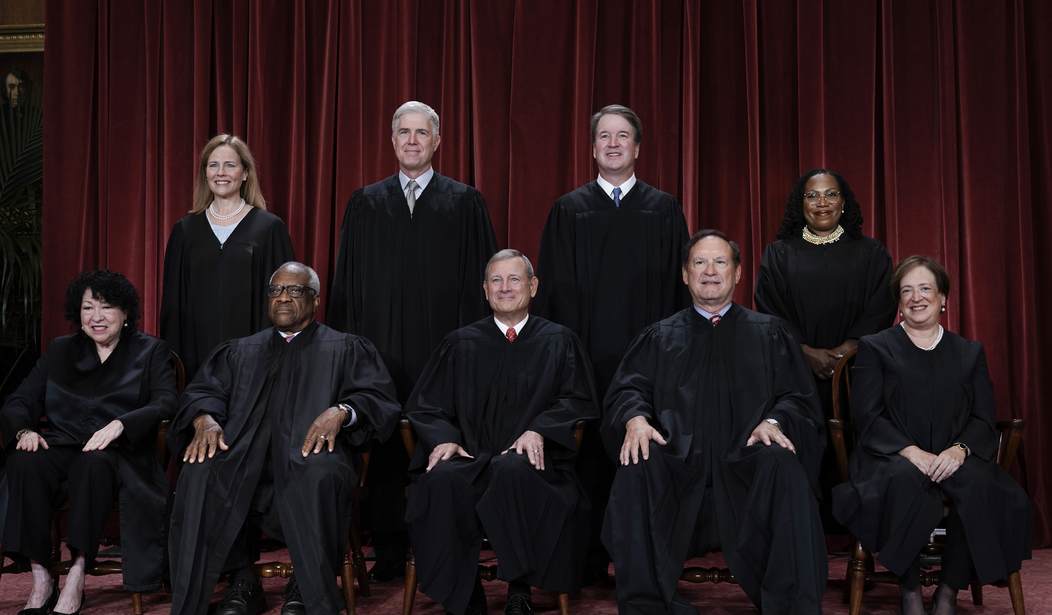
The Supreme Court of the United States shot down Hoskins' application for a stay of the Supreme Court of Missouri's ruling. The state's highest court had ordered the use of the 2022 congressional map until a public vote.
Quickly after the SCOTUS ruling, a federal judge issued a temporary restraining order, ordering the use of the 2025 redrawn congressional map.
That's when the Missouri state Supreme Court re-entered the chat:
Tuesday evening, Missouri Supreme Court Chief Justice W. Brent Powell ordered Hoskins to explain why he should not be held in contempt for pushing the federal judge's order rather than the state Supreme Court's. People Not Politicians made the emergency request to hold Hoskins in contempt.
In response, Hoskins said he would continue to abide by the federal judge's order and looked forward to his day in court.
Well, that fig leaf disappeared this morning. The U.S. Supreme Court also re-entered the chat and issued a stay of the lower court's TRO, effectively forcing Hoskins to face the music:
The application for stay presented to Justice Kavanaugh and by him referred to the Court is granted. The September 8, 2026 order entered by the United States District Court for the Eastern District of Missouri in case No. 4:26–cv–1424 is stayed pending the disposition of the appeal in the United States Court of Appeals for the Eighth Circuit and disposition of a petition for a writ of certiorari in this Court, if such a writ is timely sought.
Notably, no dissent was attached to this order. The New York Times offers its quick review of the scorecard at the moment. The only winner at the moment is confusion:
It was not immediately clear how Missouri would proceed. Thursday’s ruling left unanswered how the state would swap congressional maps between a primary and general election.
The state’s Republican leaders had been insisting they would stick with their preferred map, which was used in last month’s primary, for the general election.
The Supreme Court’s ruling landed just as Secretary of State Denny Hoskins, a Republican, was about to appear at a hearing before Missouri’s Supreme Court, which is considering whether to hold him in contempt for not using the voting boundaries that the state judges prescribed.
Redistricting opponents have suggested in court filings that candidates who won their primaries under the redrawn map might remain the nominees in the same-numbered districts under the old lines. Alternately, they theorized, state law allowed party nominating committees to select candidates for each district.
In other words, the state legislature and the state supreme court have turned the midterm congressional elections into an absolute mess. Who gets the blame? This is similar to the Democrats' botched attempt at redistricting in Virginia, where the state legislature and governor tried to circumvent a requirement in the state constitution for a referendum on any new mid-cycle redistricting. The Missouri legislature didn't offer a referendum, but it's not clear whether it's required. The plaintiffs demanded a referendum on the new map, which Hoskins had blocked, and that was the nature of the challenge that prompted the state supreme court's ruling:
Judges of the Missouri Supreme Court on Wednesday repeatedly pressed attorneys defending Secretary of State Denny Hoskins to explain why voters should not see a referendum on congressional redistricting on the November ballot.
The case over the gerrymandered congressional redistricting plan forced through by Republicans in a 2025 special session is the final legal battle to be settled before the November election. The result means more than just whether the plan will be on the ballot — it will determine the district lines used on Nov. 3 and potentially affect the fight over control of Congress.
The court also heard an appeal Wednesday in a separate case over when petitioners may begin collecting signatures on a referendum. More than 100,000 signatures were not checked on the referendum petition because they were collected before the form of the petition was approved.
That makes the court's ruling even more curious, however. If the state did not have a requirement to put the map up for a referendum first, then the new map should have governed this cycle even while the referendum on it was considered by the same electorate. If that new map got rejected in November, then the state could have reverted back to the old map for 2028. That would have eliminated the chaos of this cycle and allowed the state to proceed on a rational basis for the next cycle.
Instead, no one's really sure at the moment what will transpire. It appears that the primary winners under the new map will continue to be the nominees for districts but now under the old map, even though many primary voters cast ballots for nominees that now won't represent them in the general election.
What's next? Hoskins faces a contempt hearing, after the same federal district court that ordered the use of the new maps refused to enjoin the state supreme court from proceeding against Hoskins. The state legislature, however, is now threatening to take its own action if the judges return a contempt finding:
A group of Missouri Republican lawmakers is warning of impeachment proceedings against members of the Missouri Supreme Court if Secretary of State Denny Hoskins is held in contempt.
State Sen. Rick Brattin said Wednesday that he joined Sen. Joe Nicola and other members of the Missouri General Assembly in signing a letter to Missouri Supreme Court Chief Justice W. Brent Powell.
The lawmakers argue Hoskins should not be punished for following a federal court order requiring the state to use its 2025 congressional map in the November election. ...
“Should Secretary Hoskins be held in contempt, we will petition the Speaker of the House and legislative leadership to begin impeachment proceedings against the responsible members of this Court," the lawmakers wrote. "Those grounds exist where there is neglect of duty, incompetence, or misconduct in office.”
The letter said actions along those lines taken by the judges would constitute neglect of duty, incompetence and misconduct under the Missouri Constitution.
There's also the not-small matter of defying the will of the state legislature in forcing the state to hold a referendum which – again – does not appear to be a requirement in this case. The court itself ruled in March that the new map did not violate the Missouri state constitution, but now insists that a referendum petition is enough to prevent a legislative action signed off by the governor from taking effect. The state legislature has a real interest in holding the state supreme court accountable for that kind of interference and to lay down a clear precedent for judges who attempt to hijack the legislative process.
This is likely the reason why the U.S. Supreme Court chose not to intervene. This is not a federal matter; it is a balance-of-powers issue within the state's own constitutional structure. If the state Supreme Court has overreached, then the state legislature can take action to restore the proper balance.
In the meantime, bet on the old maps governing the upcoming election, and take one seat off the tote board for the GOP. The one potential path back to federal court would be to challenge the old map's majority-minority carve-out under the Callais ruling. Perhaps that will be the next step, so ... stay tuned to see if Hoskins attempts to apply apply apply again.