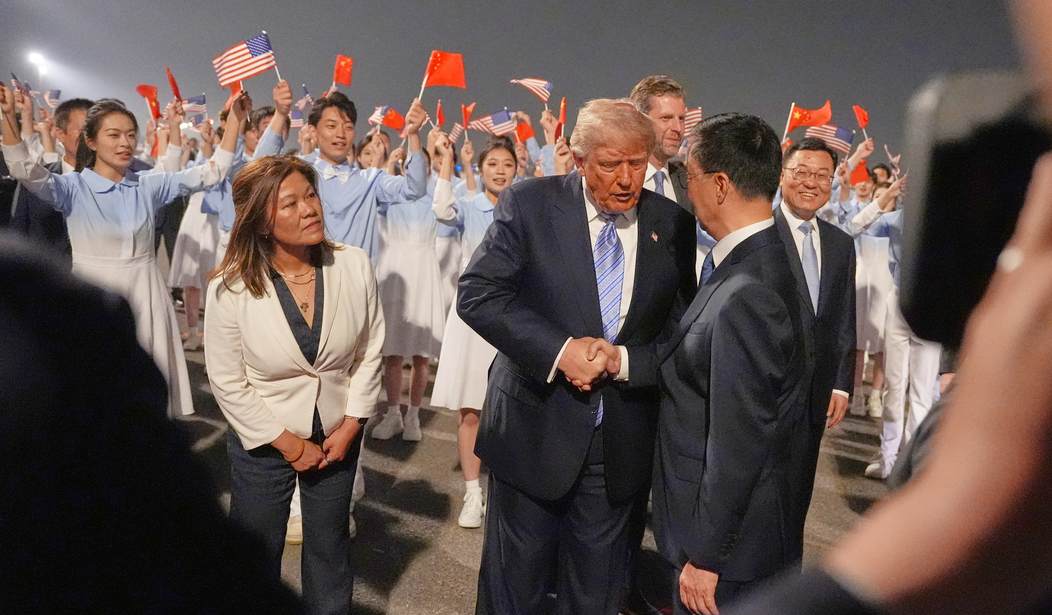
According to Marco Rubio, Xi Jinping declared that Iran cannot have a nuclear weapon and must give up claims of sovereignty over international waters. Good to know. Maybe Xi can give the Nepo Babytollah a call and tell him and Ahmad Vahidi.
Xi didn't make that concession out of the goodness of his heart, of course. The IRGC regime remnants in Tehran likely hoped to see Beijing lean on the US to force a retreat from the Strait of Hormuz. Instead, Xi focused more on China's interests closer to home, which may have implications for what the US does next:
President Donald Trump discussed the Iran war and the blockade of the Strait of Hormuz during a summit with Chinese President Xi Jinping, Secretary of State Marco Rubio told NBC News in an interview Thursday, adding that the United States was not asking for Beijing’s help with Iran.
“The Chinese side said they are not in favor of militarizing the Straits of Hormuz, and they’re not in favor of a tolling system, and that’s our position,” America’s top diplomat said in Beijing after Trump, Xi and their delegations held more than two hours of talks. ...
“We’re not asking for China’s help. We don’t need their help,” said Rubio, who has been under Chinese sanctions since 2020 over his criticism of its human rights record. (Ahead of Trump’s trip, China indicated that the sanctions would not prevent Rubio from traveling to Beijing because they concerned his actions as a senator, not secretary of state.)
The Iran war has loomed large over Trump’s China trip, causing it to be postponed by six weeks. China, which has close ties with Iran, has criticized the U.S. and Israeli strikes that began Feb. 28 and called for a diplomatic solution to the war.
Rubio said Trump and Xi had found common ground on Iran, with China reiterating its opposition to Tehran developing nuclear weapons.
NBC News notes that Beijing's readout of the talks does not contain any specific mention of Iran or the crisis in Hormuz. It merely mentions that the conversation between Trump and Xi “exchanged views on major international and regional issues including the Middle East situation,” an interesting and nuanced choice from a country where nuance matters. It essentially validates whatever the US says about those discussions and allows Trump and Rubio to frame them however they want in public. If Trump and Rubio go too far off of the substance of the discussion, Beijing will undoubtedly respond, but in the meantime, Xi allowed the US to take the lead.
That should worry Vahidi and the regime remnants. A lot. It signals that China's not going to risk an expansion of the war by intervening on Vahidi's behalf, especially while the IRGC decides to reenact the Barbary Pirates episode in maritime history. That leaves the US with a free hand to deal with Vahidi and the rest of the lunatics clinging to power in Tehran, and when Air Force One leaves China's airspace, the choices will become acute almost instantly.
As it happens, Xi is much more concerned about Taiwan than he is about Iran. The early reports from the meeting highlighted Xi's "warning" to Trump on Taiwan as having the potential to create "an extremely dangerous situation":
Xi’s remarks, while in line with China’s longstanding position, threatened to dim the mood of a visit both countries hoped would stabilize ties. The meetings that began Thursday morning at the Great Hall of the People in Beijing were billed as a gathering of superpowers to quell economic and trade disputes.
Those topics were indeed raised, including discussions of trade ties, U.S. access to the Chinese market, Beijing’s investment in U.S. industries and its purchases of American agricultural products.
Xi, however, aims to weaken the U.S. commitment to Taiwan, a self-governing democracy that Beijing seeks to bring under its control.
“Handled well, relations between the two countries can maintain overall stability,” the Chinese leader said, according to the Foreign Ministry. “If handled poorly, the two countries will collide or even clash, putting the entire U.S.-China relationship in an extremely dangerous situation.”
“‘Taiwan independence’ and cross-Strait peace are as irreconcilable as fire and water,” Xi said. “Safeguarding peace and stability across the Taiwan Strait is the biggest common denominator between China and the U.S.”
How much of a "warning" was this? Trump didn't bother to respond publicly to it, but Rubio did at length in another part of the NBC News interview. Despite the coverage this "warning" received in the US, Rubio explains that this is essentially diplomatic boilerplate in US-China talks. China raises the Taiwan issue, the US reiterates that its position hasn't changed, and the two countries move on to more substantive discussions.
In this exchange, Xi and his team seemed more eager to emphasize "stability," Rubio said, and that may be as a result of American assertion of power in Iran:
Rubio said U.S. arms sales to Taiwan “did not feature prominently” in the Trump-Xi talks Thursday.
In December, the Trump administration announced an $11 billion arms package for Taiwan that is thought to be the largest ever, with an even bigger one potentially in the works. It has also been critical of the growing military pressure Taiwan faces from China, which sends warplanes and vessels toward the island almost daily.
“From our perspective, any forced change in the status quo and the situation that’s there now would be bad for both countries,” Rubio said.
Less well reported, but included in NBC's coverage, is Trump's personal appeal to Xi to free Jimmy Lai. Beijing didn't have much to say about that either, but at least Trump continues to push for his release.
Vahidi now has to figure out what his next moves will be without any allies in support. The regime has become desperate enough over the past several weeks to accelerate political executions, an issue that the National Council of Resistance of Iran (NCRI) wants to raise to the highest levels of visibility. The NCRI will hold a rally and march in Washington DC on Saturday to demand action from the US and other nations to stop these killings. From their press release:
With little international scrutiny, Tehran’s authorities, fearing another nationwide uprising, have exploited the climate of war to suppress growing dissent. A significant number of those executed were targeted for links to the People’s Mojahedin Organization of Iran (PMOI/MEK), the principal organized opposition movement. Many more detainees affiliated with the PMOI remain on death row and face imminent risk of execution. Other victims were protesters arrested during the January uprising.
Thousands of Iranian Americans and supporters of the National Council of Resistance of Iran (NCRI), and its President-elect Mrs. Maryam Rajavi, will rally on the U.S. Capitol grounds and march along Pennsylvania Avenue in Washington, DC on Saturday, May 16. They will urge the U.S. and Western governments to hold Tehran accountable aimed to stop the wave of execution of political prisoners.
Many of the Washington DC protesters are former political prisoners, have family members executed, or currently at risk in Iran. ...
Speakers Include:
- General Wesley K. Clark, the 12th Supreme Allied Commander Europe (SACEUR)
- Honorable Carla Sands, United States Ambassador to Denmark (2017 – 2021)
- Honorable Patrick Kennedy, former member of the U.S. House of Representatives
We may have more on this later. Whatever Trump decides to do next will likely happen before this rally starts at 11:15 am ET in Upper Senate Park. Stay tuned.






Join the conversation as a VIP Member