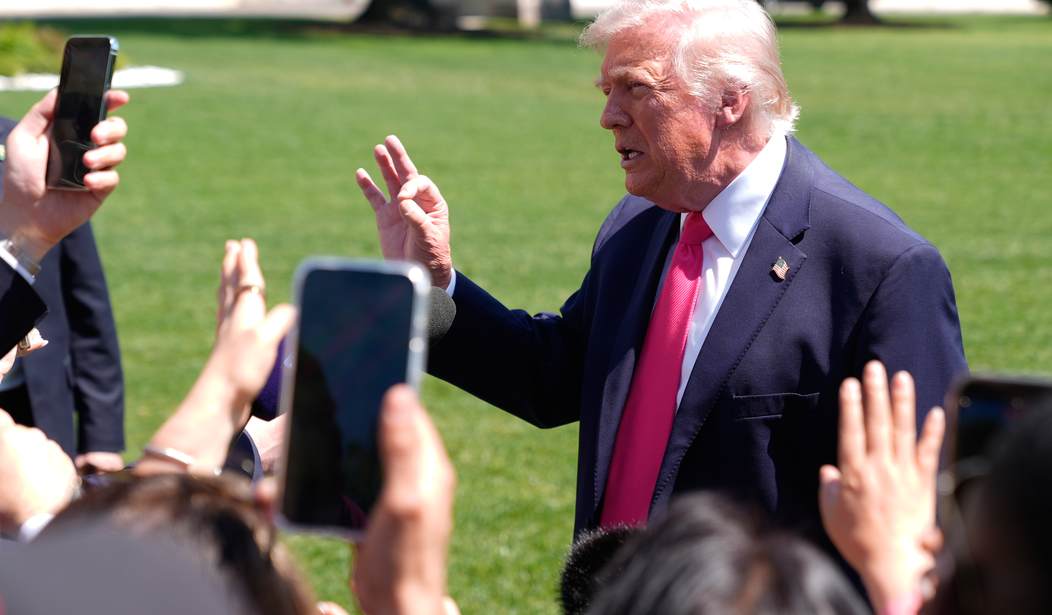
Pete Hegseth floated this claim yesterday. Today, Donald Trump made it official ... or at least as official as he can make it.
Hours before the grace period of the War Powers Resolution grants for military action expired, Trump officially informed Congress that hostilities with Iran have ended. And, as expected, Trump claimed that hostilities ended weeks ago, negating any need for congressional authorization for military activities in the Persian Gulf:
President Donald Trump notified Hill leaders on Friday, the 60th day of the Iran war, that US hostilities with Tehran are over — for now — and thus don’t need congressional authorization.
It’s a significant message to Republican lawmakers who have grown increasingly anxious and, in some cases, open to a debate over Trump’s authority to continue the conflict under the War Powers Act. That statute requires Trump to seek authorization from Congress to continue the war after 60 days, or to notify lawmakers of a 30-day withdrawal period.
Instead, Trump sent a letter outlining “changes in the posture” of US forces in the region, confirming the administration’s plans to reset the War Powers Act clock if conflict resumes. He told reporters Friday that “I don’t think it’s constitutional” for lawmakers to seek an authorization debate under the 1973 War Powers Act although he also said in the letter he will “keep the Congress fully informed, consistent with the War Powers Resolution.”
In his letters to the House and Senate, Trump told Speaker Mike Johnson and Senate President Pro Tempore Chuck Grassley, R-Iowa, that “there has been no exchange of gunfire between United States forces and Iran since April 7.”
The White House released the full letter to the media as well. Trump argued that the armed conflict lasted between February 28 and April 7, the date of the ceasefire to which Trump agreed with Iran. Noting that he has extended the ceasefire indefinitely and that no direct fire has been exchanged since it began, Trump declared that "the hostilities that began on February 28, 2026, have terminated."
However, Trump warned that the Iranians still pose a danger and that Trump foresees the possibility of further armed conflict. If that should occur, Trump informed Congress that he would treat it as a new conflict under the War Powers Resolution requirements:
Despite the success of United States operations against the Iranian regime and continued efforts to secure a lasting peace, the threat posed by Iran to the United States and our Armed Forces remains significant. Accordingly, the Department of War continues to update its force posture in the AoR in select countries, as necessary and appropriate, to address Iranian and Iranian proxy forces' threats and to protect the United States and its allies and partners. These changes are more fully outlined in the classified attachment to this letter. ...
As the situation evolves, I will continue to update the Congress on noteworthy changes in the United States Armed Forces presence, consistent with the War Powers Resolution.
How much of this is sincere argument, and how much of it is a dodge? For one thing, as I pointed out this morning, the US naval blockade of Iran is still ongoing, and that actually does qualify as "hostilities" even if it has resulted in no exchange of fire. A blockade is an act of war, and the US Navy is actively interdicting Iranian shipping and refusing to allow any arrivals or departures in Iranian ports.
For another, Trump made it clear before transmitting this letter that he's not terribly concerned with War Powers Resolution compliance. Or more accurately, he's no less concerned with it than Barack Obama was in 2011 while pounding Libya for eight months without congressional authorization:
President Trump is apparently not going to abide by the 60-day limit for a president to get congressional approval for a war.
— CBS News (@CBSNews) May 1, 2026
"Let me just tell you, on the war powers, so many presidents, as you know, have gone and exceeded it," Mr. Trump said while departing the White House for… pic.twitter.com/LRRfXwzjf7
"Let me just tell you, on the war powers, so many presidents, as you know, have gone and exceeded it," Mr. Trump said while departing the White House for Florida on Friday. "It's never been used. It's never been adhered to. And every other president considered it totally unconstitutional. And we agree with that."
After hearing that, one might have thought that Trump would just tell Congress to pound sand. Instead, Trump has decided to follow the form of the War Powers Resolution, which Obama never bothered to do, rather than taunt a hostile Congress with a blunt refusal. That is likely a wise decision.
Will this suffice under the WPR? Technically ... no. The naval blockade negates this argument. In practical terms, though, there's nothing that Congress can do about it. They may not be able to sustain a concurrent resolution now to recall forces – which Democrats have tried to pass several times to no avail in either chamber – since Trump has now declared the hostilities at an end. As commander-in-chief, Trump can deploy forces as he sees fit without congressional approval. This will leave Democrats seething, but courts are not likely to involve themselves in this dispute, and Democrats might not like what the Supreme Court may do with the WPR if they push the issue that far.
This should worry Iran more than it does the Democrats. Trump just removed the time-window leverage on which Ahmad Vahidi relied for stalling Trump. If actual shooting starts again, Trump will claim another 60-day window with which to demolish what's left of IRGC industrial infrastructure. And if Iran fires the first shot that restarts the hot-fire phase of the war, Democrats will have no choice but to allow Trump the 60-day window on Operation Epic Fury II.
Update: The Wall Street Journal reports on the substance of Iran's new proposal, which indeed attempts to sell the same rug twice without guarantee of delivery again:
The new Iranian proposal takes a step toward the U.S. by offering to discuss Tehran’s conditions for opening the Strait of Hormuz at the same time as U.S. guarantees to end its attacks and unwind its blockade of Iranian ports, people familiar with the details said.
Iran previously wanted the U.S. to drop its blockade as a precondition for talks, and agree to terms for ending the war before discussions on the future management of the strait and its nuclear program.
The new proposal then calls for discussing the issues around Iran’s nuclear file in exchange for U.S. sanctions relief, the people said.
Abbas Araghchi already agreed to the first phase of this proposal in the current ceasefire. In fact, the US hadn't even blockaded Iran at that point, but the IRGC refused to honor Araghchi's promise to allow unfettered traffic through the Strait of Hormuz. The only real change here is that Araghchi apparently agreed to discuss the nuclear issues at some point, but still in a later phase after the blockade has lifted – and with no guarantee on compliance on any of these promises.
Small wonder Trump shrugged it off. It's another stall tactic, and Trump made clear that he doesn't think Araghchi and Pezeshkian can or will deliver. He's looking for new negotiating partners in Iran instead.
Editor's Note: For decades, former presidents have been all talk and no action. Now, Donald Trump is eliminating the threat from Iran once and for all.
Help us report the truth about the Trump administration's decisive actions to keep Americans safe and bring peace to the world. Join HotAir VIP and use promo code FIGHT to get 60% off your VIP membership.









Join the conversation as a VIP Member