









"None of these people, including our own, very disappointing, NATO," Donald Trump posted to Truth Social this morning, "understood anything unless they have pressure placed upon them!!!" On the plus side, however, our erstwhile alliance partners may have begun the learning process ahead of the lunatics in Tehran. Barely.
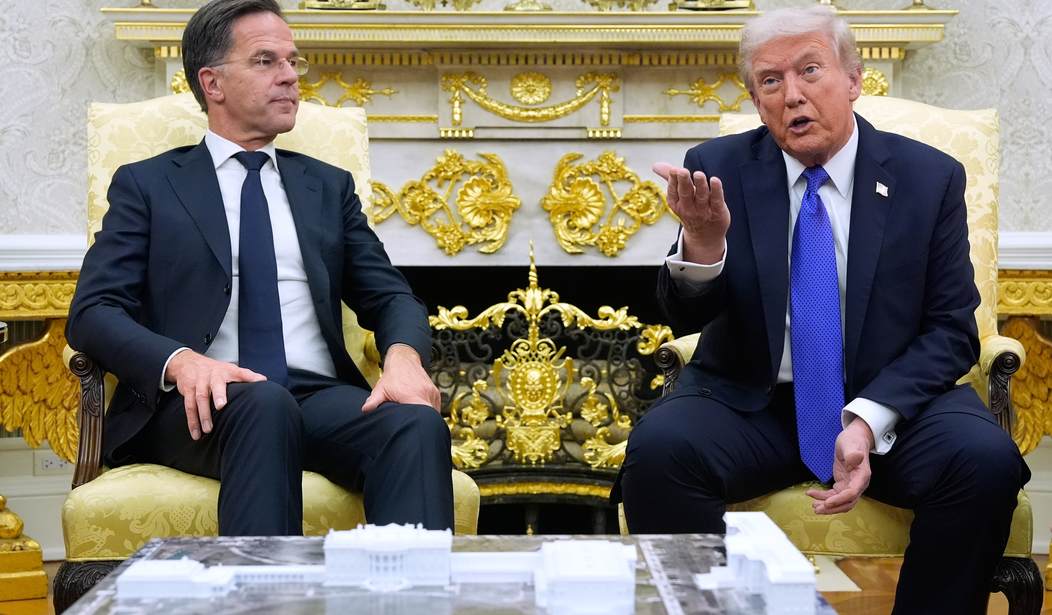
Facing an enormous amount of pressure from all directions, NATO chief and so-called Trump whisperer Mark Rutte tried meeting yesterday with the president to soothe hard feelings over refusals to cooperate on the Iran war. Unlike in past meetings, Rutte faced a hostile Trump and a resistant White House in yesterday's meeting, with administration officials much more focused on payback than cooperation:
The White House is considering a plan to punish some members of the NATO alliance that President Trump thinks were unhelpful to the U.S. and Israel during the Iran war, according to administration officials.
The proposal would involve moving U.S. troops out of North Atlantic Treaty Organization member countries deemed unhelpful to the Iran war effort and stationing them in countries that were more supportive. The proposal would fall far short of President Trump’s recent threats to fully withdraw the U.S. from the alliance, which by law he can’t do without Congress.
The plan, which has circulated and gained support among senior administration officials in recent weeks, is early in conception and one of several the White House is discussing to punish NATO. It underscores the growing rift between the Trump administration and European allies following the president’s decision to launch the war with Iran.
Trump can't pull out of NATO, as I have noted before, but he can redeploy American troops. Given the nature of Europe these days, it makes more sense to redeploy those troops further east anyway. We should have rethought the strategic layout of our forces on a continent where the threat exists much farther away from the middle of Germany than it did 40 years ago, anyway, but it's not just combat forces that matter in this equation either. We provide nearly all of the heavy logistics for NATO in Europe, which means a shift away from countries like Spain, France, and the UK would leave them without the ability to move their forces in any significant quantity, let alone quality.
To his credit, Rutte knows this and has been making this point to our allies on the Continent all along. He has spent the last few months reminding NATO countries that the alliance has no real deterrent value without the US as an Article V partner, and that these nations don't have the military infrastructure to mount a coordinated defense for themselves, let alone other countries in Europe. Earlier today, Rutte defended the alliance but scolded its members for their delay in assisting their most valuable partner in dealing with Iran, although he put a nice gloss on the current status quo:
NATO Secretary General Mark Rutte has defended the alliance and the U.S.'s European allies in a speech in D.C., but said that "some allies were a bit slow, to say the least," in providing support to the U.S. for the war in Iran.
He said that some allies were "a bit surprised" by the war, noting that Trump did not inform them before the strikes.
"But what I see when I look across Europe today is allies providing a massive amount of support, basing, logistics and other measures to ensure the powerful U.S. military succeeds in denying Iran a nuclear weapon and degrading its capacity to export chaos," he said. "Nearly without exception, allies are doing everything the United States is asking."
Rutte added this curious bit, however:
He noted that the United Kingdom is aligning military, political and economic tools "that will be required to ensure free passage through the Strait of Hormuz."
Ahem. Keir Starmer couldn't even get a warship to Cyprus, let alone to the Strait of Hormuz. That's part of the problem. That's also a problem that Trump wants fixed toute suite, and Rutte spent today delivering that message to various NATO members. Either kick in to secure the Strait of Hormuz, or Trump will look for more reliable partners:
NATO Secretary General Mark Rutte has briefed some capitals that U.S. President Donald Trump wants concrete commitments within the next few days for help securing the Strait of Hormuz, three European diplomats told Reuters on Thursday. ...
"The Secretary General is in contact with Allies about his discussions in Washington," NATO spokesperson Allison Hart said on Thursday. "It’s clear that the United States expects concrete commitments and action to ensure freedom of navigation in the Strait of Hormuz," she added.
The U.S. president has repeatedly called NATO a "paper tiger" and threatened to withdraw from the 32-member transatlantic alliance in recent weeks, arguing that Washington's European allies have relied on U.S. security guarantees while providing inadequate support for the U.S.-Israeli bombing campaign in Iran.
Is the message getting through? Somewhat, perhaps:
"We note the frustration in Washington, but they did not consult allies either before or after starting this war," said one of the diplomats.
"NATO as such would not play a role in the war against Iran, but allies want to be helpful in seeking longer-term solutions for Hormuz. With negotiations ongoing with Iran, this could be helpful," the diplomat said.
We've been hearing that for the last six weeks. It's perhaps technically true, but it's also not as though Trump launched his war in secret. The US spent weeks building assets in and around the Persian Gulf and repeatedly demanded that Iran negotiate in good faith over its nuclear-weapons program, ballistic missiles, and sponsorship of terror networks. A few of our NATO allies repeatedly attempted to push us to talk more with the Iranian regime during that period of time, and that's not even discussing their decades-long attempts to appease the mullahs to avoid having to deal directly with the nuclear threat they posed.
Trump didn't bother to "consult" before ordering military action because he knew our NATO allies would not have the stomach for it. That makes the claim technically true but utterly irrelevant. We didn't ask NATO to conduct operations against Iran, but just to allow us the use of bases we primarily support to assist in our own operations. Spain, France, and the UK refused; Italy did as well, although that may have been a coordination issue rather than a refusal to provide assistance. If we cannot rely on bases we operate to defend these nations when we are acting in defense of our own interests, why would we continue to invest money and personnel in the defense of those countries?
Rutte wants a reset of these relationships, and the control of the Strait of Hormuz provides a clear opportunity for that purpose. However, given the weak nature of these allies – especially the UK, whose navy is a shadow of its former self – the real question is whether they can provide any value at all in the Persian Gulf. Count me as skeptical, but the exercise has had the salutary effect of exposing the free ride Europe gets on the backs of the American military and the return on that investment for the US. Rutte has his work cut out for him on both sides of the Atlantic.