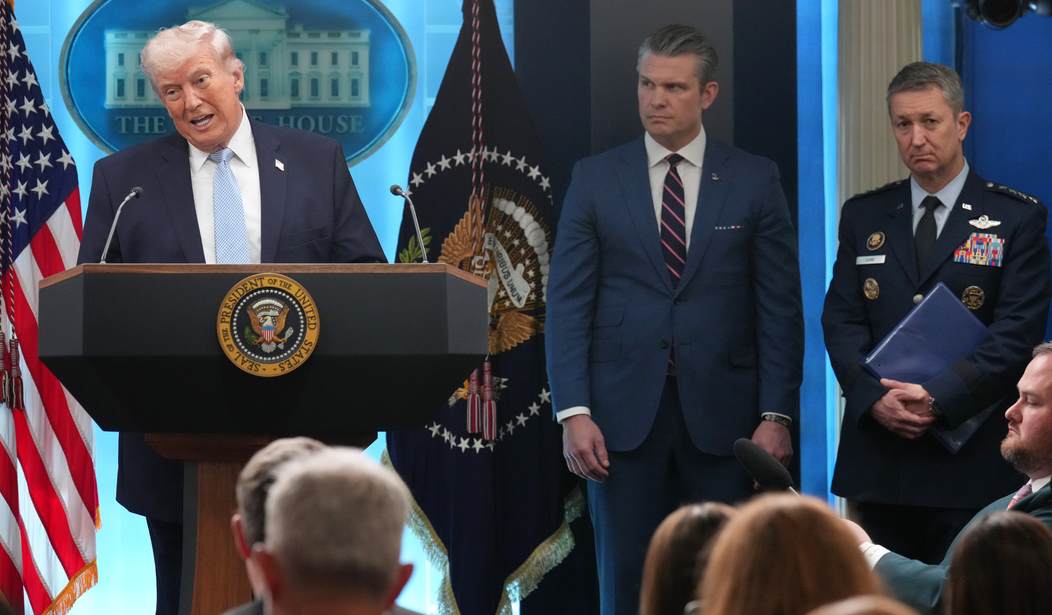
Will Donald Trump follow through on his ultimatum to target and destroy Iran’s energy infrastructure if the Strait of Hormuz did not fully reopen? We are still about 90 minutes away from H-Hour on that demand. However, we have already seen this threat expose the hypocrisy, ignorance, and propagandizing of the American media – and not just from legacy media outlets, either.
Initially, I began addressing this in my Final Word post, but it got so extensive that it clearly requires a more definitive rebuttal. The “war crime” narrative in relation to Trump’s threats to target Iranian energy infrastructure didn’t start with UN Secretary-General Antonio Guterres, but he certainly amplified it:
A spokesman for UN Secretary-General Antonio Guterres on Monday warned that attacking such infrastructure is banned under international law.
“Even if specific civilian infrastructure were to qualify as a military objective,” Stephane Dujarric said, an attack would still be prohibited if it risks “excessive incidental civilian harm".
Put simply, this is utter nonsense. First off, there’s no such thing as “international law” in this sense, or practically speaking, in any real sense. (Watch my interview with Prof. Gerald Steinberg last week for more on that point.) From the US perspective, the controlling ‘international law’ would be our adoption of the Geneva Convention. And if you think that the Geneva Convention prohibits targeting of energy and transportation infrastructure, you must have skipped history as well as law in school.
Andrew C. McCarthy rebutted this point specifically this morning, while citing the Geneva Convention:
In essence, they are turning international law on its head. By their lights, if objects having military value are somehow used by civilians, they become civilian infrastructure. This would cover, for example, the power plants and other structures around which the regime in Tehran has encouraged young Iranians to form human chains, so as to shield them from attack.
In reality, an object that makes an effective contribution to military action and whose destruction would confer a military advantage is a military object, not mere civilian infrastructure, under Article 52 of the first Additional Protocol (1977) to the Geneva Conventions (Protocol I).
Moreover, Protocol I has never been ratified by the United States, even though it was signed by the Carter administration. Indeed, President Reagan argued against its ratification, fearing that the pact would effectively legitimize guerrilla warfare and terrorism — a common tactic of both which is to exploit ostensible civilian infrastructure for military purposes.
In other words, the use of these infrastructures by the IRGC to contribute to both warmaking and terrorism makes them legitimate targets under the Geneva Comvention itself. To argue otherwise is to essentially reward terrorism and the use of human shields to protect terror operations.
As Andy goes on to explain, the Pentagon’s own manual on the subject specifically and explicitly makes this argument. That did not originate with Trump either, as the language in discussion was added by a previous administration. Guess whose?
In any event, the U.S. Defense Department’s Law of War Manual, which guides our forces, draws on Article 52’s careful qualification that objects having military value are not civilian; it also notes: “The law of war requires that civilian infrastructure not be used to seek to immunize military objectives from attack[.]” (Manual, p. 1034 n.50, quoting 2012 remarks by Obama State Department legal adviser Harold Hongju Koh.)
That did not start with the Obama administration, either. The “shock and awe” campaign that opened the 1991 war against Iraq and Saddam Hussein included massive attacks on energy and transportation infrastructure:
In Operation Desert Storm, a ground offensive was supported with extensive air strikes on every significant element of Iraq's dual-use power, communications, transportation, and industrial sectors. In a war that had the potential to become protracted, it made sense to destroy Iraq's ability to refine oil and produce ammunition, as well as its stockpiled reserves. At the same time, U.S. Air Force planners sought to cause only temporary damage to Iraq's economic infrastructure by precisely targeting easy-to-replace elements of key facilities rather than destroying such facilities outright.
Yet, these plans were thwarted by standard operating procedures that were deeply ingrained in the military community. Wary of underestimating Iraq, Desert Storm planners inflicted massive damage on the country's economic infrastructure.
This strategy was so successful, in fact, that the Pentagon later attempted to refine these strategies, not because of “international law,” but because it turned out to create headaches for the US after the war. Some of the people claiming this to be a “war crime” took part in those attacks:
CONTEXT: Retired fighter pilot Wiz Buckley points out that Mark Kelly targeted civilian infrastructure as a pilot.
— Andrew Kolvet (@AndrewKolvet) April 7, 2026
He targeted power plants, TV stations, and roads in the opening hours of that war, while up until now, President Trump has avoided hitting civilian infrastructure… pic.twitter.com/vQIT1O9xOA
He targeted power plants, TV stations, and roads in the opening hours of that war, while up until now, President Trump has avoided hitting civilian infrastructure to spare the Iranian people.
Trump chose not to go full “shock and awe” because he wanted to have escalation options. The initial decapitation of the Iranian regime offered a potential way to force the regime into capitulation. Trump took out the air defenses and air force next, followed by the navy, and has been escalating ever since. The US wanted to save this step for a final escalation to see if we could get the regime to collapse first, and therefore preserve the infrastructure for the successor government in Iran. This choice has always been strategic, not legal, and it should reflect on Trump’s overall restraint in this war, especially in contrast to the 1991 war’s start.
The “war crime” narrative also has another absurdity, which is that the IRGC and military junta has been targeting energy production sites in neighboring countries since the start of the war. The sudden claims that reciprocal attacks on Iran’s infrastructure amounts to a war crime indicts the critics making that claim for their silence on Iran’s actions, especially since those nations were not belligerents at the time.
This is nothing more than an attempt to kneecap the US and Israel from exercising legitimate military options as needed to win a war. One senses that the real offense felt by these critics isn’t a violation of “international law,” but that the US (and Trump particularly) might actually win this conflict.
Update: Damned if you do, damned if you TACO, or something.
See how they do it. Either Trump/America is committing war crimes, or he is a chicken. There is no in between.
— John Ondrasik (@johnondrasik) April 7, 2026
Like Hamas, the greatest ally Iran has is Western media. https://t.co/2Ed6ngf6Df
Editor's Note: For decades, former presidents have been all talk and no action. Now, Donald Trump is eliminating the threat from Iran once and for all.
Help us report the truth about the Trump administration’s decisive actions to keep Americans safe and bring peace to the world. Join Hot Air VIP and use promo code FIGHT to get 60% off your membership!








Join the conversation as a VIP Member