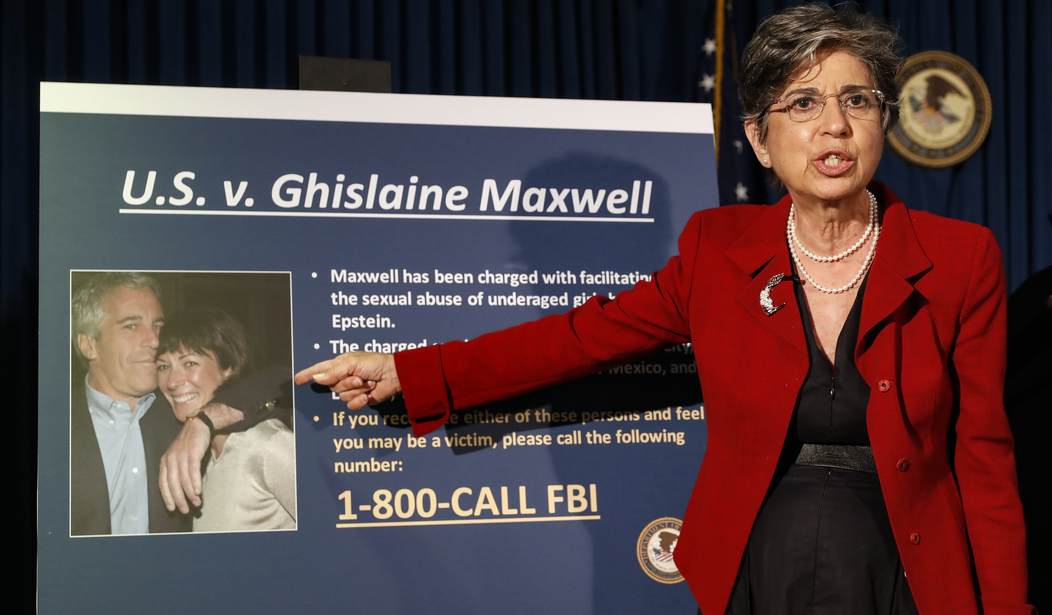
Republicans and Democrats have played chicken with each other all year over the Jeffrey Epstein case. This morning, the inevitable crash got a little closer. Or at least, the egg got closer to a lot of faces, as we'll see in a warning.
A second federal judge has released the material from a grand jury investigation into the Epstein sex-trafficking case. After a court in Florida unsealed the original grand jury material from 18 years ago, a New York court has ordered the release of the material from a grand jury probe in 2019 into Ghislaine Maxwell:
The Justice Department can publicly release investigative materials from a sex trafficking case against Ghislaine Maxwell, the longtime confidant of Jeffrey Epstein, a federal judge said on Tuesday.
Judge Paul A. Engelmayer ruled after the Justice Department in November asked two judges in New York to unseal grand jury transcripts and exhibits from Maxwell and Epstein’s cases, along with investigative materials that could amount to hundreds or thousands of previously unreleased documents.
The ruling, in the wake of the passage last month of the Epstein Files Transparency Act, means the records could be made public within 10 days. The law requires the Justice Department provide Epstein-related records to the public in a searchable format by Dec. 19.
The bill passed by Congress and signed by Donald Trump had a similar impact with Englemayer as it did with Judge Rodney Smith in Florida. Unlike Smith's relatively terse order, Englemayer issued a 24-page ruling, which essentially came down to the same rationale nonetheless:
The Act unambiguously applies to the discovery in this case. It governs “all unclassified records, documents, communications, and investigative materials in the possession of [DOJ], including the Federal Bureau of Investigation and United States Attorneys’ Offices” related to Maxwell, Epstein, and other enumerated subjects. Act § 2(a) (emphasis added). That broad formulation embraces the voluminous discovery subject to the Protective Order in this case. Such, by definition, was, and is, possessed by DOJ, and specifically by the United States Attorney’s Office in this District (the “USAO”).7
The Court thus finds that modification of the Protective Order is necessary to enable DOJ to carry out its legal obligations under the Act. Such relief is authorized by the Protective Order, which expressly provides for its modification by the Court. See Protective Order at 11–12.
As Smith did with much less fanfare, Englemayer also concludes that the new statute passed by Congress overrides the rules governing grand-jury secrecy in this one instance. Englemayer earlier notes that Congress identified both Epstein and Maxwell by name, and clearly intended for the full release of the data in its new statute:
A separate issue arises from the interplay between the Act and Rule 6(e). The two authorities squarely conflict: the Act, subject to permitted withholdings, mandates publication of grand jury records, but Rule 6(e)—as this Court recently held—forbids such disclosure.
DOJ is correct that, as between the two, the Act controls. As a general rule, “later statutes receive precedence over earlier statutes and specific statutes receive precedence over more general statutes.” United States v. Mohammed, 27 F.3d 815, 820 (2d Cir. 1994). Both canons apply here with force. The Act is specific, focused on evidence about Epstein and Maxwell, where Rule 6(e) prescribes a general rule. ...
The Court thus holds that, in passing the Act, Congress overrode Rule 6(e), in the very limited context of the Maxwell and Epstein grand jury materials. As to other grand juries, the secrecy of testimony, exhibits, and any other materials remains the rule, subject to the limited exceptions set out in Rule 6(e). But, in the case of the Maxwell and Epstein grand juries, under the Act, public disclosure of such materials is the rule, subject to the limited exceptions set out in the Act. The Act thus requires the Attorney General to make public the Maxwell grand jury materials, subject to the withholdings and redactions that the Act permits.10
However, Englemayer cast a significant dash of cold water on the idea that this release would add much to the public record. He castigated the Department of Justice for their failure to work with the victims when applying in July for the release of the materials, which created a storm of criticism at the time from the victim community. He also suggested that the DoJ misrepresented the amount of new information that would emerge from exposure of the grand jury material:
And, as the Court chronicled in denying DOJ’s motion, the motion itself misled victims—and the public at large—in holding out the Maxwell grand jury materials as essential to the goal of “transparency to the American public,” when in fact the grand jury materials would not add to public knowledge.12
Englemayer made the point more plain in a footnote, referring back to the original refusal by the court to unseal these records:
A member of the public familiar with the Maxwell trial record who reviewed the grand jury materials that the Government proposes to unseal would thus learn next to nothing new. The materials do not identify any person other than Epstein and Maxwell as having had sexual contact with a minor. They do not discuss or identify any client of Epstein’s or Maxwell’s. They do not reveal any heretofore unknown means or methods of Epstein’s or Maxwell’s crimes. They do not reveal new venues at which their crimes occurred. They do not reveal new sources of their wealth. They do not explore the circumstances of Epstein’s death. They do not reveal the path of the Government’s investigation. . . .
A “public official,” “lawmaker,” “pundit,” or “ordinary citizen” “deeply interested and concerned about the Epstein matter,” Motion to Unseal at 3, and who reviewed these materials expecting, based on the Government’s representations, to learn new information about Epstein’s and Maxwell’s crimes and the investigation into them, would come away feeling disappointed and misled.
In other words, get ready for a very large nothingburger. In part, that reflects the nature of the case that the DoJ prepped for Maxwell after Epstein's death. Prosecutors rightly recognized that any attempt to prove that Maxwell trafficked girls to anyone other than Epstein himself would damage the victims and likely be difficult to prove. Instead, prosecutors just focused on Maxwell's trafficking of underage girls to Epstein alone, and that was more than sufficient to get a conviction and a 20-year sentence. The grand jury investigation was almost certainly limited to the one beneficiary of the trafficking, and Maxwell alone as the perpetrator.
The other grand jury record sealed in the SDNY may have more potential for revelations, but it's also probably nothing too revelatory either. That grand jury investigated the same crimes that went uncharged in Florida from the 2007 grand jury in the Sunshine State. At some point, a federal judge will likely follow suit and unseal those materials under the same victim protections specifically ordered by Englemayer, but don't expect explosive revelations from either of those. Alan Dershowitz has had access to these materials for years and wants them fully released, but only because it will exonerate some of those who have been subject to speculation as part of the trafficking ring, himself included.
Let's hope that we get get all of the materials out in the open soon, just to finally put an end to the politicized circus that has taken place this year. The victims deserve better than this. Perhaps they will finally see light at the end of the tunnel.
Editor's note: Join our VIP Membership program! Choose VIP to support Hot Air and access our premium content, VIP Gold to extend your access to all Townhall Media platforms and participate in this show, or VIP Platinum to get access to even more content and discounts on merchandise. Use the promo code FIGHT to join or to upgrade your existing membership level today, and get 60% off!








Join the conversation as a VIP Member