
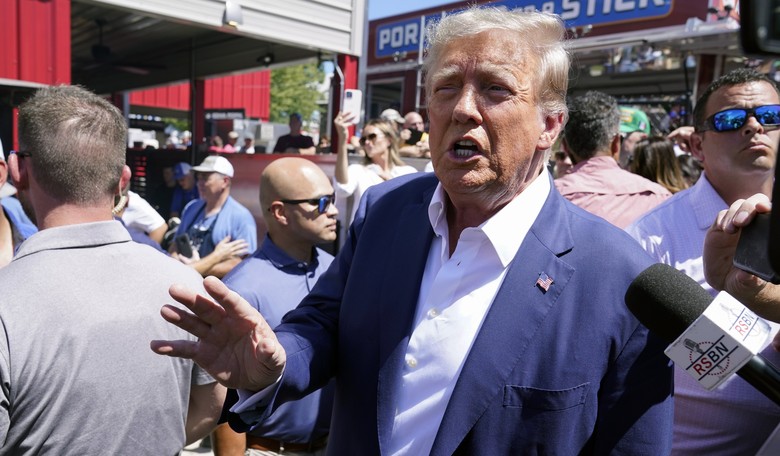
The kitchen-sink indictment from Fani Willis in Fulton County, Georgia certainly expands the legal threats Donald Trump faces. Will it also increase his political strength, as happened with Alvin Bragg’s politically motivated indictment over the Stormy Daniels payoff in March? Or has that market tapped itself out?
It has become an article of faith that each indictment strengthens Trump politically in the GOP nomination race. That isn’t quite true, in terms of polling, as the RCP aggregate-average chart demonstrates. The Bragg indictment, with its bare-faced political intent, certainly had that effect in March and April, but Trump hasn’t shown much benefit from the Jack Smith federal indictments. Of course, he hasn’t exactly suffered from them either, at least in polling:
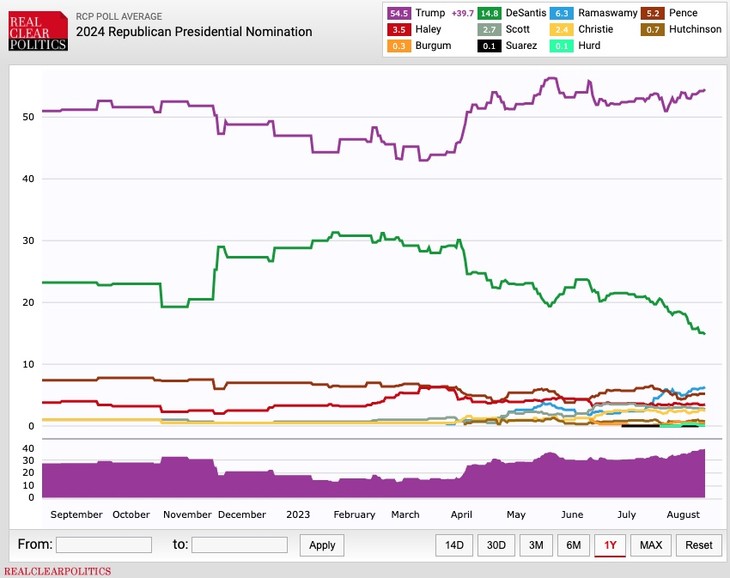
Will the Fulton County indictment change these trajectories — in either direction? If one thinks of the polling at this stage as a kind of stock market, it seems unlikely. The Fani Willis effort has been well known for months, as were the general charges that would likely result. The ‘market’ may not have anticipated an indictment this broad, but other than the list of defendants, there probably are no surprises. It’s baked into the cake already.
Furthermore, there’s enough chaff in this indictment for Trump supporters to justifiably criticize it as a political maneuver rather than a sincere law-enforcement effort. That’s especially true of Act 22 in the RICO charge (Count 1), which cites a tweet from Trump promoting OANN’s coverage of legislative hearings in Georgia, but it’s also true of several other counts regarding public statements and claims about the election:

Those less inclined to support Trump will focus on the more substantial parts of the indictment, especially the fake-elector scheme and attempts to pressure officials into allegedly violating their oaths of office. Those allegations have to be proven in court, of course, but voters can judge these events politically in terms of the nomination and general election in the meantime.
All of this seems like a wash at this point, much as the Jack Smith indictments proved to be. For those inclined to stick with Trump, it’s confirmation that politicized lawfare must be resisted by renominating and electing Trump. For others in the GOP, it’s yet more baggage Trump will carry into the next election cycle — baggage that already spoiled the midterm election cycle last year and promises to do worse in a presidential general election. If this indictment has any significant political effect, it’s probably that it will further entrench these positions.
In other words, it’s a stalemate at the moment, and that’s not good news for the GOP. Jim Geraghty warns about that in NRO today, although he knows that he seems to be whistling in the wind, at least for now:
Whether your preferred measuring stick is U.S. adults, registered voters, and likely voters – a majority of Americans don’t like Trump, they see January 6 as a national embarrassment, scandal, and disgrace, and they are unlikely to be persuaded that Trump is an innocent victim who broke no laws and who is being framed by malevolent prosecutors. Those who contended the 2020 presidential election was stolen lost just about every competitive race in the 2022 midterms; those who won were either well-known incumbents or in safely GOP states or districts. In the races for governor, secretary of state, and U.S. Senate, in Arizona, Georgia, Pennsylvania, Maryland, Michigan and Nevada, voters heard the stolen election arguments and rejected the candidates making them.
It is exceptionally unlikely that sometime between now and November 2024, many Americans change their minds about Trump and conclude he’s the most unjustly persecuted American man since Richard Kimble.
All of this makes the election of Donald Trump in 2024 extremely improbable.
Just how entrenched is this, though? It’s still too early to tell what long-term effect any of this will have. We have not yet even had the first debate in the primary, and it’s five months until the first caucus and primary. Most voters appear to be standing on their starting positions for now, which is understandable while the campaign remains in its preliminary stages and no one has to make a truly firm decision for a long while yet.
With that in mind, there are four potential inflection points over the next few months that might disrupt the entrenchment:
- The debates — These start next week, and will give voters their first clear look at the field. Trump almost certainly won’t attend the first debate, and thanks to his legal woes, may need to avoid all of them unless/until the polling changes. Even though the debates start next week, voters will want to see a few of them before either deciding on a candidate or changing their starting position.
- A Trump conviction at trial — This seems unlikely to happen before the primaries, but if it does, a conviction might cause his supporters to consider a Plan B for 2024. That’s especially true if a trial exposes significant deception from Trump and his team to his base about the 2020 election and what and when they knew about it.
- A Trump acquittal at trial — The timing is equally unlikely as a conviction, simply because these won’t come to trial quickly. But an acquittal would give Trump a yuuge boost in credibility and probably make his nomination inevitable. A well-deserved dismissal of the Bragg indictment before trial would have a similar effect, although probably not on the same scale.
- Flippers — This may be the biggest political risk from the Fani Willis indictment. In the other indictments, Trump has been either the sole defendant or nearly so. Willis indicted almost two dozen people yesterday, some of whom may be looking for the exits before a trial takes place. If some of Trump’s co-defendants come looking for a deal to avoid prison time — a big if at the moment — they won’t get immunity unless they give Willis evidence against Trump that bolsters the RICO case for trying to overturn legitimate election results. If the inner circle of “Stop the Steal” starts talking, that may have a significant political impact on Trump’s support base.
In the meantime, Trump will do his best to stoke anger among Republicans over the latest indictment. As I wrote the post, Trump announced a press conference six days from now to respond to the Willis indictment:
Donald Trump announces a press conference for Monday August 21st at 11am ET regarding his latest indictment in Georgia.
Salem News Channel will have the latest… pic.twitter.com/5S7m8JrfHK
— Salem News Channel (@WatchSalemNews) August 15, 2023
That seems like a long delay for a substantive response, and perhaps a risky move in setting expectations for a “report.” If Trump had an argument to refute the charges, one would expect that to be made in court first. Perhaps it will be, sometime this week, but we’ve heard similar promises before along these lines about Dominion, missing ballots, etc.
It still reminds us, though, that these issues will play out over months, not minutes. The primary fight hasn’t really begun in earnest yet. Stay tuned.
Meanwhile, the latest episode of The Ed Morrissey Show podcast is now up! Today’s show features:
- Did Joe Biden blow a hole in his media-generated empathy persona? Or did he just expose his cognitive issues?
- It might be both in Biden’s “no comment” answer regarding the Maui fires, Andrew Malcolm and I suggest. We also analyze the latest in the Hunter Biden probe, and take another critical look at the lack of media interest in the corruption surrounding Biden Inc.
- We also try to ketchup on condiment choices, and confess our french-fry sins.
The Ed Morrissey Show is now a fully downloadable and streamable show at Spotify, Apple Podcasts, the TEMS Podcast YouTube channel, and on Rumble and our own in-house portal at the #TEMS page!