
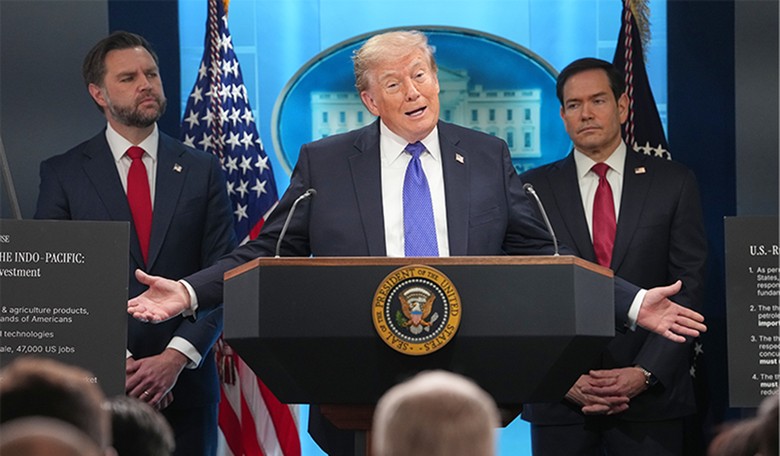
If you had to answer in five seconds what separates J.D. Vance and Marco Rubio most, the answer is obvious: foreign policy in general, and support for Israel in particular.
Sure, there are other differences, especially in tone, but none of them seemed to matter that much as Vance was the favorite not so long ago, and his support has been falling ever since the Iran War began, and most especially so since Vance began separating himself from President Trump (and Rubio) after the midterms.
New poll shows Marco Rubio leading JD Vance in key early states. Big leads among likely Republican primary and caucus voters in Iowa, New Hampshire, South Carolina, and Nevada. https://t.co/xjUOQjWin3
— Byron York (@ByronYork) November 23, 2026
Rubio's rise and Vance's fall isn't a minor blip. It's been showing up in a series of polls, and indicates that while Republicans are more skeptical of interventions in the Middle East than before Iraq, the Reaganesque desire to be a colossus astride the world is still alive and well in the Republican Party.
NEW POLL SHOWS RUBIO LEADING VANCE IN KEY EARLY STATES. For the first year of President Donald Trump’s second term, speculation about his successor focused largely on Vice President JD Vance, with a side discussion about Secretary of State Marco Rubio. Until quite recently, Vance had a huge lead over Rubio in national polls. For example, in a number of national polls from mid-September, Vance held a lead of 15 to 20 percentage points over Rubio. Now, after the disastrous Republican loss in the midterm elections, the RealClearPolitics average of national polls has Rubio at 35.4%, with Vance a bit behind, at 34.0%.
Those are national polls, but of course the Republican presidential selection process is not a national primary. As it has for a long time, it will start with the Iowa GOP caucuses, then move on to the New Hampshire primary, then to South Carolina and Nevada. The Iowa contest is a little less than 14 months away. That’s not that long a time.
Now, a new poll shows Rubio with a substantial lead over Vance among voters likely to take part in the crucial early contests. Conducted by OnMessage Inc., the survey questioned 1,000 likely voters in the four early states, 250 in each. It was conducted for a group called the Combat Antisemitism Movement, which was seeking information on voter attitudes about the controversial podcasters Tucker Carlson, Candace Owens, and Nick Fuentes. The short version: Most GOP voters in the early states don’t like them.
Neither party, it seems, is isolationist, even if their approach to the world differs dramatically. Democrats want us to be first among equals in a transnationalist alliance that replaces governments we don't like through color revolutions in the main, while Republicans care less about the internal politics of our allies and adversaries, but deeply about being the rule-maker when it comes to international conduct.
And, perhaps most interestingly, antisemitism is not at all popular among Republicans, and being associated with Tucker Carlson is hardly an asset.
OnMessage poll | surveyed mid-November 2028 Republican presidential primary (Iowa, New Hampshire, Nevada and South Carolina) 🟥Marco Rubio 47% 🟥JD Vance 28% 🟥Donald Trump Jr. 4% 🟥RFK Jr. 3% 🟥Glenn Youngkin 2% 🟥Ted Cruz 2% https://t.co/gekcw9yIKj
— Politics & Poll Tracker 📡 (@PollTracker2024) November 23, 2026
Americans' dislike for interventions in foreign affairs, especially for long military ventures, is very real. But it seems the appetite for getting involved depends more on how quickly and successfully interventions succeed than on a rejection of them in principle. Republicans have not become isolationists; they just want to win quickly and not spend a ton of time, energy, and money on fruitless ventures, which is rational — although I have to say that we have gone way too far in the direction of expecting that necessary ventures be essentially cost-free in time, treasure, and lives, however heartless that may sound.
Imagine fighting World War II today. It's hard to, even though we remember it as the good war.
Vance rips neocons on Iran: "The people who want it to become a forever war can attack me all they want. We signed up to not do this. We told the American people we would do no more forever wars. We are NOT going to stay there forever. We promised we wouldn't." https://t.co/F7M0GaKpc8
— TheBlaze (@theblaze) November 17, 2026
But that's a separate issue from this. What matters politically for 2028 is that Rubio is as associated with the war as Trump, and as Secretary of State, has been a vocal supporter of Israel, while Vance has distanced himself from the Iran conflict since before it began and is now openly opposed to it.
BREAKING: Secretary Marco Rubio is now the frontrunner to be the Republican presidential nominee for 2028. Choice for GOP Nominee: Marco Rubio: 34% (+28) JD Vance: 30% (-14) https://t.co/OLADXDJggg
— Eyal Yakoby (@EYakoby) November 23, 2026
It's hard to see what, other than Vance's open opposition to the war and his clear desire to end it before a clear victory, is the biggest variable in his fall; and Rubio's rise is his attitude toward Israel and the Middle East, and of course his rejection of a vision where America is astride the world as a colossus, dictating terms.
Rubio is an American Empire guy; Vance is for an autarkic US as much as possible.
Republicans, it seems, are still Reaganite in foreign policy, or at least Republican primary voters are.