
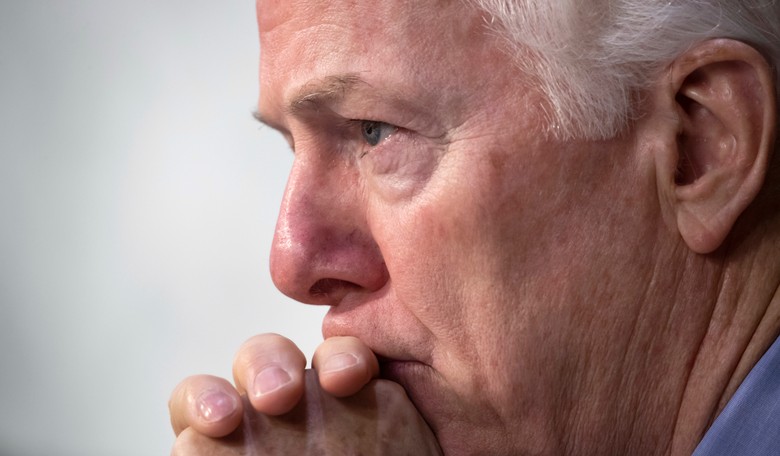
If John Cornyn had decided to write a piece entitled "I told you so," it wouldn't have been a classy way to leave the Senate, but it would have been justifiable.
After all, it's hard to argue that tossing Cornyn for Paxton put a more conservative Republican in the Senate. Instead, Texas and the rest of the country will have to put up with at least six years of James Talarico in the Senate, which is almost too much to bear.
That's not to say that if Cornyn had been on the ballot, he would have won; we don't know the counterfactual outcome, although a fair person would likely admit that it would be at least possible. I'm not saying that Cornyn would be right to argue the "I told you so" point, just that he could make a plausible case that the voters made a mistake when they booted him.
But Cornyn didn't stop there. Instead, he shared a New York Times piece arguing not that Cornyn was a better choice than Paxton, but that Texas values are a lot "Bluer" than people think.
@JohnCornyn Butthurt loser John Cornyn is reduced to spreading FUD from NYTimes instead of owning up to his own failures to serve Texas voters. Sen Cornyn: If you were a great Senator, you would have been reelected. You should write an essay "Why I failed"
— Patrick McGuinness (@mcguinnessfortx) November 20, 2026
As a piece, it's actually not that bad. It has all the "Diversity is our strength" stuff in it, of course, and it literally quotes a Palestinian-American comedian as a "cultural leader" because, of course, it does, but the gist of the piece is actually accurate: Texas IS a very diverse state with a unique culture, although I don't think it establishes that it is "Bluer" than we thought.
But it's pretty clear why Cornyn shared that piece, and it has less to do with a sociological analysis of how Texas is a melting pot with a lot of the crayons not fully melted; it has to do with the headline: Texas Is Bigger and Bluer Than You Thought.
He didn't really share a think piece; he was giving the finger to the voters who complained he was too liberal.
"See? I am more reflective of Texas than you rubes!"
Of course, that attitude is exactly what got Cornyn booted in the first place. As much as dissatisfaction with Cornyn's votes cost him, his arrogance likely cost him more. After all, I can say with confidence that Lindsey Graham often deviated from his constituents' wishes, but he won by comfortable margins despite that.
No politician perfectly represents all his constituents or even the views of his party; somebody like Cornyn gets booted because voters lose trust in him when they no longer seem to care what voters think.
Cornyn radiated that "I am better than you" vibe, and when he disagreed with his base, he didn't explain why he thought they were wrong; he insulted them for being wrong.
Too few politicians who radiate that attitude get booted, and whether or not it was GOOD that Cornyn is gone (after all, a Cornyn in that seat is better than a Talarico), it is certainly JUST that he lost. He deserved every vote that went to Paxton as a rebuke.
In any normal election cycle, Paxton would have won. I am quite confident of that, actually. I don't say that because Paxton was a great candidate or a great choice, because, frankly, I don't know. I wasn't there in Texas, and I only know Paxton from the various and sporadic articles I have read about him.
It's far simpler than that: this was a wave election, and the wave was bigger than even the best candidate could have outswum. Paxton was hardly unique in losing what should have been a safe seat; it was the rule, not the exception, and we lost South Carolina, Alaska, and Mississippi too. He may or may not have been the best candidate, but it didn't really decide the race in the end.
The tide did.
Cornyn sees this and is crowing, which isn't just bad form; it is an example of the temperament that made him anathema to the voters who booted him.