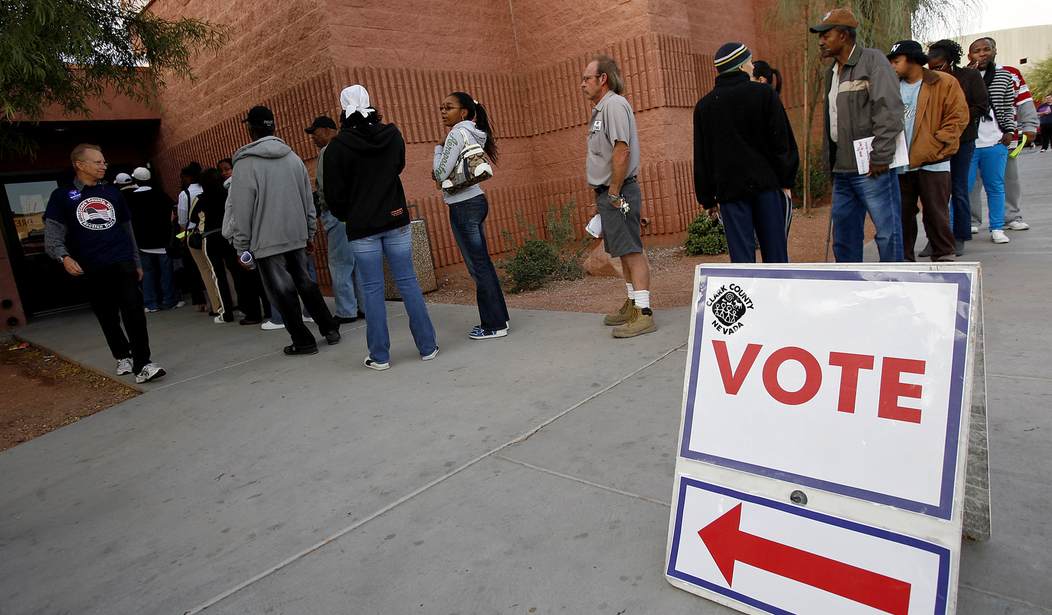
Do you ever wonder why so many Blue states refuse to hand over their voter rolls to the federal government?
After all, there is a federal law that requires certain measures to ensure ballot integrity, passed in the wake of the 2000 Florida debacle. It requires, among other things, that states clean their voter rolls of ineligible voters.
But these states refuse to do that, and they refuse to show that they aren't breaking federal law.
Of course, every sentient person knows exactly why they do both of those things: they cheat, and want to make it as hard as possible to detect the cheating, and almost impossible to audit elections to ensure that they are fair. Every time you hear a liberal say that there are so few cases of voter fraud prosecuted, what they mean is that they get away with it because there are almost no mechanisms to prove it.
Oregon's population grew by 406K from 2010-2020. It's registered voters grew by 882K in that same timeframe. pic.twitter.com/ApEV7gahCs
— Jim (@JimTBreakout) April 30, 2026
Judicial Watch, an invaluable conservative organization, sued the State of Oregon for its practice of mailing ballots to its "eligible voters" without ensuring that the voters were, indeed, eligible. Rather than face the lawsuit and the inevitable discovery proving their intention to cheat, the state settled it, agreeing to clean 800,000 ineligible voters off its rolls.
800,000. In a state of 4.3 million people, with only 3.4 million registered voters. That's about one out of four voters on the rolls. And those are only the ones we know about.
Judicial Watch filed the lawsuit in October 2024, alleging Oregon failed to remove ineligible voters and seeking to enforce Section 8 of the NVRA after identifying widespread voter roll maintenance failures across dozens of counties (Judicial Watch, et al. v. The State of Oregon et al. (No. 6:24-cv-01783)).
In its complaint, Judicial Watch argued that Oregon’s voter rolls contain large numbers of old, inactive registrations; and that 29 of Oregon’s 36 counties removed few or no registrations as required by federal election law. Judicial Watch asserted that Oregon and 35 of its counties had overall registration rates exceeding 100%; and that Oregon had the highest known inactive registration rate of any state in the nation. In combination, all of these facts showed that Oregon was failing to remove inactive registrations as required by federal law.
In August 2025, a federal court in Oregon denied a motion to dismiss by Oregon and ruled the lawsuit could proceed.
In response to the lawsuit, Oregon Secretary of State Tobias Read announced earlier this year that Oregon has about 800,000 inactive registrations, which are kept separately from the active voter rolls and do not receive ballots. Of those, roughly 160,000 already meet federal and state criteria for removal—having received confirmation notices, failed to respond, and not voted in two federal elections—and are slated for cancellation. The remaining approximately 640,000 inactive records do not yet qualify for removal and will be processed through future list maintenance efforts.
In its press release, Oregon acknowledged that routine removal of outdated records effectively stalled in 2017, leaving a large pool of long-dormant registrations on the rolls without being fully processed for removal. The scale of the backlog underscores a gap in routine list maintenance that is only now being addressed. “These directives are about cleaning up old data that’s no longer in use so Oregonians can be confident that our voter records are up to date,” said Read.
Secretaries of State go to great lengths to claim that everything is fine, just as they go to great lengths to maximize the number of obviously ineligible votes that get counted. California, for instance, routinely takes weeks to count its ballots. Five weeks in the last election cycle.
Democrats told us voter fraud didn’t exist — and we were crazy to demand Voter ID.
— Katie Miller (@KatieMiller) April 23, 2026
In California, Laura Lee Yourex registered her dog to vote and subsequently cast ballots in the dog’s name.
Please tell me more about the integrity of our voting system. pic.twitter.com/o6J1km9wKX
Some states will accept mail-in ballots that arrive days after the election, without basic details like date stamps showing when they were actually mailed.
You're looking at the wrong metric. The majority of allegations did not concern miscounts, but invalid registrations and votes. Counts are unrelated to a test of ballot validity. https://t.co/95FJGUqbix
— Art (@ZarkFiles) April 27, 2026
Hundreds of ballots are often sent to the same address. Mail drops can be used as addresses. Empty lots are used as voter addresses. The only reason we know any of this is because ordinary citizens get off their butts to check things out. Nobody in power wants to check, because they know it benefits them.
3 women were just indicted on 17 counts for voter fraud in Alabama for ballot harvesting & falsifying absentee ballots — in which they were SUCESSFUL in flipping a local election.
— Bridgett Fertig (@LightOnLiberty) March 20, 2026
When democrats tell you voter fraud doesn't happen and our elections are secure — ALWAYS know that… pic.twitter.com/1jxkVjdru6
We were told this never happens…
— C3 (@C_3C_3) March 31, 2026
Mail in ballots are a vector for fraud.
Shakir Khan
41 completed and sealed mail in ballots.
71 names registered to his address.
Now multiply Khan by 10’s of millions.
Voter fraud is staggering.
End it.pic.twitter.com/D9c8h4QRjw
There are likely millions of ineligible voters in America who receive ballots that are harvested, voted, and counted. We don't know, and Democrats don't care to know.
🚨 Nick Shirley found (108) people registered to vote in one home
— Kris (@kriswild_kris) April 25, 2026
A woman wanted to show how easy it was to commit voter fraud that she registered her two dogs and they voted
A woman voted in four times but she was already dead!🤯🤯
pic.twitter.com/Gm8q6TzNKK
Mail-in ballots are by far the least secure, which is why liberals love them. Keep the voter rolls as dirty as possible, mail ballots out to fake or ineligible voters, and voila!, you have Deep Blue cities pouring in votes in statewide and federal elections that can swing elections.
It's unlikely that city and county elections are swung by fraud because these places would overwhelmingly vote for Democrats in any case, but a Senate or presidential election could turn on fraudulent votes quite easily.
That's why Republicans are keen on increasing ballot integrity, and why Democrats will fight to the death to prevent it. Voters overwhelmingly want better fraud prevention; Democrat politicians will do almost anything to stop it.
As the Oregon case shows, the state would rather settle a lawsuit and make a modest effort to clean the voter rolls if it means avoiding discovery. Who knows what records are hidden? Theoretically, none should be, but we all know how that goes.
We are getting a glimpse into the financial fraud that funds the Democratic Party and its NGO complex; that, I suspect, is the tip of an even more corrupt iceberg.
Editor’s Note: We voted for mass deportations, not mass amnesty. Help us continue to fight back against those trying to go against the will of the American people.
Join HotAir VIP and use promo code FIGHT to receive 60% off your membership.







Join the conversation as a VIP Member