








A lot has happened in the past few days, and with so much news to digest, it's hard to separate out the wheat, the meat, the chaff, and the offal.
The meat of this metaphor is calorie-dense information that is also mostly of immediate interest. This target was struck, that leader was killed, and this country has stepped in to join us. It's all very important, but ultimately only relevant to how this particular conflict plays out. Once the dust settles, the overall strategic situation is the only thing that matters, not when some target or another was struck.
Then there is the wheat. Each individual grain doesn't make as much difference in an immediate sense, but it's the wheat that forms the basis for this meal and all subsequent ones, because you raise the cattle with the grain. Man may not live by bread alone, but bread is a big part of the diet.
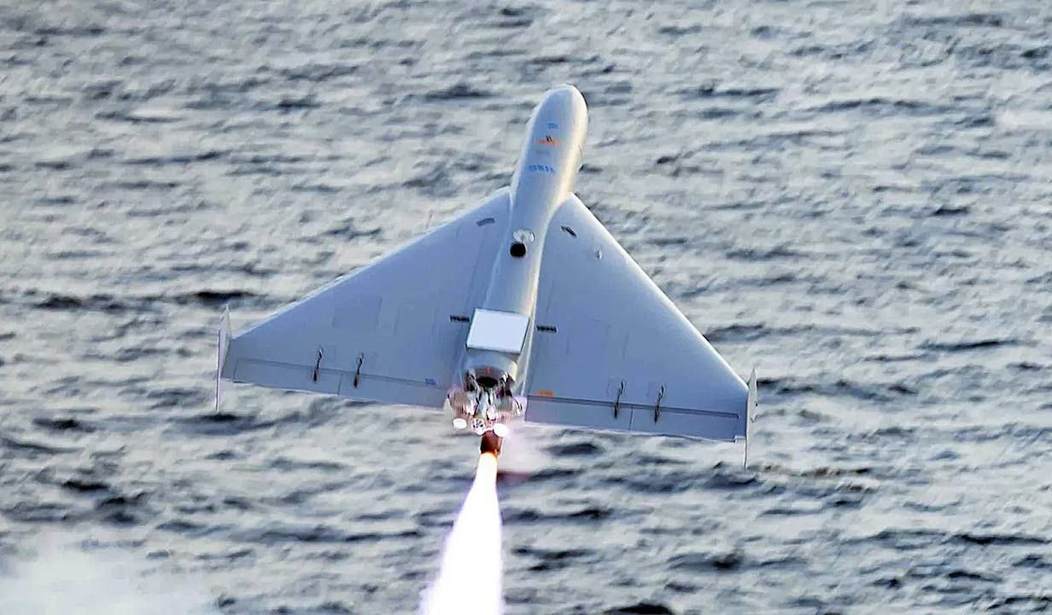
Enough of the metaphor...I took it too far. The particular wheat I want to talk about is a new strain that could change the tactical and strategic situation quite a bit, and that is the Low-Cost Uncrewed Combat Attack System (LUCAS) kamikaze drones that were deployed for the first time in this conflict with Iran.
U.S. Military Has Used Long-Range Kamikaze Drones In Combat For The First Time
— The War Zone (@thewarzonewire) February 28, 2026
America’s clone of Iran’s Shahed-136 has been used against Iran in an ironic vignette of modern drone warfare.https://t.co/6AYYhFeeNW
Everybody who has talked about these drones has noted the irony of their use, because the base design is a rip-off of the Iranian Shahed drones that Russia has bought and used in Ukraine. The irony is great, of course, but I think they have missed the significance of a few tweaks the US has made to vastly increase the lethality of these drones and make them a game-changer on the battlefield.
Meet America's homegrown, Low-cost Unmanned Combat Attack System💥
— BFBS Forces News (@ForcesNews) January 10, 2026
🇺🇸'LUCAS' is based on the Russian Shahid 136, and for the first time, the US Navy has launched a one-way attack drone from a warship at sea
🧐Take a closer look at America's Shahed Drone pic.twitter.com/GF45W7Zc0D
What's important about them is not how much they resemble the Iranian drones on which they are modeled, but how vastly different they are in capability because of those tweaks.
The LUCAS drones are designed to be a far less expensive strike weapon than missiles, which not only cost more, but are far more difficult and time-consuming to produce.
“Costing approximately $35,000 per platform, LUCAS is a low-cost, scalable system that provides cutting-edge capabilities at a fraction of the cost of traditional long-range U.S. systems that can deliver similar effects,” Navy Capt. Tim Hawkins, a CENTCOM spokesperson, told TWZ back in December. “The drone system has an extensive range and the ability to operate beyond line of sight, providing significant capability across CENTCOM’s vast operating area.”
In addition, the LUCAS design includes features that allow for “autonomous coordination, making them suitable for swarm tactics and network-centric strikes,” a U.S. official told us. As we have explained in detail in the past, the swarming capabilities combined with some of the drones being equipped with Starlink terminals, means extremely advanced cooperative tactics and dynamic targeting are possible, all while keeping humans in the loop.
The LUCAS drones have “an extensive range and are designed to operate autonomously,” CENTCOM said in a press release announcing the creation of Task Force Scorpion Strike. “They can be launched with different mechanisms to include catapults, rocket-assisted takeoff, and mobile ground and vehicle systems.”
There's a lot of technobabble in there about autonomy and swarms, but there is one line in there that should really stand out to you: "equipped with Starlink terminals."
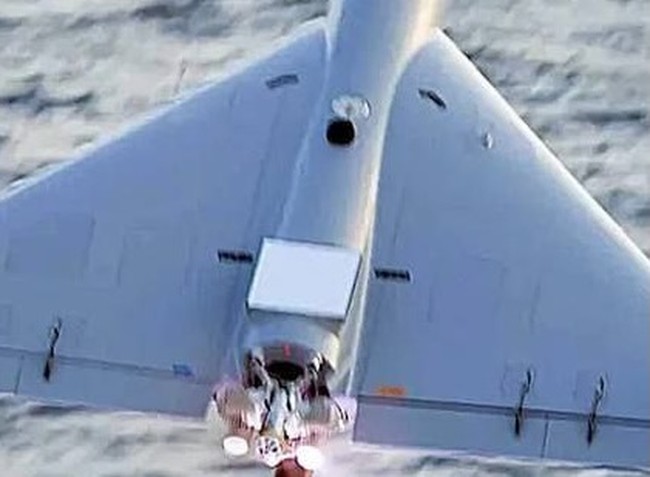
That white square? That changes absolutely everything, not only for this particular drone, but for a whole host of weapons in a similar category.
Unless I am very mistaken, the integration of Starlink into weapons could turn out to be as significant a revolution in military affairs as laser-guided weapons or stealth, and let me tell you why.
WE have a lot of smart weapons and guided missiles, like the Tomahawk, that are good at hitting targets they are programmed to hit. But for the most part, they rely on built-in intelligent systems to either fly where they are supposed to, or to identify targets like ships (LRASM) using artificial intelligence. Drones that fire Hellfire missiles have a man in the loop, but those are not a tool you use on the battlefield in a highly kinetic environment.
The Low-cost Unmanned Combat Attack System, or LUCAS drone, is a one-way attack drone reverse-engineered after the Iranian Shahed-136. https://t.co/tvsVQmgUN9
— Military Times (@MilitaryTimes) February 28, 2026
Integrating Starlink suddenly allows us to create a low-cost drone swarm with a man in the loop, using a resilient and nearly impossible-to-jam system that has a GPS-equivalent location tracking capability, the ability to coordinate, and a person hundreds or thousands of miles away able to direct them in real time.
That is not a Shahed drone. It is a new killer weapon system that is massively difficult to defeat. It can be produced in astonishingly large numbers by a country such as Iran, and even including upgrades would be incredibly cheap for the United States to mass-produce.
The integration of Starlink onto low-cost drones suddenly turns them into extremely high-precision weapons, producible at scale, that don't need a separate delivery system. They won't bust bunkers, obviously, but there are plenty of targets that do not require more firepower than these weapons provide.
And...this is just the start. Could Starlink terminals show up on Tomahawks? On LRASMs? On any other steerable weapons systems?
I would bet so.
When we think of drones on the battlefield, we focus on either the short-range first-person weapons that hunt tanks or soldiers, or the reusable drones we use for surveillance or limited strikes with Hellfires. The Shahed-type drone is relatively new and essentially a cruise missile.
LUCAS is, if I am correct, fundamentally different because of the addition of Starlink. If I am right, this will change the strategic calculus a lot, especially since no other country has the kind of access to Starlink that we do.
Editor's note: If we thought our job in pushing back against the Academia/media/Democrat censorship complex was over with the election, think again. This is going to be a long fight. If you want to join the conversation in the comments -- and support independent platforms -- why not join our VIP Membership program? Choose VIP to support Hot Air and access our premium content, VIP Gold to extend your access to all Townhall Media platforms and participate in this show, or VIP Platinum to get access to even more content and discounts on merchandise. Use the promo code FIGHT to join or to upgrade your existing membership level today, and get 60% off!



Join the Conversation
VIP members get the ability to comment on articles.