










The Atlantic has published an essay that was "extensively reported" about a child who died from complications from the Measles.
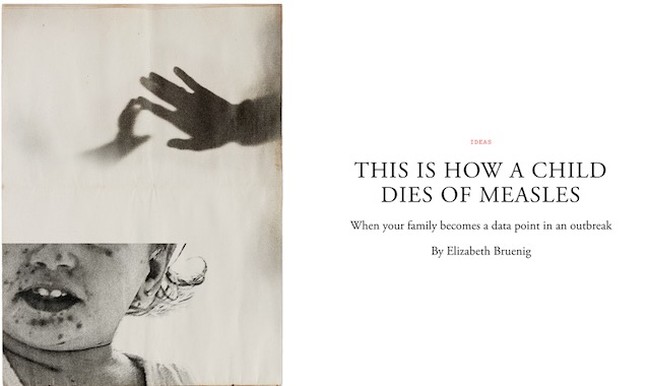
It was striking, evoking strong emotions, including revulsion, and left one not just with a deep fear of the measles and the consequences of the growing distrust of vaccines, but also with a strong impression of what motivates the people who fear the vaccines.
If you're not following this 2nd @TheAtlantic controversy, I suggest you do. They ran a terrifying, dark lyric story (entirely fiction) about a child dying of measles complications - as "reporting." @lpolgreen is rightly calling it out and asking excellent questions. pic.twitter.com/LJ1AKFNAw7
— Ann Bauer (@annbauerwriter) February 15, 2026
The piece has created a firestorm online, with a large number of people praising it for its powerful portrayal of the consequences of vaccine skepticism, and another large group of people who point out something that The Atlantic failed to: that the story was fiction, not "journalism."
First, as @Megankstack and @laurahazardowen and others have noted, this piece wasn’t “reported”, it was researched; and it isn’t creative non-fiction, it is just fiction. It is not based on a real family’s story. It is entirely invented. Per Bruenig’s interview w Laura, she never…
— Rachael Bedard (@RBMD1982) February 14, 2026
In fact, The Atlantic cleverly implied but did not outright say that the story was factual. Instead, the magazine said it was "extensively reported," which it certainly seemed to be. It was long, lovingly detailed, seeming filled with facts and certainly with pathos, and did exactly what its author intended: move the audience.
https://t.co/w1bjyLIrb0 https://t.co/U3frOjmvGx
— Benjamin Ryan (@benryanwriter) February 15, 2026
Some writers, like Benjamin Ryan, think it's just fine that fiction was presented as fact, and that if you didn't understand it then it is your fault.
Of course, that's bunk. The whole point of the article and how it was presented as "extensively reported" was to deceive people into believing that fiction was fact.
It is The Narrative™. Ryan and others believe The Narrative™ IS reality. The article may not be "True True," but it is "True" in some deep and existential way.
And even for people who understood that the piece was fiction, the effect of it was that it was read as an accurate, fair depiction of how the measles epidemic is playing out in homes across America.
— Rachael Bedard (@RBMD1982) February 14, 2026
But it isn’t.
Measles IS in hundreds, probably thousands, of homes right…
Rachael Bedard's criticism of the article is spot on: first, fiction should be labeled as fiction. Second, because this is fiction portrayed as fact, it serves as much to reinforce the prejudices of the lefty readers as anything else.
Vaccine skeptics don't see themselves in how they are portrayed, and all the piece did was confirm that their critics are willing to lie to get their way.
I now know a number of anti-vaxxers. I don’t know almost any who would see their choices or identity or experiences reflected in Bruenig’s idea of them. It’s a projection that reflects some discourse on mom message boards, maybe, but, for not being informed by more than that,…
— Rachael Bedard (@RBMD1982) February 14, 2026
It's simple enough: if you have to create a fictional world to get your point across, then people who value critical thinking instead of emotional, Narrative™-based appeals will dismiss you, as they should.
It's how we got school closures, social distancing, safe and effective, and all the rest.
Most of the arguments for vaccines these days are not based on rational evaluations of the costs and benefits of different choices; they are based on emotion and insults hurled at dissenters.
I honestly don't have a dog in the MMR vaccine hunt. I am deeply frustrated, though, at the fundamental dishonesty of the vaccine promoters. No doubt there is a good scientific argument to be made, and if Jay Bhattacharya recommended it, I would take his advice. But that's because he would give a rational explanation of the benefits and risks, not a rant about why we all should comply or sob stories meant to short-circuit our brains.
Instead we get this...the failure to even try to distinguish between fact and fiction.