
In 2010, the car brand that had been 'Engineered Like No Other Car in the World' for 30 years (1980-2010) was rebranded as 'The Best or Nothing.'
I guess someone thought it was a little more direct and to the point regarding the product. Maybe they felt it carried a dash more haughty unattainability to tease prospective buyers into a frenzy of 'must have it' - the legendary brand known for 'uncompromising quality and luxury.'
Whatever the reasons for the makeover, the fact of the matter is there's been plenty of compromising going on in the past decades at Mercedes, much of it forced on the company by government policies, both German and the European Union, and some of it unforced errors in management decisions.
There has also been ratcheting and unyielding pressure from the Chinese automakers, rapaciously gobbling up trade secrets as European lines expand into mainland China, and then undercutting their pricing in Europe with their cheaper-to-produce imports.
At no time did German union autoworkers act as if they had any cognizance that their industry was under assault on all sides; they continued on their merry way, hollowing it out from the middle with demands that seem insane to American workers, who always seem to be looking for an extra shift or a couple of extra hours to bank.
This was a year ago, in November.
Layoffs announced in Germany, past 12 months: • VW: 35,000 • Mercedes-Benz: 40,000 • Audi: 7,500 • Ford: 2,900 • Daimler Truck: 5,000 • ZF Group: 14,000 • Bosch, Continental, Schaeffler: 7,000 And countless suppliers. German economy is not in a crisis, it’s imploding. https://t.co/MbQe9Iqjkd
— Michael A. Arouet (@MichaelAArouet) November 15, 2025
In December of last year, German industries were tapped for a survey, and the results were dreariness.
...46 German business sectors were queried for the recent survey, and 22 of them came back with negative assessments of business conditions going forward into next year.
A majority of German business associations expect job cuts in 2026 as the country's economic crisis persists, with industry hit hardest by global protectionism and weak exports, a survey by the German Economic Institute IW showed on Monday.
Of 46 business associations surveyed, 22 anticipate workforce reductions next year. Only nine expect to increase hiring and 15 foresee stable employment levels....
I've been chronicling Volkswagen's descent into gridlocked inertia all fall, with one of my last posts detailing how the company's planned cost-saving job cuts had been derailed by labor union-connected politicians demanding the company's executives answer to workers for their plans.
Such is the 'German way.' Absolutely unfathomable to American companies, but I can see how it would totally be a workers' fantasy arrangement.
...And labor jumped all over the CEO and his team, demanding that the head man 'explain himself to the company's workforce.'
Like, wowsahs.
...Labor’s swift response was to heap more pressure on management. VW works council chairwoman and supervisory board member Daniela Cavallo issued an ultimatum that called on Blume to explain himself to the company’s workforce. Like other major corporations in Germany, VW runs on a system of co-determination with worker representatives that’s designed to foster long-term consensus...
Mercedes has been facing serious challenges, along with every other German carmaker.
...Chinese sales of Mercedes models dropped 8pc in the third quarter compared to a year earlier. Drivers in China have either closed their wallets or are buying cheaper, domestically made cars.
Meanwhile, German carmakers are struggling to compete against an influx of cheaper Chinese cars in their European home market, and have faced tariffs in the US.
Mercedes cut the forecast for its 2026 profit margin by two percentage points, to between 2pc and 3pc, last month. It said earnings would be flat.
It has also been a victim of hysterical union intransigence regarding layoffs. Or, even worse, as far as the unions are concerned, having the unmitigated gall to ask for the little sacrifice of a minimally extended workweek for the same pay.
This has proven to be the ultimate heresy. No one has any intention of doing any more work than they already do.
...The car giant, which is based in Stuttgart, has for months been pushing a plan under which its staff would work longer hours for the same pay.
The trade union, IG Metall, has pushed back, and Ms Seeger said “no solution is currently in sight”.
...The car giant is trying to save €800m (£668m), including through increasing the working week from 35 hours to at least 38, and potentially cutting back holiday bonuses, according to German media.
Ms Seeger said: “If we don’t increase productivity in the country and reduce costs, we can hardly invest any more here.”
The company has about 108,000 employees in Germany, comprising two thirds of its global workforce.
Unlike the weak, vacillating creatures over in Volkswagen's corporate headquarters who really are hamstrung by a deeper public chunk of ownership stymying the implementation of tough measures for survival, Mercedes-Benz seems willing to grab the one tiger by the tail it can control - it is walking away from investments in any of its factories (some of which are upwards of 100 years old), and will be doing critical assessments to determine which are going to be shuttered completely.
Mercedes-Benz has suspended all future investment in Germany, warning it may need to shut plants and relocate jobs.
The carmaker has suffered from shrinking sales and profits in recent years, triggering a wave of cost-cutting which has culminated in a decision to stop investing in its domestic plants entirely.
Michael Schiebe, the production director, told employees: “The executive board has jointly decided to halt all further investments in German sites.”
Britta Seeger, the company’s workforce chief, said bosses would now “examine specifically and in detail which locations we can still afford in Germany”.
It comes amid a showdown between management and unions over the company’s cost-cutting plans.
And that line from the production director really says it all - that the company needs to determine which locations 'we can STILL AFFORD IN GERMANY.'
IN GERMANY
That's the crux of the entire situation - affordability. Germany is unaffordable and unworkable for industry, just in labor costs alone.
...Mr Schiebe said: “The cost of an hour of labour in production in Germany is sometimes up to five times higher than at locations in Eastern Europe.”
For three more hours a week and maybe a reduced bonus, these Mercedes workers are willing to risk it all. Probably because for so long there has been no risk when they tantrum.
Every German auto factory job lost costs five more lost at suppliers.
Everyone is talking about Mercedes' announcement to stop all investments in Germany and close some factories. Why the surprise? Germany has done everything humanly possible to destroy its industry. Look at the list of mayor layoff announcements: - Volkswagen 100,000 - Thyssenkrupp Steel 11,000 - Bosch 13,000 - Schaeffler 8,160 - Porsche 9,000 - BMW 8,000 - DHL / Deutsche Post 8,000 - Audi 7,500 - ZF Friedrichshafen 7,600 - Commerzbank 6,900 - Siemens 5,600 - Daimler Truck 5,000 - Lufthansa 4,000 - SAP 3,500 - Evonik 3,200 - Vodafone 2,300 - MAN 2,300 - Zalando 2,700 - Voith 2,500 - O2 Telefónica 1,100 These are only the large companies, each job cut there costs up to five more at suppliers. Germany buys some time to mask the industrial collapse with more debt and higher government spending. A country of government workers and welfare recipients will not recover to its former strength though. Most Germans do not yet understand what is coming. Prosperity is not given forever, bad left-green choices and policies have consequences.
— Michael A. Arouet (@MichaelAArouet) November 14, 2026
- - Volkswagen 100,000
- - Thyssenkrupp Steel 11,000
- - Bosch 13,000
- - Schaeffler 8,160
- - Porsche 9,000
- - BMW 8,000
- - DHL / Deutsche Post 8,000
- - Audi 7,500
- - ZF Friedrichshafen 7,600
- - Commerzbank 6,900
- - Siemens 5,600
- - Daimler Truck 5,000
- - Lufthansa 4,000...
...These are only the large companies, each job cut there costs up to five more at suppliers. Germany buys some time to mask the industrial collapse with more debt and higher government spending. A country of government workers and welfare recipients will not recover to its former strength though. Most Germans do not yet understand what is coming. Prosperity is not given forever, bad left-green choices and policies have consequences.
And it's not just labor union vampires bleeding German industry to death.
'Energy-intensive' German industry is running nearly 18% worse than it was in 2021.
Destatis confirms it. In 2025, output in Germany's energy-intensive industries was 17.8% below 2021 (calendar adjusted) and fell another 2.6% on 2024. Overall industrial production was down 1.3% in 2025. Who will pay the taxes when companies quit, leave or need subsidies?…
— Milan Šimoník (@milan_simonik) November 16, 2026
Mercedes is aggressively looking to shift much of its German production to the US, as well as to existing plants in Eastern Europe.
...Furthermore, demand in China has dropped sharply amid fierce competition from domestic carmakers. China is Mercedes-Benz's largest single-country market, accounting for roughly 30% of its global passenger car sales. While total regional volume in Europe is slightly larger than China alone, China easily outpaces every individual country, including the United States and Germany.
Whatever move Mercedes-Benz makes in Germany, it will have no negative impact whatsoever on the automaker’s Tuscaloosa plant in Alabama. In March 2026, Mercedes-Benz Group committed to a $4 billion investment through 2030 to upgrade and expand its Vane facility in Tuscaloosa County, which is part of a broader $7 billion U.S. manufacturing push.
The facility will most likely benefit from the brand’s production strategy in Germany. To offset tariffs imposed by the Trump administration, Mercedes is already moving production of its high-volume GLC compact crossover from Germany to the United States.
Assembly is scheduled to kick off in late 2027, pushing the plant's annual output capacity toward 340,000 vehicles. Mercedes-Benz’s U.S. plant currently employs 5,800 workers and exports about 60% of its output. The plant builds luxury SUVs, such as the GLE, GLS, and all-electric EQE and EQS SUVs.
Meanwhile, the German unions want pay raises. The disconnect is mind-blowing. Even our auto-unions have made concessions when push came to shoving people out of jobs.
...Management wants workers to increase their standard workweek from 35 to 40 hours per week without a pay raise and accept cuts to special bonuses. In the meantime, the unions are pushing for wage increases, Deutsche Welle reports.
The company and the unions live in two different worlds.
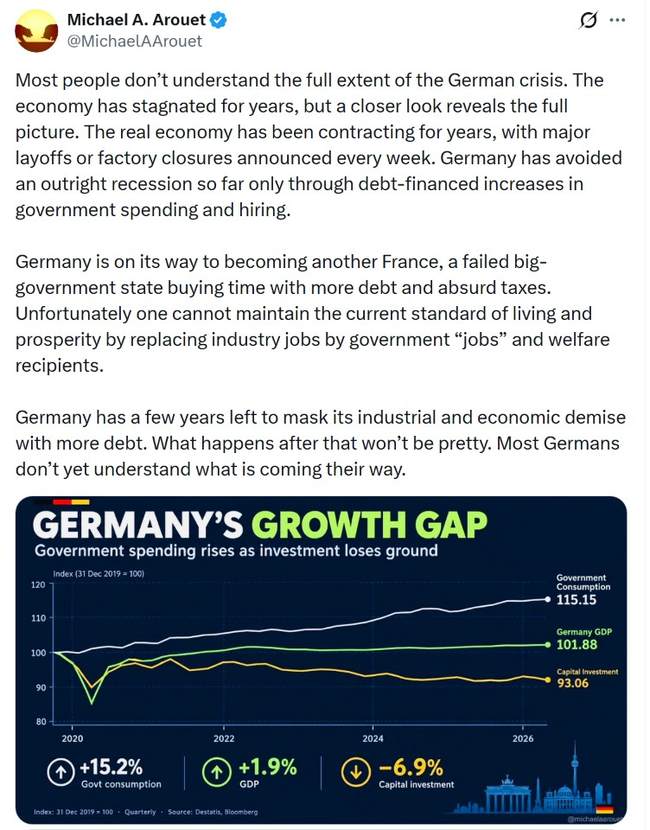
Germany is a welfare state, including those who are now working in labor unions at auto factories. When that already exceedingly fragile balance of declining capital investments, workers' wages for minimal effort, overly generous benefits, and government spending driving much of the German economy begins to completely break down with factory closings, the entire house of cards will tumble.
Mercedes employees were out protesting the cost-cutting proposals back in July, and here they are now - staring down the loss of factories that would have remained open, while denying the economics of the situation, as usual.
Der Streit zwischen Management und Arbeitnehmervertretung bei Mercedes-Benz eskaliert. Intern droht der Vorstand drastische Maßnahmen an: Künftige Fahrzeuge könnten »ausschließlich im Ausland« produziert werden. Link in X-Bio. https://t.co/ndrvXXcULO
— DER SPIEGEL (@derspiegel) November 12, 2026
The dispute between management and employee representatives at Mercedes-Benz is escalating. Internally, the board is threatening drastic measures: future vehicles could be produced “exclusively abroad.”
Reality bites, or will shortly.
As for Germany, the only question is going to be: does it go out with a bang or a whimper?