
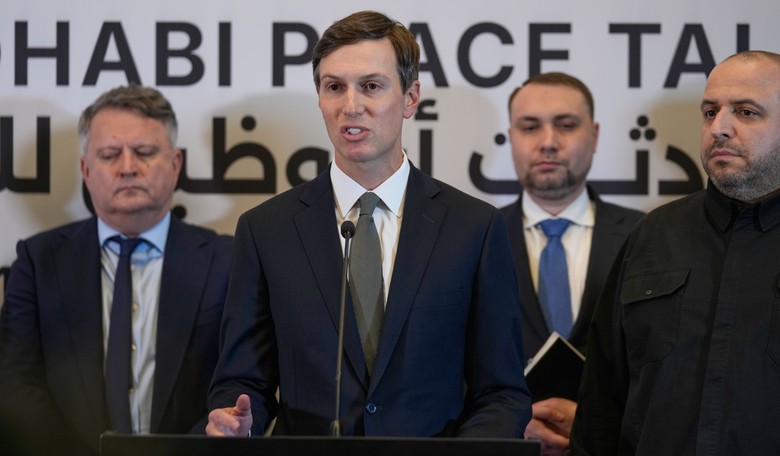
I mentioned yesterday that Ukraine and Russia were holding two days of talks in the UAE. Those talks are being mediated by the United States, specifically by Jared Kushner. Day one of the talks ended yesterday without anything concrete, and day two has now ended with an agreement to hold a prisoner swap.
Officials at U.S.-mediated talks between Russia and Ukraine said Wednesday that the sides have agreed a large exchange of prisoners of war.
"One of the positives is we agreed that we're going to have the biggest humanitarian release of prisoners, which we're going to finalize the numbers tomorrow," Jared Kushner, U.S. President Donald Trump's son-in-law, said after the two days of talks in Abu Dhabi ended...
Hopes were low for any major breakthrough in the first meeting in nine months between the delegations. Russia and Ukraine have from time to time swapped prisoners during their nearly five-year war.
No one expected much to come out of this and those low expectations were met. There's a simple reason for that. Russia's demands haven't changed even a little bit.
Despite public optimism from Trump, there has been no sign of major compromises on the main issues after more than 4-1/2 years of war since Russia's full-scale invasion of Ukraine.
With talks deadlocked on land - Ukraine has rejected Russian President Vladimir Putin's demands to surrender the whole of the eastern region of Donbas in return for peace - US mediators have tried to steer talks toward post-war security guarantees and reconstruction.
"The reality is there is no trust right now between the sides and that is to be expected after a conflict like this," Kushner said, adding that the talks in the capital of the United Arab Emirates had touched on territorial issues and that these would be the hardest to resolve.
Here it is coming from the horse's mouth, Vladimir Medinsky is the head of the Russian delegation:
Head of the Russian delegation Medinsky: Every inch of Russian land will be returned to Russia one way or another. https://t.co/VC7b7r10SV
— Clash Report (@clashreport) November 11, 2026
It's actually worse than the report makes it sound. According to President Zelensky, who got a report from his negotiators, the Russian generals in attendance talk as if they already control all of the disputed territory when in fact they do not.
When I received the second report from our negotiating team after their meetings in Abu Dhabi, they told me that the Russians think and say they have already occupied half of Donbas, which remains under our control. These were military officers, Russian intelligence, and they were serious about it. Our team told them, “We don’t know how you can even say such things. We have video footage, images, other things proving that these areas are under our control.”
This is the problem. Putin lives in a different reality. Of course, he will be sharing with the Americans that he needs one or two months to fully occupy the east of Ukraine. I can draw a picture for him too where I fully occupy Russia. But it’s not true. What was good is that the American side confirmed the Ukrainian assessment of what is happening on the battlefield.
This is why we need to sit and speak at the level of leaders. There are a lot of questions. Like we spoke about the city of Kherson that is divided by the river today. The Russians control one bank, we control the other. But people want to live united on both banks. This is a Ukrainian city. Such issues are sensitive, but we have to speak about them. I think that tomorrow the teams will discuss the possibility of meeting at the level of leaders. I'm not sure that Russia is ready, but we will raise this topic.
Russia can't win on the ground so they are just pretending they won and making demands based on those fantasies. That doesn't sound to me like a country that is serious about making peace. But here's Kushner saying yesterday that he really believes Putin is ready for peace.
.@jaredkushner says President Trump believes the war has gone on too long and is "disturbed" by the toll the Russia-Ukraine war has caused. Kushner says him and Steve Witkoff "strongly" believe Russians and President Putin are ready for peace. https://t.co/2f4FQGftR2
— CSPAN (@cspan) November 10, 2026
Here's what I'm actually seeing. Russia spent the week insulting the Europeans as useless bystanders and offering nothing like a serious proposal. After the past two days it should be clear to everyone who is the main obstacle to a deal. Here's that same clip of Medinsky above but in this slightly longer version you'll see he followed up with an attack on Europe being deluded if it thinks Russia will accept anything less than everything it demands.
The chief russian negotiator has stated: “We will return every inch of OUR land one way or another.” The so-called “talks” with russia are futile. 1. Russia has not abandoned its neo-imperial ambitions towards Ukraine, let alone its delusions of restoring hegemony over Europe. 2. Moscow has been emboldened by the Trump administration, which not only shows little regard for Europe but also shares russia’s ambition to undermine the EU and weaken Europe. Trump would welcome a joint russian-American stranglehold on the European economy, achieved in part by restoring Europe’s energy dependence on Moscow. 3. Europeans made a strategic mistake by opening up the question of Europe’s future security architecture for discussion with russia. Moscow’s vision is fundamentally incompatible with the principle of a “Europe whole, free and at peace”. Rather than discussing the restoration of Cold War and early post-Cold War mechanisms – arrangements that russia itself has systematically dismantled – Europeans should focus on establishing a new balance of power in the face of the declining credibility and presence of the United States in European affairs. Russia will only take transparency, arms control and other confidence-building measures seriously when it recognises that Europe has developed credible defence and deterrence capabilities, and that Moscow can no longer sustain the arms race.
— Alexander Khara 🇺🇦 (@alexanderkhara) November 11, 2026
This isn't the language of peace, obviously. And you can see from the long hesitation that he's choosing these words carefully, saying only what Putin would want him to say.
Jared Kushner will now fly to Russia to speak to Putin and then he's headed to Ireland to speak to Zelensky. I don't think it will amount to much but we'll see.
Finally, here's what Russian state-controlled newspapers were saying yesterday about negotiations. If you assume all of this is designed to prepare Russian readers for the future, does it sound like Russia is preparing its people for peace?
Update: Here's more Medinsky. "Wherever the foot of our Russian soldier has stepped, that is ours," he said, quoting Putin.
Here is the unedited translation of what Russia’s chief negotiator Vladimir Medinsky told Russian state TV today. Q: A significant part of the territory of Kharkiv Oblast and other regions is currently under Russian control. Were exchanges of these territories discussed during the negotiations, and for which territories? Medinsky: The topic of possible territorial exchanges is periodically floated by various sides. Let me remind you of the history. After Ukraine's incursion into Kursk Oblast, a decision was made — the president has spoken about this more than once — to create a security zone along the border with the Russian Federation. This zone is now quite substantial. It is expanding, and it will continue to expand. I don't see any possibility of exchanging these territories. And again, as our leader so vividly put it, wherever the foot of our Russian soldier has stepped, that is ours. As the entire history of Russia has shown, every time we have shown a willingness to make concessions, to agree to compromises that are disadvantageous to us, to demonstrate peaceful intentions and a willingness to yield — every time we have taken steps towards our opponents to avoid certain hardships, as we thought, the result has been that we have ended up with even greater hardships. As the saying goes, we get both war and disgrace. But whenever Russia has demonstrated firmness and confidence in its own strength, as a result, all hardships have been overcome, and a time of lasting peace, tranquillity and development has come, both for us and for our neighbours. Therefore, wherever the Russian flag has been raised, it must not be lowered. The task is something else, and we talked about this today. The task is to create a system of comprehensive security in Europe that will become a new, modern Yalta and Potsdam. One that will be imbued with the spirit of Helsinki in 1975, that will reflect new, contemporary realities, and that will be fair. If we manage to create such a security system, then we will ensure peace in Europe for decades, perhaps even centuries. That is our main task. Q: At the very beginning of the meeting, you said some very cautious and important words: that we would try to move closer to achieving peace. Have you moved closer? Medinsky: I think so, yes, but right now a great deal depends on all participants in the process. A lot depends on Ukraine, on the position of the United States, and on whether Europe comes to its senses. In any case, all the objectives we have set ourselves will be achieved. Q: Are you satisfied for now? Medinsky: Only when we win and sign a peace agreement on our terms.
— Liza Fokht (@lizafokht) November 11, 2026
Q: A significant part of the territory of Kharkiv Oblast and other regions is currently under Russian control. Were exchanges of these territories discussed during the negotiations, and for which territories?
Medinsky: The topic of possible territorial exchanges is periodically floated by various sides. Let me remind you of the history. After Ukraine's incursion into Kursk Oblast, a decision was made — the president has spoken about this more than once — to create a security zone along the border with the Russian Federation.
This zone is now quite substantial. It is expanding, and it will continue to expand. I don't see any possibility of exchanging these territories.
And again, as our leader so vividly put it, wherever the foot of our Russian soldier has stepped, that is ours.
As the entire history of Russia has shown, every time we have shown a willingness to make concessions, to agree to compromises that are disadvantageous to us, to demonstrate peaceful intentions and a willingness to yield — every time we have taken steps towards our opponents to avoid certain hardships, as we thought, the result has been that we have ended up with even greater hardships.
As the saying goes, we get both war and disgrace.
But whenever Russia has demonstrated firmness and confidence in its own strength, as a result, all hardships have been overcome, and a time of lasting peace, tranquillity and development has come, both for us and for our neighbours.
Therefore, wherever the Russian flag has been raised, it must not be lowered.
The task is something else, and we talked about this today. The task is to create a system of comprehensive security in Europe that will become a new, modern Yalta and Potsdam. One that will be imbued with the spirit of Helsinki in 1975, that will reflect new, contemporary realities, and that will be fair.
If we manage to create such a security system, then we will ensure peace in Europe for decades, perhaps even centuries. That is our main task.
Q: At the very beginning of the meeting, you said some very cautious and important words: that we would try to move closer to achieving peace. Have you moved closer?
Medinsky: I think so, yes, but right now a great deal depends on all participants in the process. A lot depends on Ukraine, on the position of the United States, and on whether Europe comes to its senses.
In any case, all the objectives we have set ourselves will be achieved.
Q: Are you satisfied for now?
Medinsky: Only when we win and sign a peace agreement on our terms.