
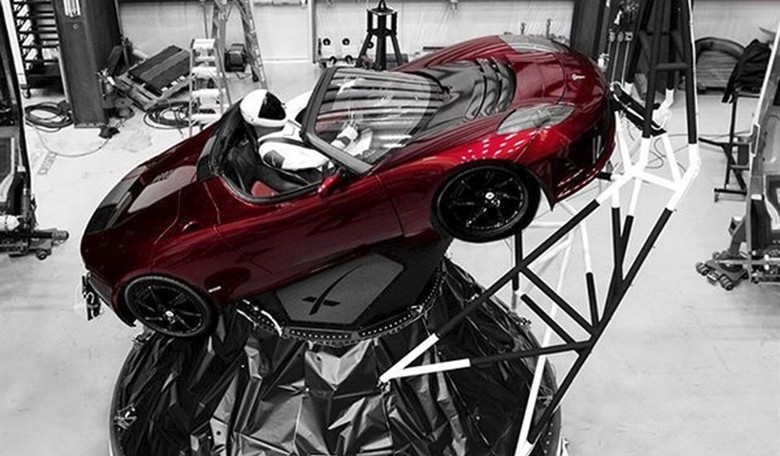
When Tesla first started the company only had one model. The Tesla Roadster was based on a car made by Lotus that the company heavily modified to make it battery powered.
In 2018, Tesla launched Elon's personal Tesla Roadster into space. It served as a "dummy mass" for a test launch of SpaceX's Falcon Heavy rocket. That car, which Musk used to drive to work, is still in orbit around the sun.
My OG Roadster is still orbiting Mars and Earth
— Elon Musk (@elonmusk) October 16, 2026
In 2017, Tesla announced a new roadster to replace the original version which had ceased production in 2012. It was shown off on stage but never went into production. Instead, Elon decided the new roadster would do a lot more than just go fast and look good.
There was a lot of build-up about the new car. Elon kept hinting that it would use SpaceX designed thruster that would allow it to accelerate faster than any production car ever made. He also hinted that it would be able to lift off the ground.
There was a lot of discussion about that online. A few weeks ago Tesla released a promo shot for the new car which had the words "we won't need roads" hidden in it.
See you next week https://t.co/BT52bGVxFu
— Tesla (@Tesla) September 25, 2026
This was a reference to the end of Back to the Future when the main characters leave in a flying DeLorean.
This obviously raised the hype about the possibility that the new car would actually fly.
Last night, the long delayed new demo happened and the new version of the roadster was unveiled. Musk mentioned the SR-71 and F-35 as inspiration but it looks a bit like a Lamborgini to me.
Our design language has evolved since the last reveal: from S3XY to Cybertruck, Cybercab & Optimus Roadster is inspired by the SR-71 & F-35 https://t.co/CV7trDTS66
— Tesla (@Tesla) October 16, 2026
In any case, what this car can do is truly one of a kind. First off, it has a fan system that can actually suck the car to the ground with enough force that it can drive upside down.
Tesla Roadster demonstration up close https://t.co/kuzA4c47ty
— Sawyer Merritt (@SawyerMerritt) October 16, 2026
But the real stunt did involve the car flying.
Real life, baby https://t.co/3QEqn18wig
— Tesla (@Tesla) October 16, 2026
The car also did a flying jump over the entire Tesla model line without ramps.
The Tesla Roadster is real and it can fly and it looks incredible in person https://t.co/VVrk8JupFY
— Edmunds (@edmunds) October 16, 2026
This is something straight out of an 80s sci-fi TV show that Musk used to watch.
One of my favorite shows as a kid!
— Elon Musk (@elonmusk) October 16, 2026
The 0-60 time for this version of the roadster is 0.81 seconds, which they demonstrated last night. Musk joked that the limiting factor was trying not to detach the driver's retinas.
🔥 WOW!! The new Tesla Roadster just did 0-60 in 0.81 seconds and Elon says the production model will be even faster! https://t.co/eCXIaG1gsw
— Chief Nerd (@TheChiefNerd) October 16, 2026
This thing really is pulling something like 3Gs when it launches. I'm guessing there is going to be a long health release you have to sign when buying any version of this car.
As for when it will be available, Musk promised real production and the first sales in 2028. There will be three models. The last one, will be invitation only.
Here are the trim levels for @Tesla’s next-gen Roadster: • Performance: $50k deposit • Thrust: $250k deposit • Rocket: Invite Only Production starts in 2028. Final/total prices TBD. https://t.co/JDhJafsBKh
— Sawyer Merritt (@SawyerMerritt) October 16, 2026
Apparently you need to put $250,000 down for that middle version, which is equivalent to the car in the demo (I think).
Finally, there were a bunch of people commenting online last night that all of this is old technology. Also, none of this will ever be legal on normal streets. That's almost certainly true. This is mostly going to be a very rare exotic car for very wealthy people who have their own test track to drive it on.
But still...
Musk made something that no one has ever seen outside of science fiction. As recently as a few weeks ago, people were doubting it would really do the things it did yesterday.
Is it practical? Not at all. As is often the case with Elon, part of what he wants is just to push the boundaries of what is possible for its own sake. Someone else probably could have done this 10 or 20 years ago but no one did. He made it real because he could. He's raised the bar for everyone else.
Peter Thiel has made an argument that our success as Americans and as a species isn't guaranteed. At some point, if we stop pushing forward into what is possible, we're actually sliding backward.
When tracked against the admittedly lofty hopes of the 1950s and 1960s, technological progress has fallen short in many domains. Consider the most literal instance of non-acceleration: We are no longer moving faster. The centuries-long acceleration of travel speeds — from ever-faster sailing ships in the 16th through 18th centuries, to the advent of ever-faster railroads in the 19th century, and ever-faster cars and airplanes in the 20th century — reversed with the decommissioning of the Concorde in 2003, to say nothing of the nightmarish delays caused by strikingly low-tech post-9/11 airport-security systems. Today’s advocates of space jets, lunar vacations, and the manned exploration of the solar system appear to hail from another planet. A faded 1964 Popular Science cover story — “Who’ll Fly You at 2,000 m.p.h.?” — barely recalls the dreams of a bygone age.
His argument is that we've been slowing down and losing even the motivation to go faster and farther than we have before. And Thiel sees Musk in particular as someone who is trying to rebel against this retrograde tide and push us all into the future we all dreamed was possible 50 years ago, i.e. the one with flying cars and a base on the moon and humans living on Mars. It's all science fiction until someone makes it real and possible.
Will all of those plans succeed? Maybe or maybe not. But what's important is having the drive to try. Because if we lose that, we've lost something fundamental to what America is. We're a civilization that is based around expanding into the new frontier. If we're not doing that anymore, then we're not the same culture.
Back in 1974, Evel Kneivel tried to jump the Snake River Canyon in a personal rocket ship. If you were around at the time, you probably remember the hype for this. It was something that every kid was watching. Evel didn't make it because a parachute ejected prematurely. And no one ever tried again. Last night, Musk suggested it might be time to return to Snake River Canyon with the new Roadster and see if it can be done.
So, again, the naysayers have a point that flying cars aren't very practical and you won't see one on the highway anytime soon. But it's real now and that's the most important thing. A new frontier has been conquered and it's both fun and inspiring. There are kids watching this whose estimation of what is possible for their future just went up a notch.
That's the culture we want to have again. It's like the old joke about why you climb a mountain. What's the point? And the answer is because it's there. That's a big part of being human that can get lost in a world that is more interested in safe spaces than pushing boundaries.