
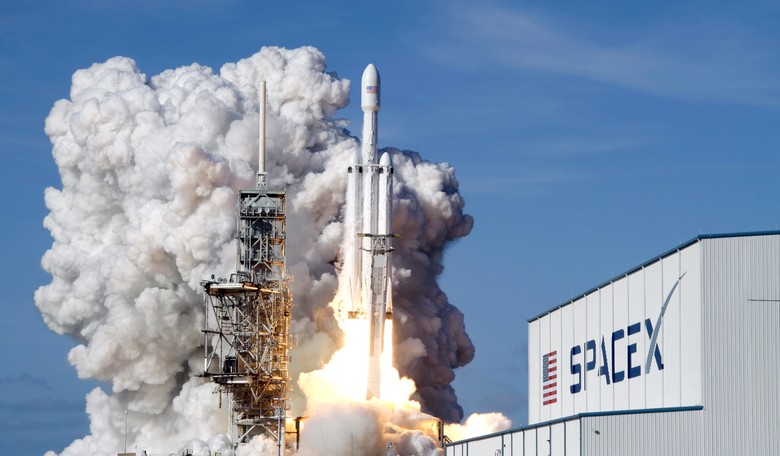
While everyone is wowed by the progress on a fully reusable two-stage rocket — Starship—and its dramatically increased capacity to send mass to orbit, few people seem aware that the company plans to exit the commercial launch business.
Elon Musk is currently very unpopular with the media and the Democrats, so every glitch gets coverage and every success is downplayed, but even his critics have been blown away by the amazing achievement of catching the Starship orbital vehicle after it was launched, deployed its payload of Starlink satellites, and returned to Earth for a safe and spectacular landing.
Mechazilla catches Starship! Congratulations to the entire SpaceX team on this incredible achievement! https://t.co/YJzmGUZb2B
— SpaceX (@SpaceX) November 14, 2026
It is impossible to overstate how important this achievement is both as an economic and engineering triumph. Starship is still an experimental vehicle, but Musk has proven that he can build a fully reusable two-stage rocket that can carry more mass to orbit than any rocket in history at some point in the foreseeable future. He is on track to deliver the high-cadence, high-mass launch capability he promised a few years back. For years, people insisted this goal was impossible; now his critics want to seize his company to get it.
To be sure, SpaceX has yet to catch both the booster and the Starship on the same launch, and the system is not clockwork yet, but the goal is now proven to be possible.
SpaceX has just released the first video footage of Starship deploying operational Starlink V3 satellites into orbit, following the image shared earlier. https://t.co/g47PmNwuMp
— Stellarix (@Stellarixorine) November 11, 2026
The most amazing achievement is one that few people have paid much attention to: creating a heat shield system that will be rapidly reusable, and doing it for a ship that is extremely complicated geometrically. But he and his team appear to have done it.
"Even just a year ago, we weren’t adopting it that quickly, but really starting this year, we started to adopt it extremely rapidly. And the acceleration we have seen in our ability to do engineering is unlike anything I’ve ever seen at the company." https://t.co/oYM5UMPdZ1
— Eric Berger (@SciGuySpace) November 9, 2026
All of this is great news, but for all its importance, it is not great news for the people who need cheap, reliable access to space. Because SpaceX is not building Starship for commercial launch, at least not for other customers. It's building it for NASA, probably the military eventually to deliver cargo, and most especially for internal use. If you want to book a launch or ride-share on Starship, you are out of luck.
That's too bad, but not the bad news. The bad news is that SpaceX plans to retire the Falcon 9 for commercial launch in the near future and has already stopped taking orders for new trips to orbit. Anyone who wants to get a satellite into space has just lost SpaceX as an option, and, in practical terms, there really isn't another option. SpaceX has, for all practical purposes, already exited the commercial launch business and the space industry is, rightfully, in a panic.
Satellite operators are in panic mode due to a worsening launch crisis What this means Here's the thing: 270 orbital rockets a year looks like a golden age — triple a decade ago, cheaper, faster. Satellite operators are still panicking because they cannot book a ride. Quilty Space's Caleb Henry: "What we have is an industry in panic." Hidden points - Telesat has 11 Falcon 9s locked and told other companies no, they will not share. Amazon LEO throttled satellite production because few of the dozens of launches it booked half a decade ago are ready. AST SpaceMobile said launch availability is now the pacing item - SpaceX flew Falcon 9 165 times last year and will probably fly about 20 fewer this year. Q2 2026: Starlink $4.3 billion of $7.8 billion revenue; space services, including commercial launch, under 12%. Customers already cannot reliably buy Falcon after 2028; one source says SpaceX told the US government commercial Falcon ends after 2028, with only limited federal missions after that - Starship is the supposed replacement, but the PEZ dispenser is built for Starlink, and the fear is SpaceX keeps the rocket for Starlink v3 and orbital data centers - Ariane 6 tops out around 10 a year. Vulcan has flown two military missions in six years after Northrop booster issues; the Pentagon already moved payloads to Falcon 9. New Glenn's only pad blew up in a May static fire — offline at least through end of 2026, probably into early 2027 Real impact / takeaways Without Falcon 9 the West has been screwed since Ukraine took Soyuz and Proton off the table. Next-gen medium-lift — Stoke Nova, Rocket Lab Neutron, Relativity Terran R, Firefly/Northrop Eclipse — might debut around 2027, but they will not scale fast. Stoke's Devon Papandrew says 2028 is when it gets really acute. Henry's line: some balance maybe in the 2030s. Investor / trader take This is a launch-slot squeeze, not a demand fade. Amazon LEO and AST SpaceMobile are already production- or deploy-constrained by rockets. SpaceX is rotating the P&L to Starlink, not selling more Falcon slots. The listed names in the piece are Amazon, AST SpaceMobile, Rocket Lab, Northrop Grumman, and Telesat. Rocket Lab's Neutron is the public shot at new medium-lift — even a 2027 debut does not fill the hole. Treat launch availability as the gate on constellation names through 2028. Bottom line Satellite operators cannot plan on Falcon 9 after 2028, and Vulcan, New Glenn, and Ariane 6 are not filling the gap — the crunch likely gets worse into 2028. Source : Ars Technica https://t.co/RaGjnIZbdv #SpaceX #Falcon9 #Starship #Satellites #Launch $AMZN $ASTS $RKLB $TSAT
— Tesla_Optimus (@Tesla_Optimus_K) August 18, 2026
Satellite operators are in panic mode due to a worsening launch crisis
What this means
Here's the thing: 270 orbital rockets a year looks like a golden age — triple a decade ago, cheaper, faster. Satellite operators are still panicking because they cannot book a ride. Quilty Space's Caleb Henry: "What we have is an industry in panic."
Hidden points
- Telesat has 11 Falcon 9s locked and told other companies no, they will not share. Amazon LEO throttled satellite production because few of the dozens of launches it booked half a decade ago are ready. AST SpaceMobile said launch availability is now the pacing item
- SpaceX flew Falcon 9 165 times last year and will probably fly about 20 fewer this year. Q2 2026: Starlink $4.3 billion of $7.8 billion revenue; space services, including commercial launch, under 12%. Customers already cannot reliably buy Falcon after 2028; one source says SpaceX told the US government commercial Falcon ends after 2028, with only limited federal missions after that
- Starship is the supposed replacement, but the PEZ dispenser is built for Starlink, and the fear is SpaceX keeps the rocket for Starlink v3 and orbital data centers
- Ariane 6 tops out around 10 a year. Vulcan has flown two military missions in six years after Northrop booster issues; the Pentagon already moved payloads to Falcon 9. New Glenn's only pad blew up in a May static fire — offline at least through end of 2026, probably into early 2027
SpaceX puts up somewhere around 80 percent to 90 percent of all mass to orbit, and will continue to do so, since SpaceX is SpaceX's biggest launch customer. But it put up a similarly large percentage of mass to orbit for commercial customers, and it is exiting the business, with all its nominal competitors not close to replacing the capacity SpaceX currently has.
This New Glenn rocket explosion released 20% of the energy of the Hiroshima atomic bomb and that wasn't even the bad part: → The pad: LC-36 is the only pad on Earth that launches New Glenn and now it's gone. Over $1B to build. SpaceX needed 7 months to rebuild after a similar hit. → The deadline: Amazon needs 1,618 satellites up by July 30 to keep its FCC license. It has ~300. The rocket that was supposed to help fix that just blew up twice in a row SpaceX made us believe that landing rockets on barges was a normal expectation. Turns out rocket science is hard after all. Wishing the team a speedy recovery 🚀
— Josh Kale (@JoshKale) May 29, 2026
Capacity has effectively evaporated from the market already, since only launches for other customers are booked. The fact that Falcon will continue to launch for the next few years is irrelevant to the demand that won't be met by supply. Capacity is about to shrink, and prices will skyrocket.
Gosh, things going from bad to worse for @ulalaunch. No launch since February due to investigating the SRB nozzle issue, now a mission failure 9 months later. https://t.co/RW0PKDyRVO
— Marcus House (@MarcusHouse) November 15, 2026
SpaceX isn't even bidding for Space Force orders now, and will only complete its current NASA contract, not take new ones. And its relatively big competitors are grounded. ULA just lost a spacecraft with all its cargo — Amazon LEO satellites — which is a huge blow to Amazon. And Blue Origin's New Glenn rocket is currently grounded because its launch pad is still being repaired.
NASA: $61,700 per kilo to orbit SpaceX: $1,400 The Shuttle was a $200B government money pit that barely flew and exploded twice, while Saturn V was already better at $5,200/kg. Then one private company cut the cost 44x while actually reusing the rockets. The difference is the incentive to get paid for making things work. The profit and loss system is a miracle.
— Rothmus 🏴 (@Rothmus) November 14, 2026
Falcon 9 created an entire space industry that never existed, and its exit from the launch market is nothing short of a disaster for companies that make small satellites. Nobody else can address that market right now, although new entrants may eventually. But one-off launches from similarly small companies can't service the market that exists.
What Falcon 9 is to the market
- 165 launches in 2025 — a single-year record for any rocket; 85% of all U.S. launches that year; more than half of global orbital launches to LEO (~51% of the global total on BryceTech figures cited by Via Satellite).
- Falcon family passed 710 total missions by late Oct 2026, >99.5% full mission success; a booster has flown 37 times (record, Aug 2026).
- Price points: dedicated list $74 million (raised from $70M in Feb 2026; ~$54M in 2013 — roughly flat in real terms). Rideshare (Transporter/Bandwagon/Twilight): $350,000 for up to 50 kg to SSO + $7,000/kg additional (Feb 2026 pricing). Transporter-18 (Oct 1, 2026) carried 130 spacecraft; cumulative rideshare deliveries passed 1,800 payloads across 18 dedicated SSO missions.
- That standardized, quarterly, cheap rideshare is what built the current smallsat economy (Planet, ICEYE, Capella, Umbra, Spire, GHGSat and peers maintain constellations on it).
There's a simple, easy-to-understand reason SpaceX is exiting the commercial launch market: Starlink is profitable, while launching for other customers is not nearly as much. The opportunity cost of servicing third parties is not attractive anymore. And Musk is taking the company into space-based data centers, which are still unproven, but who wants to bet against Elon Musk turning an engineering challenge into a successful business?
Nobody. And that's the point. Musk's critics keep saying he is stupid and lucky, but only stupid people believe that.
You work your ass off solving really hard problems day after day for decades, and this is what you get: anyone could have done it. As an investor, I can tell you the limiting factor isn't investment. It's founder ability. https://t.co/WrkxrJa1nZ
— Paul Graham (@paulg) November 15, 2026
Musk is a character out of a Heinlein novel, while also becoming the living embodiment of John Galt under attack by small people with small minds. The bureaucrats and backbiters want what he has and talk of seizing his companies, taxing him out of his fortune, and throwing him in jail. But any sane person knows that without Musk, SpaceX will become Boeing, which can't build a working space capsule anymore or keep ULA a safe alternative to SpaceX.
Musk is correct. NASA and the US national security enterprise need SpaceX a lot more than the company needs them. However, state and federal governments have regulatory power that could very much slow his businesses down. That is the big political risk going forward.
— Eric Berger (@SciGuySpace) November 6, 2026
Elon Musk doesn't need the rest of the market or government contracts, but the rest of the market and the government need him very badly. I don't say that because I idolize the man; it's obvious on its face, and every person in the space industry knows it and is panicking.
A hole in the market might not be filled until the late 2030s, and at best, it will be filled in the first half of the next decade.
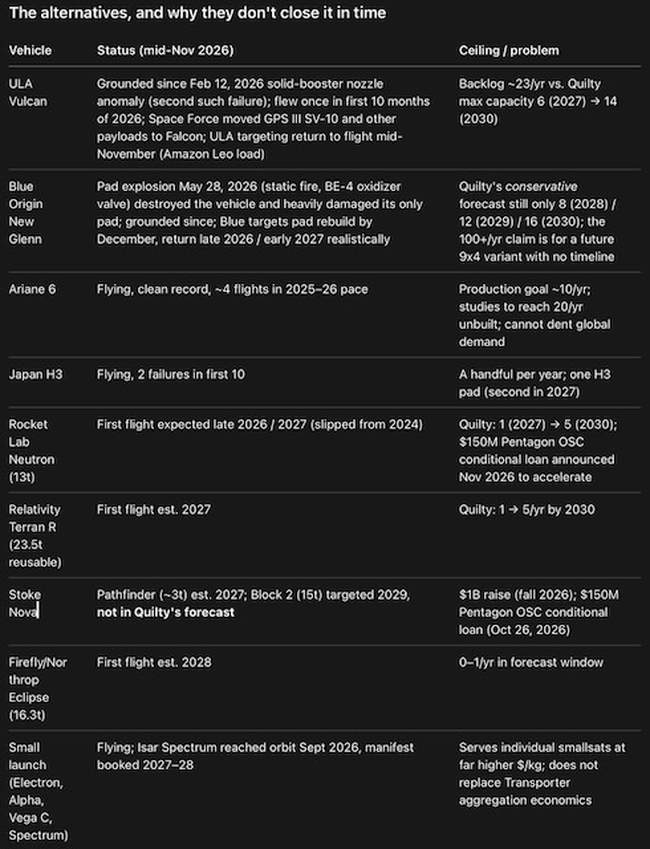 All this means that if SpaceX really does wind down its commercial launch businesses and focuses exclusively on fulfilling current contracts and servicing only its internal needs for Starlink and the new AI satellites (which will replace stalled data center construction by eliminating the need for massive earthbound capacity increases), everybody else is screwed.
ULA has not updated the mission page in nearly 40 minutes, since they announced the second stage of the rocket had separated from the booster stage. This is a bad sign. https://t.co/7nyM7ZhIoH
— Eric Berger (@SciGuySpace) November 15, 2026
It's hard to imagine that happening, but it is. SpaceX has already shut down orders, and right now, nobody has a legal way to stop the move to shut down SpaceX's commercial launch business.
"SpaceX isn’t a tech company. It’s an aerospace and communications company. It is vital to America’s national security and it must be brought to heel and aligned with America’s interests." https://t.co/0CyFiky1bH
— The Bulwark (@BulwarkOnline) November 3, 2026
That doesn't mean that nobody has leverage; Musk is in industries with significant regulatory exposure, and that matters a lot. He may be given an "offer he can't refuse," so to speak.
He also has enormous leverage that lawmakers may not have realized. Legal battles take forever, and Musk has resources that, in practical terms, arguably outstrip the government's. It's not practical for the government to use ALL its lawyers to fight Elon Musk, so while there is a resource and power asymmetry between Musk and the government, Musk can, in practical terms, make the government hurt far more than most people think. If Blue Origin could bully the government using legal maneuvers, as it has in the past, imagine what Musk could do.
Musk is playing an interesting game here. His decision makes economic sense in a vacuum, but it has such global consequences that I expect he will compromise in some way to keep serving the market at some level.
If not, a lot of people will be screwed.