
Well, this is quite the development. And no one would have expected it, given Trump's campaign rhetoric, his policies over the past two years, and especially his elevation of Stephen Miller to Chief of Staff. Of all people, Miller is the administration's immigration maximalist.
Still, Trump said it out loud during his conversation with Ross Douthat (who did a great job in his interview with Trump).
Just a year ago, Trump told Norah O'Donnell that his immigration policy wasn't tough enough. Yesterday, 60 Minutes aired its interview with Trump; he argued the opposite.
President Trump says his administration’s deportation policy was “too tough.” https://t.co/4EQsg4QA8c https://t.co/JDcqgRAySp
— 60 Minutes (@60Minutes) November 9, 2026
Calling this a reversal is a pretty big understatement. Aside from tariffs, there has been no more consistent policy position in the Trump administration than "deport them all," and now Trump is suggesting that he can work with the Democrats on an amnesty bill that would normalize illegal aliens who have been here for some period of time — say 10-15 years.
Trump endorses an amnesty deal with Democrats, saying immigration maximalists are on the “pretty far right” and suggesting that illegals who have been in the US for 10-15 years should have an opportunity to stay. Follow: @AFpost https://t.co/HSbH4RluaK
— AF Post (@AFpost) November 9, 2026
Needless to say, not everyone in his coalition is on board, including his new Chief of Staff, although Trump didn't name him specifically.
Here are some choice quotes from the interview:
Douthat: “What is one thing you would like to work with a Democratic majority on–”
Trump: “I'd love to do something on immigration.”
Trump: “I think it both helped and hurt. I think I got an A+ for closing up the border. I get very high marks for getting the bad ones out. But I get hurt because we also took people that had good jobs, that– that created one violation, or breaking of the law, and that was that they came into the country illegally.”
Douthat: “So you think your deportation policy–” / “Went too far–”
Trump: “Too tough.”
Douthat: “It was too tough?”
Trump: “I think it might be too tough, yeah.”
In the extended cut, he adds the political cost in his own words: “I think ultimately that hurt me” — and calls a deal “actually doable.”
Douthat: some kind of legal status for the landscapers? Trump: “the deal would be we would work something out. And I think it's something– I think that's something that's actually doable.”
“When you go into a hotel and you have a woman that's worked there as– you know, as a maid, as a cleaner, as a this, as a that, as a waitress, a lotta good things, great jobs, and all of a sudden, they're being taken outta the country, it's tough. It's a tough thing.”
“There's a group of people that I would say on the sort of pretty far right that would like everybody taken out.”
Douthat: Do any of those people work in your administration, in the building right now?
Trump: “Yes” — “Well, there're a lotta those people.”
Those are big statements that amount to admissions and policy reversals, and an implicit rebuke of a significant chunk of his MAGA base.
On the substance of his political analysis, I think he is right: the perceived harshness of his immigration policies, and especially the optics, did hurt him with Independents who would want a needle threaded: they want the immigration chaos to go away, and they don't want to see the chaos that results from fixing the problem.
Frankly, I think 70 percent of their squeamishness is that they have to SEE the chaos, and about 30 percent is a genuine belief that the policies were too indiscriminate. In an ideal world, many people just want the problem gone without any muss and fuss, and only nominally care about what it takes to get there (within limits). If the illegal aliens could be teleported out without all the drama, they would be fine with it; if the illegal aliens were (mostly) allowed to stay without all the accompanying problems (cultural and criminal), they would be fine with that too.
What they want is the appearance of normality. Which is, frankly, not Trump's style, although he is signaling here that he heard the message.
“Get the killers out, get the rapists out, get all the rough ones out, get the drug dealers out, but let the people that are here, and in some cases here for 10 and 15 years, work a deal for them.”
Trump even said there were people he might work with to get an immigration deal, and one name stood out: James Talarico. Which, again, was a surprise, given that Trump spent much of the campaign calling him much less flattering names. He even suggested that he would tone down the rhetoric to get a deal.
"People have already called me.” He cites newly elected Sen. James Talarico of Texas, who said on Fox that immigration was something he wanted to work on, and says others who won said the same. Asked if he could go six months without insulting Democrats to get a deal done: “Very easily.”
As you might imagine, not everybody was pleased with "New Trump," and they aren't afraid to say so:
Trump just said he’s willing to do a mass amnesty deal for millions of illegal immigrants… People voted for no more wars and mass deportations. Trump gave them a war in Iran and amnesty. Complete and total betrayal. https://t.co/qQBwvt1asw
— Geiger Capital (@Geiger_Capital) November 9, 2026
If Trump does this, I’m done. Amnesty is not an option. And he just nominated Stephen Miller to be Chief of Staff, so it won’t happen. But I’ll tell you, this is what the big donors push. Not very long ago I had a conversation with someone who is a major player and donor, and they’ll go unnamed, but they gave me a 20-30 minute impassioned speech about the need for Republicans to flip and offer amnesty. Not even kidding. They complained that their caterer was recently deported. Not even kidding. They stressed the need for cheap labor… like out of a playbook or something. I was told if I and other “influencers” would flip on immigration, we’d be leading the way and it would help set a tone. I’m too poor to have caterers and so is 95% of the country so I don’t have those kinds of problems to worry about. My problem is that our country is being flooded with absolute garbage from the third-world and they did so illegally. The conversation needs to be “how much legal immigration do we want?” and not “do we deport illegals?” because we already were clear in 2024… MASS DEPORTATIONS!
— Joey Mannarino (@JoeyMannarino) November 9, 2026
We've all been watching the brewing Civil War among the Democrats, with the Bolsheviks and the Organized Crime Democrats duking it out. Well, there is obviously going to be a similar Civil War among Republicans, and Trump is trying to ensure that, of all people, the moderates win the war despite the fact that he has been one of the chief instigators on the right.If Trump does this, I’m done.
Amnesty is not an option.
And he just nominated Stephen Miller to be Chief of Staff, so it won’t happen.
But I’ll tell you, this is what the big donors push. Not very long ago I had a conversation with someone who is a major player and donor, and they’ll go unnamed, but they gave me a 20-30 minute impassioned speech about the need for Republicans to flip and offer amnesty.
Not even kidding.
They complained that their caterer was recently deported. Not even kidding. They stressed the need for cheap labor… like out of a playbook or something.
I was told if I and other “influencers” would flip on immigration, we’d be leading the way and it would help set a tone.
I’m too poor to have caterers and so is 95% of the country so I don’t have those kinds of problems to worry about. My problem is that our country is being flooded with absolute garbage from the third-world and they did so illegally.
The conversation needs to be “how much legal immigration do we want?” and not “do we deport illegals?” because we already were clear in 2024… MASS DEPORTATIONS!
It's hard to say whether this is a winning strategy, or whether this is just an opening negotiating move, or what exactly Trump is trying to do here. Is this the "real" Trump, harking back to his days as a moderate Democrat, a change of heart, or a negotiating tactic?
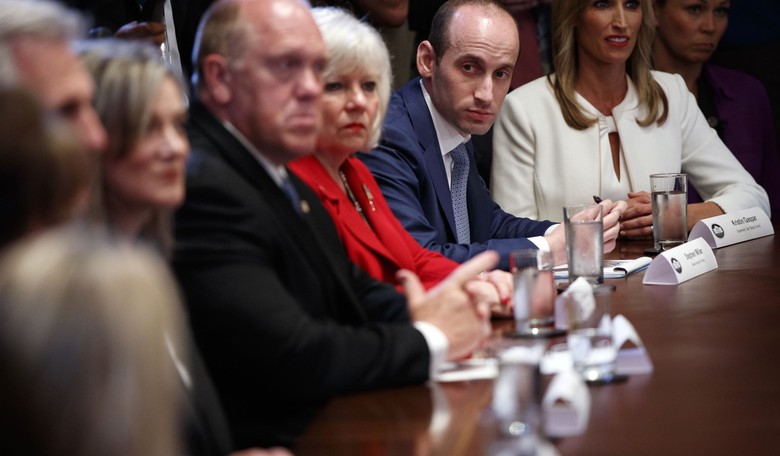
How does Stephen Miller's appointment fit in? After all, Miller is probably the most hated member of Trump's team among the Democrats, and he is already a focal point for anger.
Jeffries: "There's not gonna be any opportunity to work with Stephen Miller and what he represents. We're committed to forcefully pushing back against the extremism that they may try to continue to unleash on the American people." https://t.co/gb7bT3asda
— Aaron Rupar (@atrupar) November 8, 2026
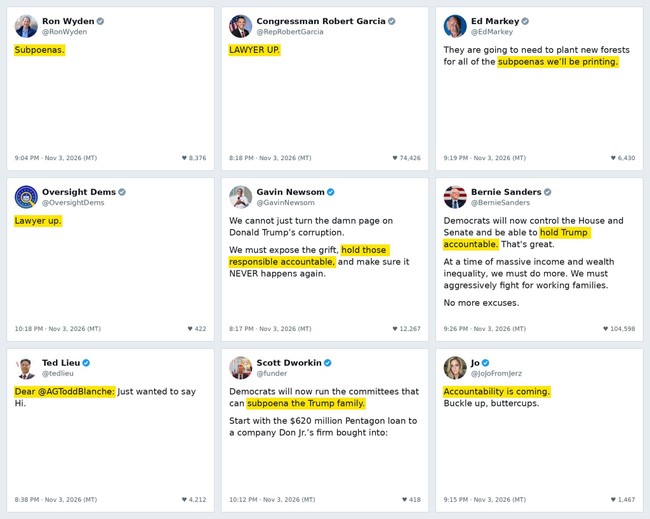
Jeffries makes it clear that working with Trump is not on the table, no matter what Trump wants. The investigations will move forward, and there is an insatiable hunger to put some Trump allies in jail. Elon Musk will face legal trouble for years, and Stephen Miller and Pete Hegseth will be hounded, perhaps out of the administration altogether.
In October I wrote that Senator Slotkin was announcing a program of Lawfare designed to deter young Republicans from serving a duly elected President. Her own formulation was revealing: she wanted prospective staffers to worry that joining this Administration meant “buying myself a ton of problems that I don’t want.” She added: “I want that deterrence message sent.” Now the President has named Slotkin while calling for DOJ to examine threats against administration officials and supporters. Whether particular conduct violates a criminal statute requires evidence and legal analysis. My objection to the deterrence program does not depend on establishing a crime. There is a constitutional difference between investigating identifiable misconduct and announcing consequences for people before they have even entered public service. Impeachment and oversight are real Article I powers. They are not licenses to make service to the opposing party professionally ruinous. As I said then, quite apart from party, Lawfare and Barfare are anathema to the American experiment. I do not want young Democrats punished for serving Democratic officials. I want their arguments defeated by better arguments. A system that instead frightens the next generation out of serving is selecting for submission, not constitutional government.
— Jeff Clark (@JeffClarkUS) November 8, 2026
Democrats are very much not in a "forgive and forget" mode, and whatever they said during the campaign, their primary agenda is destroying Trump and "Trump-proofing" America. Their beef may be with Trump, but not only with Trump. They understand that their entire business model has been threatened, and they need that threat gone.
That, I believe, is the Democrats' real agenda for the next two or more years.