
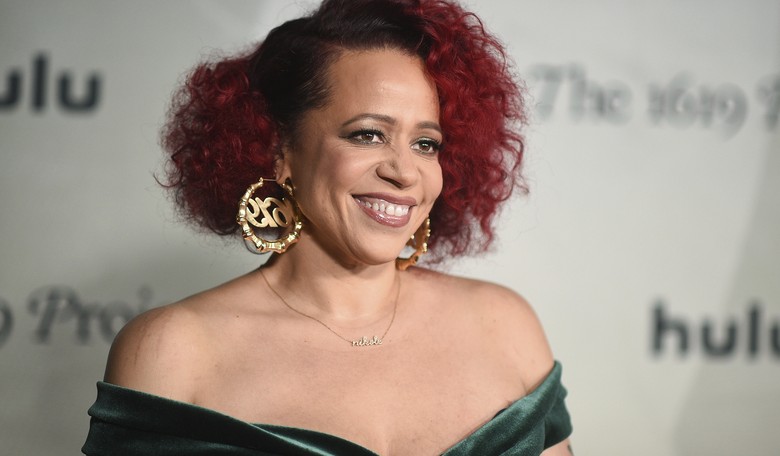
"It was worth a try." That's Nikole Hannah-Jones' take on putting her daughter into a terrible school in a newly published video interview.
We covered this at length last month when the NY Times published a lengthy article in which Hannah-Jones described putting her daughter in substandard schools in an attempt to change the system and benefit other black parents. You can read all about it here, but there were really a few key points of the article.
First, Hannah-Jones daughter started telling her mom that her school was terrible in first grade.
Faraji and I decided that our role in this struggle meant upending the status quo and sending our child not to a wealthy white school but to a poor Black one...
Toward the end of first grade, Najya started sometimes saying she didn’t like her school and complaining how chaotic it was at lunch...
My husband and I were frustrated and worried but remained committed.
Her six-year-old was asking for help and Hannah-Jones effectively said no.
Second, Hannah-Jones gradually realized that the problem with the bad schools wasn't about a lack of resources or a lack of integration. It was about bad teachers who weren't teaching (but of course couldn't be fired because unions!).
In Najya’s third-grade year, her teacher missed a significant number of days, leading Najya to complain about the substitute teachers who rarely taught and how sometimes there was no substitute at all...
But fourth grade was the worst year.
In fourth grade, Hannah-Jones discovered that her daughter's assignments weren't being graded at all. She spent weeks fighting with the principal and the teachers only to learn those teachers were doing nothing.
Third, Hannah-Jones' daughter eventually figured out that she'd been sent to terrible schools to make some kind of political point rather than having her mom look out for her best interests. She was angry about it.
In the outside world, my choice had earned me valor. And yet that day, under the withering glare of my daughter, the words that I was formulating sounded hollow to my ears even before they passed my lips...
...my child just shook her head, her face a mask of disbelief, and something else: betrayal.
“So you had money to send me to one of the best schools, and you chose not to?” she said, hurling her words. “Because other kids are disadvantaged, you didn’t want to put me in a great school?”
Yes, that's exactly what happened. Hannah-Jones' piece even ends on a note of regret.
I felt overcome with regret. Najya deserved better. They all did. But she was mine. This girl, my only child, looked to me to protect her, to give her what she needed to thrive. And I had not chosen her.
As a confessional, it's a great story. As an account of a partisan driven to put her politics over her own daughter, it is a horror show. And her daughter suffers a lot, even after she's finally allowed to pick her own high school (a better ranked one with lots more white kids), she's far behind and struggles to catch up.
Finally, what did all of this child sacrifice accomplish? Nothing. Not one single thing has changed in New York's school system as a result of Hannah-Jones' efforts. Not one teacher or principal fired. Not one school is better. Her intervention did nothing.
So here she is again, and she seems to have backslid a bit from her own previous admission that she failed in every way possible.
Q: When you think about the educational choices that you were making for Najya, do you feel like you made the right choice?
HNJ: I love that you’re asking that because I actually think, no offense, that’s the wrong question. And that’s the question that has been so much of the focus since the piece came out, is whether this one family’s choice for their one child was right or wrong. To me, the question is, why do we abide a system that forces this choice? And that’s really what I wanted us to question, to say, you know, even a parent who has all of these resources was getting crushed by the system of inequality. So if it can crush me, what do you think it’s doing to our most marginalized children? That, to me, is really the question.
No, sorry, the question is why did you still defend making this choice when by your own admission it was the wrong one to make for your daughter and accomplished nothing. The system that failed here wasn't just the school, it was your household.
She then goes into a ramble about "systems of inequality" but again if you read her actual piece, the system wasn't the issue. The issue was the bad teachers who should be fired for not doing their jobs. If there's a systemic problem, it's that the bad teachers are allowed to be bad and keep their jobs. But NHJ doesn't address that. She only wants to talk about race.
...we’re all complicit in these structures of inequality. It doesn’t mean we agree with them, but we’re also not really doing anything to end them. And many of us actually take advantage of them or we benefit from them.
The people taking the most advantage are the bad teachers who rely on union contracts to keep them in their jobs even when they fail year after year to teach. Hannah-Jones saw this happen and still won't acknowledge the problem wasn't racial.
Here's the interview. It's seven minutes long and she's still trying to defend this even after admitting she was wrong.