
The Schengen Agreement is on life support, although I don't expect it to die in the near term. Call it hospice treatment.
The Schengen Agreement provides for the free flow of people throughout the EU and other member states. No passports or visas are required, which in theory is a very good thing. The fewer barriers to trade and travel, the more efficient the economy will be and theoretically the less tension between people of different countries.
Since the ultimate goal of the EU, sometimes stated, other times not, is the formation of a United States of Europe to create an economic and political powerhouse to match or exceed the United States' status as a colossus, the idea makes sense in theory, as long as you ignore the fact that European countries are far less similar to the states in the US.
Even here we have cultural differences and clashes, and some divergence in dialects, but overall the system works very well, although with the emergence of Blue states and Red states, you can see hints at the potential for an informal national divorce. Florida and Texas are rather different culturally than California and Massachusetts, but that is nothing compared to Poland, the UK, France, Spain, and Germany. All of those countries have been at war with each other in recent memory and have languages that diverge past the point of mutual unintelligibility.
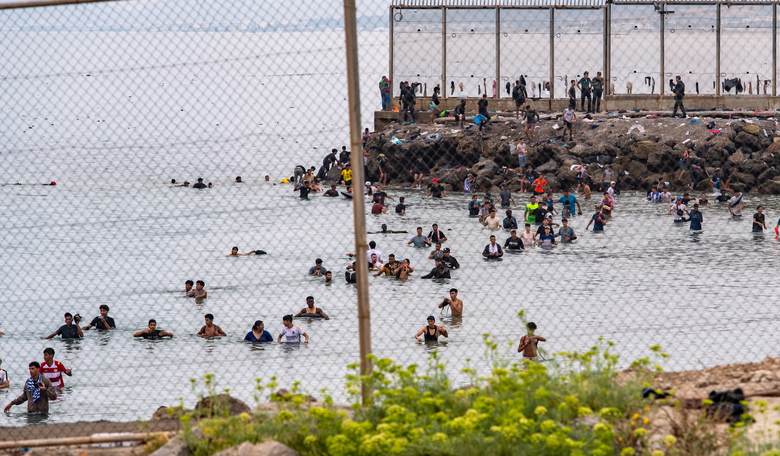
With the growing migrant crisis and the divergent views on open borders between countries committed to liberalization, countries that have tried it and decided it was a disaster, and countries in the east that never wanted it, Schengen, the European Union itself, and the European Human Rights laws have been primed for a conflict, and Ceuta has brought things to a head.
BREAKING:
— Visegrád 24 (@visegrad24) August 1, 2026
The prime ministers of 22 out of 27 EU member states have written a joint letter to the EU, demanding an emergency summit over the invasion of illegal migrants in Ceuta.
They are outraged by the recent ruling of the Spanish Supreme Court:
🇮🇹 Italy
🇩🇪 Germany
🇩🇰… pic.twitter.com/cCqEEcY45l
BREAKING:
The prime ministers of 22 out of 27 EU member states have written a joint letter to the EU, demanding an emergency summit over the invasion of illegal migrants in Ceuta.
They are outraged by the recent ruling of the Spanish Supreme Court:
🇮🇹 Italy
🇩🇪 Germany
🇩🇰 Denmark
🇫🇮 Finland
🇸🇪 Sweden
🇦🇹 Austria
🇧🇪 Belgium
🇳🇱 Netherlands
🇧🇬 Bulgaria
🇨🇾 Cyprus
🇸🇮 Slovenia
🇭🇷 Croatia
🇨🇿 Czechia
🇸🇰 Slovakia
🇪🇪 Estonia
🇱🇻 Latvia
🇱🇹 Lithuania
🇫🇮 Finland
🇬🇷 Greece
🇭🇺 Hungary
🇵🇱 Poland
🇷🇴 Romania
France, Ireland and Portugal were the only larger EU states that didn’t sign the letter.
Spain is trying to sell the idea that the Ceuta crisis is basically over, and I am really unclear whether that is really the case. There are conflicting reports about what has been happening there, and since everybody has a strong interest in everybody accepting their spin, I don't know who to trust.
But in a political sense, it doesn't matter. Ceuta was the boulder that broke the camel's back.
— Buttermaker (@BiffGizmo) August 1, 2026
So on Tuesday, the top political officials of EU countries will have a video meeting to have a "discussion" about the issue, and you can expect it to be contentious. Several countries have already suspended their obligations to Spain under Schengen, and no doubt Ursula von der Leyen will try to smooth things over.
And perhaps she will, but it will be temporary. The divisions are too stark.
Spain attacks 'selfish' response of some EU countries to Ceuta migrant crossings https://t.co/Zvt8N12wJh
— BBC News (UK) (@BBCNews) August 1, 2026
The entire idea behind the EU is based on a combination of utopian ideology and a firm belief in the virtues of technocracy. Technocrats see culture as an impediment to rational management of society, and people see culture as a foundation for their identity. Never the twain shall meet.
🇪🇸🇮🇹🇪🇺 Spain's PM Sánchez isn't backing down. He just sent von der Leyen a letter calling Italy and Denmark's response "selfish, polarising and unlawful"
— Mario Nawfal (@MarioNawfal) August 1, 2026
He demanded an emergency meeting of all 27 EU interior ministers.
His case: Ceuta isn't even in Schengen, almost every… pic.twitter.com/mQC2BIy8WD
🇪🇸🇮🇹🇪🇺 Spain's PM Sánchez isn't backing down. He just sent von der Leyen a letter calling Italy and Denmark's response "selfish, polarising and unlawful"
He demanded an emergency meeting of all 27 EU interior ministers.
His case: Ceuta isn't even in Schengen, almost every migrant already went back to Morocco, and Spain's border is less porous than Italy's own.
Von der Leyen backs him up publicly: "not a single person reached mainland Spain."
Meloni's side though isn't blinking either: their 22-country letter stands, signed and public.
Two competing versions of the same crisis, both citing real numbers. Ireland's EU presidency is now stuck refereeing it.
At least 67 people died getting there. Spain's answer: a 500-meter sea barrier.
Does an emergency meeting actually bridge this?
Source: Fox News, Frontex / Writer: Oliver
There are so many reasons why a common currency is a disaster—Greece, Spain, and Italy should not have the same currency as Germany, for instance—that the currency regime was doomed to fail. The EU itself is anti-democratic, with technocrats really running things and the EU Parliament being nothing more than a bit of theater.
The EU is doomed, and Schengen probably before that.